
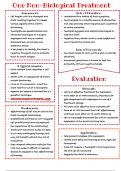
One Non-Biological Treatment
Assessment: Role of Education:
CBT begins with the therapist and Understand the nature of their symptoms.
client working together to assess The therapist is a valuable source of information
various aspects of the client’s and also provides other resources such as printed
functioning. or online materials.
Therapists use questionnaires and Therapist suggests and explains techniques to
interview techniques to measure help the client.
depression and any co-morbid Together they decide what is most helpful and
disorders such as anxiety and how it should be carried out.
substance abuse.
A key task is to identify the client’s Role of Homework:
negative thoughts and re-evaluate The client needs to carry out the plan in real-life
them to avoid relapse. situations.
Homework gives them a chance to test the
(un)reality of their negative beliefs.
A Typical Session:
Keith Dobson 2008 describes a CBT
session.
Evaluation
Starts with an assessment of client’s
current functioning.
Move on to homework - what the
client learnt or what is incomplete. Strength:
Agenda for session is decided like a 3 CBT is an effective treatment for depression.
question technique. Irene Elkin et al 1989 randomly allocated 239
Automatic Negative Thoughts - ANTs. ppts diagnosed with depression to one of 4
treatment groups.
All were more effective than a placebo pill.
Weaknesses:
Effectiveness of CBT may be due to the Shea et al 1992 showed that CBT effectiveness
client-therapist relationship. continued even after an 18 month follow up.
Easterbrook anf Meehan 2017 suggest CBT is a successful treatment for mild to moderate
CBT practitioners have downplayed depression in the short and long term.
the importance of the relationship.
Treatment adherence is also an issue.
It is a very challenging therapy and Application:
may not benefit without the aid of Help prevent relapses into depression.
medication. Clients learn skills and techniques they apply for
High dropout rates are costly for the themselves.
NHS and make it difficult in research Does not require a therapist in the longer term
studies to assess the true effectiveness like the use of homework.
of therapy. Respects the client’s autonomy.
Assessment: Role of Education:
CBT begins with the therapist and Understand the nature of their symptoms.
client working together to assess The therapist is a valuable source of information
various aspects of the client’s and also provides other resources such as printed
functioning. or online materials.
Therapists use questionnaires and Therapist suggests and explains techniques to
interview techniques to measure help the client.
depression and any co-morbid Together they decide what is most helpful and
disorders such as anxiety and how it should be carried out.
substance abuse.
A key task is to identify the client’s Role of Homework:
negative thoughts and re-evaluate The client needs to carry out the plan in real-life
them to avoid relapse. situations.
Homework gives them a chance to test the
(un)reality of their negative beliefs.
A Typical Session:
Keith Dobson 2008 describes a CBT
session.
Evaluation
Starts with an assessment of client’s
current functioning.
Move on to homework - what the
client learnt or what is incomplete. Strength:
Agenda for session is decided like a 3 CBT is an effective treatment for depression.
question technique. Irene Elkin et al 1989 randomly allocated 239
Automatic Negative Thoughts - ANTs. ppts diagnosed with depression to one of 4
treatment groups.
All were more effective than a placebo pill.
Weaknesses:
Effectiveness of CBT may be due to the Shea et al 1992 showed that CBT effectiveness
client-therapist relationship. continued even after an 18 month follow up.
Easterbrook anf Meehan 2017 suggest CBT is a successful treatment for mild to moderate
CBT practitioners have downplayed depression in the short and long term.
the importance of the relationship.
Treatment adherence is also an issue.
It is a very challenging therapy and Application:
may not benefit without the aid of Help prevent relapses into depression.
medication. Clients learn skills and techniques they apply for
High dropout rates are costly for the themselves.
NHS and make it difficult in research Does not require a therapist in the longer term
studies to assess the true effectiveness like the use of homework.
of therapy. Respects the client’s autonomy.


