
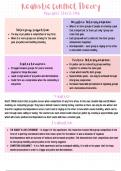
Realistic Conflict Theory
Muzafer Sherif 1966
Negative Interdependence:
When 2 or more groups of people are sharing a goal
Intergroup Competition: that is important to them; yet only 1 group can
The key to prejudice is competition of any form. reach that goal.
When 2 or more groups are striving for the same Each group will act to obstruct the other group’s
goal, prejudice and hostility intensity. achievement (negative).
Interdependent - each group is relying on the other
to lose which creates hostility.
Positive Interdependence:
Limited Resources: Prejudice can be reduced by groups working
Struggle between groups for scarce material, together to achieve the same goal.
physical or things like power. A task which benefits both groups.
Leads to high levels of prejudice and discrimination. Superordinate goals - can only be achieved through
Could form as a compromise when the commodity is intergroup cooperation.
subjective Increases favourable perceptions of opposing groups
and a harmonious interaction.
4 marker:
Sherif (1966) stated that prejudice occurs when competition of any form arises. In this case, Seaside High and Elk Manor
Academy are competing groups. They have a limited resource during hockey ,matches as there can only be one winner and
therefore negative interdependence occurs. Each team is relying on the other to lose which causes hostility, which can be
seen through name calling or booing. The teachers ate each school could reduce prejudice by creating a superordinate goal
which will create positive interdependence as both teams will have a common goal.,
Evaluation:
THE ROBERT’S CAVE EXPERIMENT - In stage 2 of the experiment, the researches created intergroup competition in the
form of a sporting tournament where there was a prize for the winner. It was a situation of negative
interdependence with an outcome of violence and increased prejudice. This demonstrates that competition does lead
to intergroup hostility and prejudice as the theory suggests.
COMPETIING ARGUAMNET - It is a field experiment and has ecological validity, it is said on the paper that the boys
needed provocation in order to trigger prejudice and discrimination.
Muzafer Sherif 1966
Negative Interdependence:
When 2 or more groups of people are sharing a goal
Intergroup Competition: that is important to them; yet only 1 group can
The key to prejudice is competition of any form. reach that goal.
When 2 or more groups are striving for the same Each group will act to obstruct the other group’s
goal, prejudice and hostility intensity. achievement (negative).
Interdependent - each group is relying on the other
to lose which creates hostility.
Positive Interdependence:
Limited Resources: Prejudice can be reduced by groups working
Struggle between groups for scarce material, together to achieve the same goal.
physical or things like power. A task which benefits both groups.
Leads to high levels of prejudice and discrimination. Superordinate goals - can only be achieved through
Could form as a compromise when the commodity is intergroup cooperation.
subjective Increases favourable perceptions of opposing groups
and a harmonious interaction.
4 marker:
Sherif (1966) stated that prejudice occurs when competition of any form arises. In this case, Seaside High and Elk Manor
Academy are competing groups. They have a limited resource during hockey ,matches as there can only be one winner and
therefore negative interdependence occurs. Each team is relying on the other to lose which causes hostility, which can be
seen through name calling or booing. The teachers ate each school could reduce prejudice by creating a superordinate goal
which will create positive interdependence as both teams will have a common goal.,
Evaluation:
THE ROBERT’S CAVE EXPERIMENT - In stage 2 of the experiment, the researches created intergroup competition in the
form of a sporting tournament where there was a prize for the winner. It was a situation of negative
interdependence with an outcome of violence and increased prejudice. This demonstrates that competition does lead
to intergroup hostility and prejudice as the theory suggests.
COMPETIING ARGUAMNET - It is a field experiment and has ecological validity, it is said on the paper that the boys
needed provocation in order to trigger prejudice and discrimination.


