

Written by students who passed Immediately available after payment Read online or as PDF Wrong document? Swap it for free 4.6 TrustPilot
logo-home
Document preview thumbnail
Preview 2 out of 12 pages
Exam (elaborations)

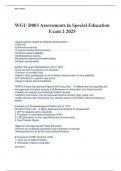
WGU D003 Assessments in Special Education Exam 2 2025

Document preview thumbnail
Preview 2 out of 12 pages

Legal practices related to eligibility determination - - -Child find -Universal screening -Progress monitoring/Pre-referral -Decisions about feasibility -Multidisciplinary testing -Nondiscriminatory/non-biased testing -Multiple assessments Section 504 of the Rehabilitation Act of 1973 - - -Equal access to programs and activities -Provision of auxiliary aids -Illegal to deny participation to an individual based solely on their disability -Not restricted to a specific age group -Illegal to refuse accommodations FERPA (Family Educational Rights and Privacy Act) - -A federal law that regulates the management of student records and disclosure of information from those records. -Parents can inspect and challenge student records -Directory information may be accessed without consent (age, grade, etc) -Under judicial order, the school may release student information without notifying a parent. Education for All Handicapped Children Act of 1975 (EAHCA PL94-142) - -4 Major Requirements Relative to Assessment: 1. IEP for students with a disability 2. Protection in evaluation procedures (PEP) 3. LRE (Education in the Least Restrictive Environment) 4. Due Process Rights *Right to Free Appropriate Public Education *Parents can challenge placement and inspection of records *Assessments are to be fair and nondiscriminatory 8 Provisions of PEP (EAHCA 1975) - - 1. Tests are nondiscriminatory 2. Assessed in Native Language 3. Tests validated for their specific purpose 4. Tests administered by a trained professional 5. Tests must include those designed to provide information about specific educational needs, not just IQ. 6. Decisions based on more than the performance of 1 test 7. Evaluations made by a multidisciplinary team with one teacher or specialist with knowledge in the area of suspected disability 8. Children must be assessed in all areas related to a specific disability including (where appropriate) vision, hearing, social/emotional, general intelligence, academic performance, communication skills, and vision or motor skills EAHCA Amendments of 1986 (PL99-457) - --Rights extend to preschoolers -Multidisciplinary assessment to develop IFSP for preK IDEA 1990 (PL101-476) - --Name changed from EAHCA to IDEA -Traumatic brain injury and Autism added as disability categories -Definition of transition services added Americans with Disabilities Act of 1990 - --A law passed in 1990 that requires employers and public facilities to make "reasonable accommodations" for people with disabilities and prohibits discrimination against these individuals in employment. -Equal opportunity to individuals with disabilities in employment, public services, transportation, state and local services, government agencies, and telecommunications IDEA 1997 reauthorization - --participation of students with disabilities in statewide assessments -Annual reported progress of all students regardless of ability -Accommodations/alternate assessments in place for students that need it -States must offer mediation as a voluntary option to parents and educators 7 Major Principles of IDEA - -1. Informed, written consent 2. Zero Reject (right to education) 3. FAPE (Free Appropriate Public Education) 4. Non-biased, multidisciplinary evaluation 5. LRE (Least Restrictive Environment) 6. IEP 7. Due Process and Procedural Safeguards (PEP) Disability Categories in IDEA - -Traumatic Brain Injury, Autism, Other Health Impairment, Deafness, Hearing Impairment, Visual Impairment, Deaf-Blindness, Multiple Disabilities, Specific Learning Disability, Intellectually Disabled, Emotional Disturbance, Speech/Language Impairment, Orthopedic Impairment No Child Left Behind Act 2001 PL107-110 - --A U.S. law enacted in 2001 that was intended to increase accountability in education by requiring states to qualify for federal educational funding by administering standardized tests to measure school achievement. -Title 1 Funds -Provide for teacher development -AYP (adequate yearly progress) for all students -Students must be taught using "evidence-based instructional methods" -Parents of children in failing schools two years in a row can transfer them to another school IDEA 2004 Reauthorization - --MEASURABLE ANNUAL OBJECTIVES for students with disabilities -Can use data from RTI in making eligibility services -Assessment requirements of universal screening and progress monitoring -Added PLAAFP instead of PLOP ESSA (Obama, 2015) - --"race to the top" achievement standards -Funding for MTSS -Common core state standards -flexibility to states What does ESSA say about MTSS - --Student achievement, teacher effectiveness, paid funding -Strategies used are effective -Benchmarks compare and contrast Americans with Disabilities Act Amendment 2008 - --Further defines and clarifies criteria necessary for determining disability under ADA and 504 -Students entitled to SpEd services as a protection under 504/ADAA -Mandates use of scribe, interpreter, auxiliary aids for access to exams Curriculum-Based Assessment - -This is a particular type of criterion-referenced test in which the test items are taken from the curriculum being taught to the student. This type of test can provide information regarding how well the student is learning the curriculum being taught. -Allows for continual monitoring of developmental progress Decisions made using assessment information - -*Screening- Are there unrecognized problems? *Progress monitoring- Is the student making adequate progress? Toward individual goals Toward state or common core standards *Instructional planning and modification- What can we do to enhance competence and build capacity, and how can we do it? *Resource allocation- Are additional resources needed? *Eligibility for special education services- Is the student eligible for special education and related services? *Program evaluation- Are the instructional programs that are being used effective? *Accountability- Are we achieving desired outcomes? Competency-based assessment - -An observable and measurable assessment of a specific skill, knowledge or attitude that is learned and demonstrated within a course. Formal Assessment - --Individually administered -Follow a prescribed format for scoring and administering *norm-referenced tests are generally more efficient 4 ways assessment information is collected - -Remember RIOT: 1. Record review (past and medical) 2. Interview (rating scale most formal) 3. Observation 4. Test (yields qualitative and quantitative data) 4 Methods for assessing social-emotional behavior - -1. Interviews 2. Situational Measures 3. Rating Scales 4. Observations -Assessed for identification of intellectual disability and intervention planning Assessment in special education - --The systematic process of gathering educationally relevant information to make legal and instructional decisions about the provision of special services. -There are 14 types: Formative, summative, formal, informal, diagnostic, behavioral, rating scale, emotional, screening, authentic, performance, group/individual, criterion-referenced, norm-referenced Assessment - --Gathering data and then making decisions based on that data -Methods of data collection: RIOT -The end goal of assessment is improved educational outcomes for students -Matches instruction to student's level of skill occupational therapy - -fine motor and upper body functions physical therapy - -gross motor skills and lower body functions Academic achievement evaluation - --recommended when a child's skill level is unknown/inconsistent -Determines strengths and weaknesses *Achievement can develop a learning profile and determine LRE Perceptual evaluation - --focus on auditory, tactile, visual, kinesthetic modalities. reception/perception -strong/weak process areas, LRE -Used when team (MDT) suspects discrepancies in the child's ability to receive and process information Academic evaluation - -(reading, writing, spelling, math) -Helps determine strengths and weaknesses in academic skill areas -Develops learning profile -Always part of the formal evaluation -Helps determine LRE Intellectual/psychological evaluation - --Rules out emotionality as primary cause of problem -Necessary before diagnosis of LEARNING DISABILITY can be made -Determines present levels of overall intellectual ability, verbal, non-verbal, nonlanguage intellectual ability -Ascertain anxiety with testing -Normal part of referral Speech and Language evaluation - --an assessment of receptive language (the ability to understand spoken language), expressive language (the ability to formulate and organize oral language and written language), phonological processing (the ability to manipulate individual sounds within words), articulation, voice, auditory memory, pragmatics (the ability to use language effectively to interact with people) -Used if a child has difficulties after 3rd grade Achievement tests - --Assesses what students know and should be able to do in content areas 3 Characteristics of Effective Testing Programs - -Ease, Efficiency, Integration Intelligence tests - --Base scores on interval scales (arbitrary zero) -Measure general abilities of intelligence -Used to inform special education eligibility decision making -Sample behaviors of discrimination, generalization, motor behavior, general knowledge, abstract reasoning, memory, vocabulary, induction, comprehension, sequencing, detail recognition, analogical reasoning, pattern completion. -Predictor of school success Social/Emotional tests - --Tests executive function of flexible thinking Diagnostic Testing - --Measures knowledge and skills in order to tailor instruction -Given before a lesson to see what students already know 4 Considerations for Selecting a Test - -1. Content Validity 2. Stimulus Response Modes 3. Opportunity to Learn 4. Relevant Norms Tests - --Predetermined set of questions. -Results are used to make high-stakes decisions -Tests yield two types of information—quantitative and qualitative. criterion-referenced - --Measures certain criteria (knowledge about a specific set of facts or skills). -Tested against a standard Norm-referenced - -a test is norm-referenced when students are measured in relation to other students, in other words, a "norm" Intellectual Disability - --Requires both low intelligence AND limited adaptive behavior 5 Functions of Behavior - -1. Social attention/communication 2. Access to tangibles in preferred activities 3. Escape, delay, reduction/avoidance of aversive tasks or activities 4. Escape/avoidance of other individuals 5. Internal Stimulation non-medical eligibility categories - --Specific Learning Disability: IQ is average and above so it does not get recognized until school. RTI Intellectual Disability: deficits in two areas: functional performance, and below average IQ Adaptive Behavior Scales - --Can be assessed by direct observation -Parents are the primary source of information with interviews and questionnaires -qualitative observational method (ABC chart) Direct behavior rating (DBR) - --Quantitative observational method 4 Components of Observation - -1. Routine and ongoing 2. Developmentally focused 3. In different times and in different contexts 4. As objective as possible Behavior is defined in terms of its topography, its function, and its characteristics Anecdotal recording - -Records both positive and negative behaviors RTI Assessment - --Informally and systematically with progress monitoring -highly specific and frequent Components of RTI - --High quality and scientifically based classroom instruction -ongoing student assessment -tiered instruction (3 tiers: Universal, targeted, intensive) -parental involvement -ongoing progress monitoring -data collection/assessment at each tier to inform decisions -tiers are flexible/permeable -efficiency, ease, and integration of specific, frequent measurements -formative, benchmark, informal tests 7 Assumptions that Underlie the Practice of Assessing RTI - -1. Instruction occurs. 2. It occurs as intended. 3. The instruction that is assessed is known to be generally effective. 4. The measurement system is adequate to detect changes in student learning as a result of instruction. There are four subcomponents to this assumption. a. The measurement system reflects the curriculum or assesses the effect of instruction in that curriculum. It is axiomatic that response to instruction must reflect the content being instructed. b. The measurement system can be used frequently. Frequent measurement is important to avoid wasting a student's and a teacher's time when instruction is not working. It is also important to prevent a student from practicing (and mastering) errors and making them more difficult to correct. c. The measurement system is sensitive to small changes in student performance. If measurement is conducted frequently, it is unlikely that there will be large changes in student learning. Thus, to be effective, the measurement system must be capable of detecting small, but meaningful, changes in student learning or performance. d. The measurement system actually assesses pupil performance, not simply what the teacher does. Clearly, what a teacher does is important because it relates directly to treatment fidelity. However, we are interested in whether the student is learning. 5. There are links between the assessment data and modifications in instruction. This is the concept of data-driven decision making and reiterates our earlier point that data collected and not used to make decisions are useless. 6. There are consequences that sustain (a) improved student outcomes and (b) continued implementation of the measurement system. It is assumed not only that the system is good, but also that it is worth keeping in place. 7. Assessment of RTI is not setting-specific. It is ass Purpose of each step in the assessment process - -1. Screening and teacher identification, pre-referral strategies, opportunity to learn (RTI). -Referral and Parent Permission 2. Eligibility Determination: MDT designs assessment plan, review pre-referral data, administer, score, and interpret data, eligibility determination, Report results 3. Goes to IEP team. They design the IEP. The parent agrees to the IEP -Program Planning -Program Implementation and Evaluation 4. IEP implementation and ongoing progress monitoring, Annual IEP review, triennial reevaluation of eligibility multidisciplinary team - --a cooperative group that includes professionals with different qualifications, skills, and areas of expertise

Content preview

WGU D003


WGU D003 Assessments in Special Education
Exam 2 2025

Legal practices related to eligibility determination - -
-Child find
-Universal screening
-Progress monitoring/Pre-referral
-Decisions about feasibility
-Multidisciplinary testing
-Nondiscriminatory/non-biased testing
-Multiple assessments

Section 504 of the Rehabilitation Act of 1973 - -
-Equal access to programs and activities
-Provision of auxiliary aids
-Illegal to deny participation to an individual based solely on their disability
-Not restricted to a specific age group
-Illegal to refuse accommodations

FERPA (Family Educational Rights and Privacy Act) - -A federal law that regulates the
management of student records and disclosure of information from those records.
-Parents can inspect and challenge student records
-Directory information may be accessed without consent (age, grade, etc)
-Under judicial order, the school may release student information without notifying a
parent.

Education for All Handicapped Children Act of 1975
(EAHCA PL94-142) - -4 Major Requirements Relative to Assessment:
1. IEP for students with a disability
2. Protection in evaluation procedures (PEP)
3. LRE (Education in the Least Restrictive Environment)
4. Due Process Rights

*Right to Free Appropriate Public Education
*Parents can challenge placement and inspection of records
*Assessments are to be fair and nondiscriminatory

8 Provisions of PEP (EAHCA 1975) - -
1. Tests are nondiscriminatory
2. Assessed in Native Language
WGU D003

, WGU D003


3. Tests validated for their specific purpose
4. Tests administered by a trained professional
5. Tests must include those designed to provide information about specific educational
needs, not just IQ.
6. Decisions based on more than the performance of 1 test
7. Evaluations made by a multidisciplinary team with one teacher or specialist with
knowledge in the area of suspected disability
8. Children must be assessed in all areas related to a specific disability including (where
appropriate) vision, hearing, social/emotional, general intelligence, academic
performance, communication skills, and vision or motor skills

EAHCA Amendments of 1986 (PL99-457) - --Rights extend to preschoolers
-Multidisciplinary assessment to develop IFSP for preK

IDEA 1990 (PL101-476) - --Name changed from EAHCA to IDEA
-Traumatic brain injury and Autism added as disability categories
-Definition of transition services added

Americans with Disabilities Act of 1990 - --A law passed in 1990 that requires employers
and public facilities to make "reasonable accommodations" for people with disabilities
and prohibits discrimination against these individuals in employment.
-Equal opportunity to individuals with disabilities in employment, public services,
transportation, state and local services, government agencies, and telecommunications

IDEA 1997 reauthorization - --participation of students with disabilities in statewide
assessments
-Annual reported progress of all students regardless of ability
-Accommodations/alternate assessments in place for students that need it
-States must offer mediation as a voluntary option to parents and educators

7 Major Principles of IDEA - -1. Informed, written consent
2. Zero Reject (right to education)
3. FAPE (Free Appropriate Public Education)
4. Non-biased, multidisciplinary evaluation
5. LRE (Least Restrictive Environment)
6. IEP
7. Due Process and Procedural Safeguards (PEP)

Disability Categories in IDEA - -Traumatic Brain Injury, Autism, Other Health
Impairment, Deafness, Hearing Impairment, Visual Impairment, Deaf-Blindness,
Multiple Disabilities, Specific Learning Disability, Intellectually Disabled, Emotional
Disturbance, Speech/Language Impairment, Orthopedic Impairment

No Child Left Behind Act 2001 PL107-110 - --A U.S. law enacted in 2001 that was
intended to increase accountability in education by requiring states to qualify for federal

WGU D003

Document information

Uploaded on
June 9, 2025
Number of pages
12
Written in
2024/2025
Type
Exam (elaborations)
Contains
Questions & answers
$16.49

Wrong document? Swap it for free Within 14 days of purchase and before downloading, you can choose a different document. You can simply spend the amount again.
Written by students who passed
Immediately available after payment
Read online or as PDF

Seller avatar
Reputation scores are based on the amount of documents a seller has sold for a fee and the reviews they have received for those documents. There are three levels: Bronze, Silver and Gold. The better the reputation, the more your can rely on the quality of the sellers work.
AlexScorer
2.5
(2)
Sold
11
Followers
0
Items
1800
Last sold
2 weeks ago


Why students choose Stuvia

Created by fellow students, verified by reviews

Quality you can trust: written by students who passed their tests and reviewed by others who've used these notes.

Didn't get what you expected? Choose another document

No worries! You can instantly pick a different document that better fits what you're looking for.

Pay as you like, start learning right away

No subscription, no commitments. Pay the way you're used to via credit card and download your PDF document instantly.

Student with book image

“Bought, downloaded, and aced it. It really can be that simple.”

Alisha Student

Working on your references?

Create accurate citations in APA, MLA and Harvard with our free citation generator.

Working on your references?

Frequently asked questions

