lkjhgfd
Solutions Manual
for
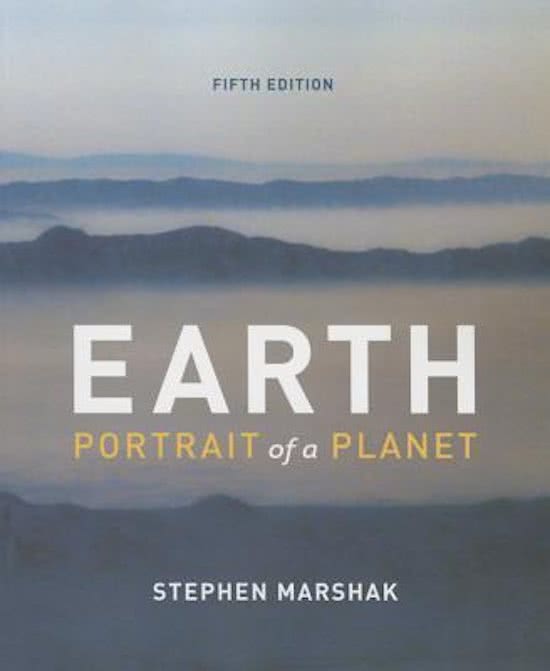
Earth Portrait of a Planet, 5e,
by Stephen Marshak
N
U
R
SE
D
O
C
S
lkjhgfds
, lkjhgfd
CHAPTER 1
Cosmology and the Birth of Earth
Learning Objectives
N
1. Students should be aware of the Big Bang theory and the major evidence
supporting it. Distant galaxies are uniformly red-shifted rather than blue-
U
shifted; this implies that they are all moving away from us. The farthest
galaxies are those that are most strongly red-shifted, meaning that they are
R
receding the fastest. Extrapolation of velocities and trajectories into the past
suggests that all matter in the Universe was contained in a single point,
approximately 13.7 billion years ago. At that time, the Universe explosively
SE
came into existence.
2. Stars, including our Sun, are nuclear fusion reactors. For most of their life
histories (on the order of billions of years), hydrogen atoms are fused together
to form helium. Later stages in stellar evolution include fusion of helium atoms
D
and other, heavier elements; ultimately, iron is the heaviest element that can
be produced through fusion reactions within stars.
O
3. After their cycles of fusion are complete, large stars violently explode (forming
supernovae), producing elements heavier than iron and leaving behind a
C
residue of diffuse nebulae, which may be recycled to form a new star at some
point in the future.
S
4. Our Solar System is approximately 4.57 Ga (billion years old). All eight planets
revolve around the Sun in coplanar, elliptical orbits. All planets orbit in the
lkjhgfds
, lkjhgfd
same direction (counterclockwise as viewed from above Earth’s North Pole).
These facts imply simultaneous planetary formation from a swirling nebula
surrounding the Sun (the similarities in orbits would then be a natural result of
conservation of angular momentum). The planets accreted from this nebula
through gravitational attraction and haphazard collisions. Pluto, long
considered the “ninth planet,” has seen its status demoted; astronomers now
recognize eight major planets.
5. The terrestrial planets (Mercury, Venus, Earth, and Mars) are relatively small,
N
dense, and rocky worlds. The giant planets are predominantly composed of the
light gases hydrogen and helium (Jupiter and Saturn) or ices (Uranus and
U
Neptune); they are much larger and much less dense than the terrestrial
planets.
R
6. Our Moon is chemically similar to the Earth’s mantle. The Moon is thought to
have originated from debris accumulated when a protoplanet collided with
SE
Earth approximately 4.3 Ga.
Summary from the Text
The geocentric model placed Earth at the center of the Universe, with the planets
D
and Sun orbiting around the Earth within a celestial sphere speckled with stars. The
heliocentric model, which gained acceptance during the Renaissance, placed the Sun
O
at the center.
Eratosthenes was able to measure the size of Earth in ancient times, but it was
C
not until fairly recently that astronomers accurately determined the distances to the
Sun, planets, and stars. Distances in the Universe are so large that they must be
S
measured in light-years.
The Earth is one of eight planets orbiting the Sun, and this Solar System lies on
the outer edge of a slowly revolving galaxy, the Milky Way, which is composed of
about 300 billion stars. The Universe contains at least hundreds of billions of galaxies.
The red shift of light from distant galaxies, a manifestation of the Doppler effect,
indicates that all distant galaxies are moving away from Earth. This observation leads
lkjhgfds
, lkjhgfd
to the expanding Universe theory. Most astronomers agree that this expansion began
after the Big Bang, a cataclysmic explosion about 13.7 billion years ago.
The first atoms (hydrogen and helium) of the Universe developed within minutes
of the Big Bang. These atoms formed vast gas clouds, called nebulae.
Gravity caused clumps of gas in the nebulae to coalesce into revolving balls. As
these balls of gas collapsed inward, they evolved into flattened disks with bulbous
centers. The protostars at the center of these disks eventually became dense and
sufficiently hot that fusion reactions began within them. When this happened, they
N
became true stars, emitting heat and light.
Heavier elements form during fusion reactions in stars; the heaviest are mostly
U
made during supernova explosions. Earth and the life forms on it contain elements
that could have only been produced during the life cycle of stars. Thus, we are all
R
made of stardust.
According to the nebular theory of planet formation, planets developed from the
SE
rings of gas and dust surrounding protostars. The gas and dust condensed into
planetesimals, which then clumped together to form protoplanets and finally true
planets. Inner rings became the terrestrial planets; outer rings grew into giant
planets.
The Moon formed from debris ejected when a protoplanet collided with Earth in
D
the young Solar System.
A planet assumes a near-spherical shape when it becomes so soft that gravity can
O
smooth out irregularities.
C
Answers to Review Questions
S
1. Why do the planets appear to move with respect to the stars?
ANS: Stars are so relatively distant that they appear fixed with respect to one
another as viewed from Earth. As Earth and the other planets traverse through their
orbits around the Sun, the positions of the planets vary with respect to the “fixed”
celestial sphere.
lkjhgfds
Solutions Manual
for
Earth Portrait of a Planet, 5e,
by Stephen Marshak
N
U
R
SE
D
O
C
S
lkjhgfds
, lkjhgfd
CHAPTER 1
Cosmology and the Birth of Earth
Learning Objectives
N
1. Students should be aware of the Big Bang theory and the major evidence
supporting it. Distant galaxies are uniformly red-shifted rather than blue-
U
shifted; this implies that they are all moving away from us. The farthest
galaxies are those that are most strongly red-shifted, meaning that they are
R
receding the fastest. Extrapolation of velocities and trajectories into the past
suggests that all matter in the Universe was contained in a single point,
approximately 13.7 billion years ago. At that time, the Universe explosively
SE
came into existence.
2. Stars, including our Sun, are nuclear fusion reactors. For most of their life
histories (on the order of billions of years), hydrogen atoms are fused together
to form helium. Later stages in stellar evolution include fusion of helium atoms
D
and other, heavier elements; ultimately, iron is the heaviest element that can
be produced through fusion reactions within stars.
O
3. After their cycles of fusion are complete, large stars violently explode (forming
supernovae), producing elements heavier than iron and leaving behind a
C
residue of diffuse nebulae, which may be recycled to form a new star at some
point in the future.
S
4. Our Solar System is approximately 4.57 Ga (billion years old). All eight planets
revolve around the Sun in coplanar, elliptical orbits. All planets orbit in the
lkjhgfds
, lkjhgfd
same direction (counterclockwise as viewed from above Earth’s North Pole).
These facts imply simultaneous planetary formation from a swirling nebula
surrounding the Sun (the similarities in orbits would then be a natural result of
conservation of angular momentum). The planets accreted from this nebula
through gravitational attraction and haphazard collisions. Pluto, long
considered the “ninth planet,” has seen its status demoted; astronomers now
recognize eight major planets.
5. The terrestrial planets (Mercury, Venus, Earth, and Mars) are relatively small,
N
dense, and rocky worlds. The giant planets are predominantly composed of the
light gases hydrogen and helium (Jupiter and Saturn) or ices (Uranus and
U
Neptune); they are much larger and much less dense than the terrestrial
planets.
R
6. Our Moon is chemically similar to the Earth’s mantle. The Moon is thought to
have originated from debris accumulated when a protoplanet collided with
SE
Earth approximately 4.3 Ga.
Summary from the Text
The geocentric model placed Earth at the center of the Universe, with the planets
D
and Sun orbiting around the Earth within a celestial sphere speckled with stars. The
heliocentric model, which gained acceptance during the Renaissance, placed the Sun
O
at the center.
Eratosthenes was able to measure the size of Earth in ancient times, but it was
C
not until fairly recently that astronomers accurately determined the distances to the
Sun, planets, and stars. Distances in the Universe are so large that they must be
S
measured in light-years.
The Earth is one of eight planets orbiting the Sun, and this Solar System lies on
the outer edge of a slowly revolving galaxy, the Milky Way, which is composed of
about 300 billion stars. The Universe contains at least hundreds of billions of galaxies.
The red shift of light from distant galaxies, a manifestation of the Doppler effect,
indicates that all distant galaxies are moving away from Earth. This observation leads
lkjhgfds
, lkjhgfd
to the expanding Universe theory. Most astronomers agree that this expansion began
after the Big Bang, a cataclysmic explosion about 13.7 billion years ago.
The first atoms (hydrogen and helium) of the Universe developed within minutes
of the Big Bang. These atoms formed vast gas clouds, called nebulae.
Gravity caused clumps of gas in the nebulae to coalesce into revolving balls. As
these balls of gas collapsed inward, they evolved into flattened disks with bulbous
centers. The protostars at the center of these disks eventually became dense and
sufficiently hot that fusion reactions began within them. When this happened, they
N
became true stars, emitting heat and light.
Heavier elements form during fusion reactions in stars; the heaviest are mostly
U
made during supernova explosions. Earth and the life forms on it contain elements
that could have only been produced during the life cycle of stars. Thus, we are all
R
made of stardust.
According to the nebular theory of planet formation, planets developed from the
SE
rings of gas and dust surrounding protostars. The gas and dust condensed into
planetesimals, which then clumped together to form protoplanets and finally true
planets. Inner rings became the terrestrial planets; outer rings grew into giant
planets.
The Moon formed from debris ejected when a protoplanet collided with Earth in
D
the young Solar System.
A planet assumes a near-spherical shape when it becomes so soft that gravity can
O
smooth out irregularities.
C
Answers to Review Questions
S
1. Why do the planets appear to move with respect to the stars?
ANS: Stars are so relatively distant that they appear fixed with respect to one
another as viewed from Earth. As Earth and the other planets traverse through their
orbits around the Sun, the positions of the planets vary with respect to the “fixed”
celestial sphere.
lkjhgfds