
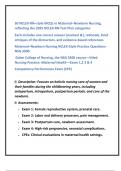
50 NCLEX-RN–style MCQs in Maternal–Newborn Nursing,
reflecting the 2025 NCLEX-RN Test Plan categories
Each includes one correct answer (marked ★), rationale, brief
critiques of the distractors, and evidence-based references
Maternal–Newborn Nursing NCLEX-Style Practice Questions-
NSG 3500:
Galen College of Nursing, the NSG 3500 course—titled
Nursing Practice: Maternal Health—Exam 1,2 3 & 4
Competency Performance Exam (CPE)
Description: Focuses on holistic nursing care of women and
their families during the childbearing years, including
antepartum, intrapartum, postpartum periods, and care of the
newborn.
Assessments:
Exam 1: Female reproductive system, prenatal care.
Exam 2: Labor and delivery processes, pain management.
Exam 3: Postpartum care, newborn assessment.
Exam 4: High-risk pregnancies, neonatal complications.
CPEs: Clinical evaluations in maternal health settings.
,Prenatal Care (12 Questions)
1. Difficulty: Easy
A 32-year-old primigravida at 28 weeks’ gestation has BP
142/92 mm Hg, 1+ proteinuria, and reports headache.
What is the nurse’s priority action?
A. Encourage increased dietary protein
B. Assess for hyperreflexia ★
C. Recommend bed rest at home
D. Instruct client to ambulate every hour
Rationale: Hyperreflexia is an early neurologic sign of
worsening preeclampsia, indicating risk for eclampsia and
cerebral irritability.
Distractors:
o A: Protein intake doesn’t alleviate preeclampsia.
o C: Bed rest may be ordered later, but assessment
comes first.
o D: Ambulation can increase BP; contraindicated.
References: ACOG Practice Bulletin No. 202 (2019),
AWHONN Preeclampsia Guidelines (2024)
2. Difficulty: Moderate
At the first prenatal visit, a 24-year-old client reports
drinking 2–3 beers nightly. Which information should the
nurse include?
A. “You should limit yourself to one drink per day.”
B. “Any alcohol use can harm fetal development.” ★
, C. “Switch to wine if you can’t quit beer.”
D. “Alcohol only affects the baby in the third trimester.”
Rationale: No safe level of alcohol has been established in
pregnancy; abstinence is recommended.
Distractors:
o A: Drinking even small amounts is discouraged.
o C: Wine also contains alcohol; not safer.
o D: Alcohol affects organogenesis in the first trimester.
References: CDC Fetal Alcohol Spectrum Disorders
Guidelines (2023), ACOG Committee Opinion No. 762
(2019)
3. Difficulty: Hard
A 37-year-old G3P2 with insulin-dependent diabetes
mellitus presents at 30 weeks. Which fetal assessment is
MOST appropriate?
A. Biophysical profile weekly ★
B. Nonstress test every four weeks
C. Kick-count monitoring only
D. Contraction stress test at 32 weeks
Rationale: Weekly biophysical profiles combine NST, amniotic
fluid, and other indices to detect fetal compromise in high-risk
pregnancies.
Distractors:
o B: NST alone may miss oligohydramnios.
, o C: Kick counts are adjunctive, not sole monitoring.
o D: CST carries risk and is less predictive than BPP in
diabetes.
References: ACOG Practice Bulletin No. 201 (2019),
WHO Recommendations on Antenatal Care (2016)
4. Difficulty: Easy
Which vaccine is recommended during each pregnancy
between 27–36 weeks?
A. Influenza
B. MMR
C. Tdap ★
D. Varicella
Rationale: Tdap given in third trimester maximizes
transplacental anti–pertussis antibody transfer.
Distractors:
o A: Influenza is seasonal, ideally any trimester during
flu season.
o B/D: Live vaccines contraindicated.
References: CDC Immunization Schedule (2025),
ACOG Committee Opinion No. 741 (2018)
5. Difficulty: Moderate
During a fundal height check at 24 weeks, the
measurement is 28 cm. What should the nurse do first?
A. Notify the provider to schedule ultrasound
B. Confirm date of last menstrual period ★
reflecting the 2025 NCLEX-RN Test Plan categories
Each includes one correct answer (marked ★), rationale, brief
critiques of the distractors, and evidence-based references
Maternal–Newborn Nursing NCLEX-Style Practice Questions-
NSG 3500:
Galen College of Nursing, the NSG 3500 course—titled
Nursing Practice: Maternal Health—Exam 1,2 3 & 4
Competency Performance Exam (CPE)
Description: Focuses on holistic nursing care of women and
their families during the childbearing years, including
antepartum, intrapartum, postpartum periods, and care of the
newborn.
Assessments:
Exam 1: Female reproductive system, prenatal care.
Exam 2: Labor and delivery processes, pain management.
Exam 3: Postpartum care, newborn assessment.
Exam 4: High-risk pregnancies, neonatal complications.
CPEs: Clinical evaluations in maternal health settings.
,Prenatal Care (12 Questions)
1. Difficulty: Easy
A 32-year-old primigravida at 28 weeks’ gestation has BP
142/92 mm Hg, 1+ proteinuria, and reports headache.
What is the nurse’s priority action?
A. Encourage increased dietary protein
B. Assess for hyperreflexia ★
C. Recommend bed rest at home
D. Instruct client to ambulate every hour
Rationale: Hyperreflexia is an early neurologic sign of
worsening preeclampsia, indicating risk for eclampsia and
cerebral irritability.
Distractors:
o A: Protein intake doesn’t alleviate preeclampsia.
o C: Bed rest may be ordered later, but assessment
comes first.
o D: Ambulation can increase BP; contraindicated.
References: ACOG Practice Bulletin No. 202 (2019),
AWHONN Preeclampsia Guidelines (2024)
2. Difficulty: Moderate
At the first prenatal visit, a 24-year-old client reports
drinking 2–3 beers nightly. Which information should the
nurse include?
A. “You should limit yourself to one drink per day.”
B. “Any alcohol use can harm fetal development.” ★
, C. “Switch to wine if you can’t quit beer.”
D. “Alcohol only affects the baby in the third trimester.”
Rationale: No safe level of alcohol has been established in
pregnancy; abstinence is recommended.
Distractors:
o A: Drinking even small amounts is discouraged.
o C: Wine also contains alcohol; not safer.
o D: Alcohol affects organogenesis in the first trimester.
References: CDC Fetal Alcohol Spectrum Disorders
Guidelines (2023), ACOG Committee Opinion No. 762
(2019)
3. Difficulty: Hard
A 37-year-old G3P2 with insulin-dependent diabetes
mellitus presents at 30 weeks. Which fetal assessment is
MOST appropriate?
A. Biophysical profile weekly ★
B. Nonstress test every four weeks
C. Kick-count monitoring only
D. Contraction stress test at 32 weeks
Rationale: Weekly biophysical profiles combine NST, amniotic
fluid, and other indices to detect fetal compromise in high-risk
pregnancies.
Distractors:
o B: NST alone may miss oligohydramnios.
, o C: Kick counts are adjunctive, not sole monitoring.
o D: CST carries risk and is less predictive than BPP in
diabetes.
References: ACOG Practice Bulletin No. 201 (2019),
WHO Recommendations on Antenatal Care (2016)
4. Difficulty: Easy
Which vaccine is recommended during each pregnancy
between 27–36 weeks?
A. Influenza
B. MMR
C. Tdap ★
D. Varicella
Rationale: Tdap given in third trimester maximizes
transplacental anti–pertussis antibody transfer.
Distractors:
o A: Influenza is seasonal, ideally any trimester during
flu season.
o B/D: Live vaccines contraindicated.
References: CDC Immunization Schedule (2025),
ACOG Committee Opinion No. 741 (2018)
5. Difficulty: Moderate
During a fundal height check at 24 weeks, the
measurement is 28 cm. What should the nurse do first?
A. Notify the provider to schedule ultrasound
B. Confirm date of last menstrual period ★


