

Written by students who passed Immediately available after payment Read online or as PDF Wrong document? Swap it for free 4.6 TrustPilot
logo-home
Document preview thumbnail
Preview 4 out of 36 pages
Exam (elaborations)

BIO 254 Tested Questions and their correct Answers (Guaranteed A).

Document preview thumbnail
Preview 4 out of 36 pages

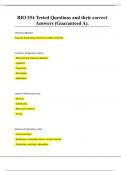
BIO 254 Tested Questions and their correct Answers (Guaranteed A). Chemical digestion Enzymes break down food into simpler chemicals Functions of digestive system - Mechanical & chemical digestion - Ingestion - Propulsion - Absorption - Defecation Layers of alimentary canal - Mucosa - Submucosa - Muscularis externa - Serosa Mucosa of alimentary canal - Innermost layer - Epithelium, connective tissue, smooth muscle - Protection, secretion, absorption Submucosa of alimentary canal - Loose connective tissue, blood & lymphatic vessels, nerves - Nourishes, transport Muscularis externa of alimentary canal - Smooth muscle in circular & longitudinal groups - Movement Serosa of alimentary canal - Outermost layer - Epithelium, connective tissue - Protection, lubrication Movement of alimentary canal - Mixing not moving in 1 direction - Propelling moving in 1 direction via peristalsis Innervation of alimentary canal wall Plexus: submucosal for secretions, myenteric for motility ANS: parasympathetic increases, sympathetic inhibits Enteroendocrine cells: stomach & small intestine secrete hormones to control GI organs & processes Mouth - 1st part of alimentary canal - Ingestion - Mastication: mechanical breakdown & mixing w/ saliva - Speech & sensory reception - Lips, cheek, tongue, palate, oral cavity, vestibule Cheeks - Form lateral walls - Hold food in - Muscles for chewing & expression - Inner lining of moist stratified squamous epithelium Lips - Highly mobile & surrounds opening of mouth - Sensory receptors for temp & texture of food - Boundary between skin & mucous membrane in mouth Tongue - Thick muscular organ on floor - Lingual frenulum, papillae, lingual tonsils Lingual frenulum Holds tongue to floor of mouth Papillae - Taste buds - Projections that move food Lingual tonsils Lymphatic tissue on root of tongue Palate - Roof of oral cavity - Hold food in & directs food to pharynx - Hard, soft, palatine tonsils, pharyngeal tonsils Hard palate - Anterior portion - Palatine processes of maxillae & palatine bones Soft palate - Posterior portion - Muscular arch that ends in uvula Palatine tonsils Lymphatic masses on sides of tongue Pharyngeal tonsils - Adenoids - Lymphatic masses in posterior wall of nasopharynx Teeth - Hardest structure in body - Not part of skeletal system - Omnivore - 20 primary (deciduous) - Mechanical digestion & chewing mixes food w/ enzymes Incisors Biting Canines - Grasping - Tearing Molars & premolars Grinding Crown of tooth Above gum line Enamel of tooth Covers crown Dentin of tooth - Makes up most of tooth - Surrounds pulp cavity Periodontal ligament & cementum Holds root in place Salivary glands - Moisten food to bind together - Dissolve food so can be tasted - Contain enzymes that chemically digest carbs - Contain HCO3 ions to keep pH favorable for enzyme activity & protect teeth from acid - Minor glands throughout tongue, mucosa, palate, cheeks that keep mouth lining moist - Parotid, submandibular, sublingual Parotid gland - Within cheek anterior to ear - Clear watery fluid rich in salivary amylase Submandibular gland - Mandible - Serous fluid w/ some mucus Sublingual gland - Inferior to tongue - Thick stringy mucus Pharynx - No digestion w/ muscular walls for swallowing - Posterior to mouth from nasal cavity to esophagus - Naso, oro, laryngo Nasopharynx - Behind nose - Air Oropharynx - Behind mouth - Air, food Laryngopharynx - Below epiglottis to esophagus - Air, food Esophagus - No digestion w/ muscular walls for swallowing - Tube from pharynx to stomach Stomach - Upper left & J shaped - Rugae - Initiates protein digestion - Limited absorption - Smooth muscle: inner circular, outer longitudinal, innermost oblique fibers Rugae Folds that allow distention Cardia of stomach - Opening of esophagus - Includes cardial sphincter (LES) Fundus of stomach - Rounded & rises above cardia - Temp food storage - Swallowed air Body of stomach Main middle portion between fundus & pylorus Pylorus of stomach - Closest to small intestine - Narrows to become pyloric canal - Includes pyloric sphincter Pyloric sphincter of stomach Smooth muscle that controls gastric emptying Major components of gastric juice of stomach - Pepsinogen - Pepsin - HCI - Mucus - Intrinsic factor - Chemical messengers Cells responsible for gastric secretions in stomach - Chief - Parietal - Mucous Gastric secretion: pepsinogen - Gastric chief cells - Inactive pepsin Gastric secretion: pepsin - Pepsinogen + HCI - Active enzyme - Breaks down protein to polypeptides Gastric secretion: gastric lipase Fat splitting enzyme that is inhibited by low pH Gastric secretion: HCI - Parietal cells - Converts pepsinogen to pepsin Gastric secretion: mucus - Mucous cells - Lubrication - Protect stomach lining Gastric secretion: intrinsic factor - Parietal cells - Absorption of B12 in small intestine Gastric secretion: chemical messengers - Enteroendocrine cells - Regulate motility & secretion Regulation of gastric secretions in stomach - Produced continuously, rate varies - Neural - Hormonal Neural regulation of gastric secretions in stomach - Sympathetic decrease gastric activity - Parasympathetic increase gastric activity & promote histamine release Hormonal regulation of gastric secretions in stomach - Somatostatin - Gastrin - Cholecystokinin (CCK) Regulation of gastric secretions via somatostatin Inhibit HCI secretion Regulation of gastric secretion via gastrin Increase gastric juice secretion Regulation of gastric secretion via CCK - Decrease gastric motility - Released by small intestine when protein & fat enter Phases of gastric secretion in stomach - Cephalic - Gastric - Intestinal Cephalic phase - Sight, taste, smell, thought of food trigger parasympathetic - Gastric juice secreted Gastric phase - Food in stomach chemically & mechanically stimulate release of gastrin - Gastrin & reflex responses stimulate secretion of gastric juice Intestinal phase - Food enters small intestine & stimulates release of intestinal gastrin which promotes release of gastric juice from stomach wall - Primarily inhibits gastric juice secretion by sympathetic reflex & CCK hormone response Gastric absorption in stomach - Pepsin breaks down protein - Not adapted to absorb - Does absorb: H2O, certain salts, certain lipid soluble drugs, alcohol Mixing & emptying actions of stomach - Food + gastric juice = chyme - Peristaltic waves push chyme to pylorus - LES prevents backflow of chyme - Rate of emptying depends on consistency of chyme & type of food - Chyme enters duodenum & accessory organs add secretions to act on chyme - Chyme fills duodenum triggering stretch receptors to initiate enterogastric reflexes which slow stomach emptying & intestinal filling Vomiting - Caused by drugs, food toxins, overstretching of stomach, body motion changes, motion sickness related to inner ears - Controlled by vomiting center in medulla oblongata Pancreas - Endocrine gland secreting insulin & glucagon - Exocrine gland secreting pancreatic juice - Structure includes acinar cells, ducts, hepatopancreatic sphincter (of Oddi) Pancreatic acinar cells - Make up most of pancreas - Release pancreatic juice into ducts Pancreatic ducts - Empties into duodenum - Joins w/ bile duct at tube called hepatopancreatic ampulla (of Vater) Hepatopancreatic sphincter (of Oddi) - Surrounds ampulla - Controls movement of bile & pancreatic juice into duodenum Pancreatic juice contains Enzymes that digest carbs, fats, proteins, nucleic acids Pancreatic juice consists of - Amylase - Lipase - Trypsin - Chymotrypsin - Carboxypeptidase - Nucleases - HCO3 ions Pancreatic amylase Splits starch & glycogen into disaccharides Pancreatic lipase - Breaks down triglycerides - Fats into fatty acid & glycerol Trypsin from pancreas - Digest protein or partially digested enzymes into peptides - Released in inactive form trypsinogen - Activated by enterokinase in small intestine Chymotrypsin from pancreas - Digest protein or partially digested enzymes into peptides - Released as inactive enzyme - Activated by trypsin Nucleases of pancreas Digest nucleic acid into nucleotides HCO3 ions of pancreas - Make pancreatic juice alkaline - Buffer HCI Regulation of pancreatic secretions - Hormones - Nervous system Hormonal regulation of pancreatic secretions - Secretin - CCK Regulation of pancreatic secretion via secretin Release of pancreatic juice that is high in HCO3 ions Regulation of pancreatic secretion via CCK Release of pancreatic juice that is high in enzymes Nervous system regulation of pancreatic juice Parasympathetic impulses stimulate pancreas to secrete digestive enzymes during cephalic & gastric phases Liver - Largest internal organ - Upper right abdominal quad - Reddish-brown - Well supplied w/ blood vessels Hepatic portal vein Brings nutrients to hepatic sinusoids Hepatic artery Supplies O2 rich blood which mixes w/ O2 poor blood from portal vein Functions of the liver - Detoxification - Carb, lipid, protein metabolism - Storage - Blood filtering - Secretion Detoxification function of liver Removes toxins from blood Carb metabolism function of liver - Polymerizes glucose to glycogen - Breaks down glycogen to glucose - Converts noncarbs to glucose Lipid metabolism function of liver - Oxidizes fatty acids - Synthesizes lipoproteins, phospholipids, cholesterol - Converts excess carbs into fat molecules Protein metabolism function of liver - Deaminates amino acids - Forms urea - Synthesizes plasma proteins - Converts certain amino acids into other amino acids Storage function of liver - Blood - Glycogen - Vit A, D B12 - Iron Blood filtering function of liver Remove damaged RBC's & foreign substances by phagocytosis Secretion function of liver Produces & secretes bile Composition of bile - Yellow green - H2O, bile salts, bile pigment, cholesterol, electrolytes Bile salts - Made from cholesterol - Emulsify fat increasing surface area available to lipase - Only component that has digestive function - Enhance absorption of fatty acids & cholesterol by forming micelles - Help absorb fat soluble Vit A, D, E, K - Almost all are recycled Bile pigment - Bilirubin, biliverdin - Derived from hemoglobin breakdown Jaundice - Yellowing of skin, eye sclera, mucus membranes - Caused by blocked ducts, disease (cirrhosis, hepatitis), rapid RBC destruction Gallbladder - Pear shaped & found in inferior surface of liver - Cystic ducts is only entrance & exit - Stores & concentrates bile - Releases bile into duodenum - Under control of hormone CCK which stimulates contraction Cystic duct of gallbladder Merges w/ common hepatic duct to form common bile duct Hepatopancreatic sphincter regulates Release bile into duodenum Gallstones - Cholelithiasis - Cholesterol into solid crystals Hormones of digestive tract - Gastrin - Intestinal gastrin - Somatostatin - Intestinal somatostatin - Cholecystokinin (CCK) - Secretin Hormones of digestive tract: gastrin - Gastric cells in response to food - Increase secretory activity of gastric glands Hormones of digestive tract: intestinal gastrin - Cells of small intestine in response to chyme - Increase secretory activity of gastric glands Hormones of digestive tract: somatostatin - Gastric cells - Inhibits secretion of acid by parietal cells Hormones of digestive tract: CCK (cholecystokinin) - Intestinal wall cells in response to protein & fat in the small intestine - Decrease secretory activity of gastric glands & inhibits gastric motility - Stimulates pancreas to secrete fluid w/ high digestive enzyme concentration - Stimulates gallbladder to contract & release bile Hormones of digestive tract: secretin - Duodenal wall cells respond to acidic chyme entering small intestine - Stimulates pancreas to secrete fluid w/ high HCO3 concentration Small intestine - Tubular organ from pyloric sphincter to large intestine - Fills most of abdominal cavity - Receives secretions from liver & pancreas - Completes digestion of nutrients in chyme - Absorbs products of digestion - Transports remaining residue to large intestine Parts of small intestine - Duodenum - Jejunum - Ileum - Mesentery - Greater omentum Duodenum Shortest & most fixed Jejunum Middle region & more active than ileum Ileum Distal region & contains Peyer's patches Mesentery Jejunum & ileum suspended by double-layered fold of peritoneum which transports blood, lymphatic vessels, & nerves to intestinal walls Greater omentum Double fold of peritoneum that drapes down from stomach over large intestine & folds of small intestine Peyer's patches Large collections of lymphoid tissue found in submucosa of small intestine Structure of small intestine - Intestinal villi - Microvilli - Intestinal glands (crypts of lieberkuhn) - Plicae circulares Intestinal villi of small intestine - Projections of mucosa that increase surface area for absorption & digestion - Simple columnar epithelium w/ core of connective tissue - Blood vessels that absorb nutrients - Lacteals - Nerve fibers Lacteals of small intestine Lymphatic capillaries that absorb large fats Microvilli of small intestine In free surfaces of epithelial cells that also increase surface are for absorption Intestinal glands (crypts of Lieberkuhn) of small intestine Located between bases of villi Plicae circulares of small intestine Circular mucosal folds that increase surface area Secretions of small intestine - Mucus - Watery fluid - Enzymes in microvilli membranes Secretions of small intestine: mucus - By goblet cells - By specialized Brunner's glands that secrete thick alkaline mucus in response to certain stimuli Secretions of small intestine: watery fluid - By intestinal glands - Picks up digestion products & transports to villi - No digestive enzymes Secretions of small intestine: enzymes in microvilli membranes - Peptidases - Sucrase, maltase, lactase - Lipase Peptidases of small intestine - Intestinal mucosal cells - Peptides into amino acids Sucrase, maltase, lactase of small intestine - Intestinal mucosal cells - Break down disaccharides into monosaccharides Lipase of small intestine - Intestinal mucosal cells - Fats into fatty acids & glycerol Major digestive enzymes (most end with "ase") - Salivary amylase - Pepsin - Pancreatic amylase - Pancreatic lipase - Proteolytic enzymes: trypsin, chymotrypsin, carboxypeptidase - Nucleases - Peptidase - Sucrase, maltase, lactase - Intestinal lipase - Enterokinase Digestive enzyme: salivary amylase - Salivary glands - Digestion of carbs by breaking down starch to disaccharides Digestive enzyme: carboxypeptidase - Pancreas - Protein or partially digested enzymes into peptides Digestive enzyme: enterokinase - Intestinal mucosal cells - Trypsinogen into trypsin Regulation of small intestine secretions - Mucus in response to mechanical stimulation or irritants such as gastric juice - Chyme stimulates goblet cells to secrete mucus & intestinal glands to secrete watery fluid - Distension activates nerve plexuses - Distension stimulates parasympathetic reflexes that trigger release of intestinal enzymes Absorption in small intestine - Villi increase surface area - Most important absorbing organ of alimentary canal - Absorption so effective very little reaches distal end - Carbs, proteins, fats -Micelles & chylomicrons Carb digestion & absorption in small intestine - Salivary & pancreatic amylase break down starch & glycogen into disaccharides - Intestinal enzymes break down disaccharides into monosaccharides - Monosaccharides are absorbed by facilitated diffusion & active transport into blood vessels in villi Protein digestion & absorption in small intestine - Pepsin in stomach breaks down protein into polypeptides - Pancreatic proteases (trypsin, chymotrypsin, etc) break down protein & polypeptides into smaller peptides - Intestinal peptidases break down peptides into amino acids - Amino acids are absorbed by active transport into blood vessels of villi Fat digestion & absorption in small intestine - Emulsified by bile salts - Digested mainly by enzymes from pancreas & small intestine - Digested into glycerol & fatty acids - Fatty acids & glycerol are absorbed by process involving several steps into blood or lacteals - Micelles - Chylomicrons Digestion & absorption in small intestine: micelles - Loose complexes of fatty acids & bile salts from which fatty acids can migrate to microvilli & be absorbed - Fatty acids + glycerol resynthesized into triglycerides in smooth ER Digestion & absorption in small intestine: chylomicrons - New triglyceride clusters that are encased in protein - Absorbed by lacteals Intestinal absorption of nutrients: monosaccharides - Facilitated diffusion & active transport - Circulated by blood in capillaries Intestinal absorption of nutrients: amino acids - Active transport - Circulated by blood in capillaries Intestinal absorption of nutrients: fatty acids & glycerol - Facilitated diffusion of glycerol - Diffusion of fatty acids into cells or blood capillaries - Most fatty acids into triglycerides & chylomicrons which is circulated by lymph in lacteal - Fatty acids w/ short carbon chains are absorbed w/out being changed which is circulated by blood in capillaries Intestinal absorption of nutrients: electrolytes - Diffusion & active transport - Circulated by blood in capillaries Intestinal absorption of nutrients: H2O - Osmosis - Circulated by blood in capillaries Movements of small intestine - Peristalsis - Segmentation - Parasympathetic impulses stimulate & inhibit both - If overdistended or irritated, strong peristaltic rush rapidly sweeps contents into large intestine resulting in diarrhea - Ileocecal sphincter joins ileum to cecum & helps regulate flow of chyme Movements of small intestine: peristalsis Wave-like pushing propels chyme Movements of small intestine: segmentation Ring-like contractions for back & forth movements Large intestine - Diameter is small intestine & 1.5 m long - Distal end opens to outside the body through anus - Absorbs some H2O & electrolytes - Reabsorbs & recycles H2O & digestive secretions - Forms & stores feces Parts of large intestine - Cecum - Colon - Rectum - Anal canal Cecum Pouch at beginning of large intestine w/ appendix attached Colon - Ascending, transverse, descending, sigmoid - Contains hepatic (right colic) & splenic (left colic) flexures Rectum From sigmoid colon to anal canal next to sacrum Anal canal - Last 2.5 - 4 cm of large intestine that opens to outside as the anus - Internal & external anal sphincters guard anus Structure of large intestine walls - Has same 4 layers as other tubular organs of alimentary canal - Does not have villi or plicae circulares - Taeniae coli - Haustra Taeniae coli 3 longitudinal bands of muscle in large intestine Haustra Taeniae coli create pouches which aid in the formation of feces Functions of large intestine - Has little or no digestive function - Secretes mucus via tubular glands containing goblet cells - Absorbs H2O & electrolytes - Houses intestinal flora (bacteria) that break down cellulose & produces Vit K, B12, thiamine - Forms feces & carries out defecation - Intestinal gas is mixture of nitrogen, O2, methane, CO2, H, ammonia, hydrogen sulfide Movement of large intestine - Similar to small intestine but slower & less frequent - Mixing movements - Mass movement - Defecation reflex movement Mass movement of large intestine Peristaltic waves 2 -3 x's/day usually after meals Defecation reflex of large intestine - Eliminate feces from body - Involves holding deep breath & contracting abdominal muscles - Feces move into rectum - Peristaltic waves in descending colon - Relax internal then external anal sphincters Feces - Composed of material not digested or absorbed - 75% is H2O - Electrolytes - Mucus - Bacteria - Bile pigments Feces odor - Produced by bacterial compounds including - Phenol - Hydrogen sulfide - Indole - Skatole - Ammonia
Content preview

BIO 254 Tested Questions and their correct
Answers (Guaranteed A).
Chemical digestion

Enzymes break down food into simpler chemicals


Functions of digestive system

- Mechanical & chemical digestion

- Ingestion

- Propulsion

- Absorption

- Defecation


Layers of alimentary canal

- Mucosa

- Submucosa

- Muscularis externa

- Serosa


Mucosa of alimentary canal

- Innermost layer

- Epithelium, connective tissue, smooth muscle

- Protection, secretion, absorption

,Submucosa of alimentary canal

- Loose connective tissue, blood & lymphatic vessels, nerves

- Nourishes, transport


Muscularis externa of alimentary canal

- Smooth muscle in circular & longitudinal groups

- Movement


Serosa of alimentary canal

- Outermost layer

- Epithelium, connective tissue

- Protection, lubrication


Movement of alimentary canal

- Mixing not moving in 1 direction

- Propelling moving in 1 direction via peristalsis


Innervation of alimentary canal wall

Plexus: submucosal for secretions, myenteric for motility

ANS: parasympathetic increases, sympathetic inhibits

,Enteroendocrine cells: stomach & small intestine secrete hormones to control GI organs &
processes


Mouth

- 1st part of alimentary canal

- Ingestion

- Mastication: mechanical breakdown & mixing w/ saliva

- Speech & sensory reception

- Lips, cheek, tongue, palate, oral cavity, vestibule


Cheeks

- Form lateral walls

- Hold food in

- Muscles for chewing & expression

- Inner lining of moist stratified squamous epithelium


Lips

- Highly mobile & surrounds opening of mouth

- Sensory receptors for temp & texture of food

- Boundary between skin & mucous membrane in mouth


Tongue

, - Thick muscular organ on floor

- Lingual frenulum, papillae, lingual tonsils


Lingual frenulum

Holds tongue to floor of mouth


Papillae

- Taste buds

- Projections that move food


Lingual tonsils

Lymphatic tissue on root of tongue


Palate

- Roof of oral cavity

- Hold food in & directs food to pharynx

- Hard, soft, palatine tonsils, pharyngeal tonsils


Hard palate

- Anterior portion

- Palatine processes of maxillae & palatine bones

Document information

Uploaded on
June 2, 2025
Number of pages
36
Written in
2024/2025
Type
Exam (elaborations)
Contains
Questions & answers
$10.49

Wrong document? Swap it for free Within 14 days of purchase and before downloading, you can choose a different document. You can simply spend the amount again.
Written by students who passed
Immediately available after payment
Read online or as PDF

Sold
0
Followers
0
Items
87
Last sold
-


Why students choose Stuvia

Created by fellow students, verified by reviews

Quality you can trust: written by students who passed their tests and reviewed by others who've used these notes.

Didn't get what you expected? Choose another document

No worries! You can instantly pick a different document that better fits what you're looking for.

Pay as you like, start learning right away

No subscription, no commitments. Pay the way you're used to via credit card and download your PDF document instantly.

Student with book image

“Bought, downloaded, and aced it. It really can be that simple.”

Alisha Student

Working on your references?

Create accurate citations in APA, MLA and Harvard with our free citation generator.

Working on your references?

Frequently asked questions
