
Nur 641 E Final Exam Study Guide Grand Canyon University
Nur 641 E Final Exam Study Guide Grand Canyon University
2025|Actual Exam Set Questions And Verified Answers (Correct
Study online at https://quizlet.com/_92hbsn
solutions) | Get It 100% Accurate!!
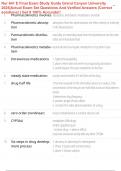
1. Pharmacokinetics involves absorption, distribution, metabolism, excretion
2. Pharmacokinetic absorp- absorption from the administration site either directly or indirectly
tion in the blood plasma
3. Parmacokinetic distribu- reversibly or irreversibly move from the bloodstream into the inter-
tion stitial and intracellular fluid
4. Pharmacokinetics metabo- biotransformed via hepatic metabolism or by other tissue
lism
5. Intravenous medications 1. highest bioavailability
2. places entire does into venin thus bypassing absorption
3. avoids hepatic first pass metabolism in the liver
6. steady state medication usually reached within 4-5 half lives of the drug
7. drug half life 1.the time required for the elimination process to reduce 2.the
concentration of the drug to one half what it was at initial adminis-
tration
3.determines drug frequency
4. predicts length of toxic effects
5. constant first order pharmacokinetics of a drug
8. zero order (nonlinear) drug is metabolized at a constant rate per unit
9. CYP3A4 metabolizes 50% drugs
inhibit: grapefruit juice
- increase drug -> adverse effects
may have enhanced activity with any other CYP3A4
10. Six steps in drug develop- 1. discovery or laboratory for development
ment process 2. Phase 1 begins with animal testing
3. phase 2 human subjects
, Nur 641 E Final Exam Study Guide Grand Canyon University
Study online at https://quizlet.com/_92hbsn
4. compare drug to placebo or other drug that is effective
5.FDA then reviews result and determines approval
6. Post market study to determine other side effects that were not
seen while lab testing
11. organizations for medica- 1.Institute of Safe mediation Practice
tion safety 2. Institute of Medicine
3. Joint commission
4.National Coordinating Council form mediation error reporting
and prevention
5. Food and Drug Administration (safe use initiative)
12. Adverse Drug Reaction 1.Also known as a side effect, an undesirable reaction that accom-
(ADR) panies the principal response for which the drug was taken include
allergic reactions and adverse drug effects
2. Either pharmacological or idiosyncratic
3. 85-90% of ADRs are pharmacological
4. Reporting is not mandated by FDA thus are not commonly re-
ported
5. usually preventable occur in hospital and nursing homes due to
med errors
6. Polypharmacy, multiple doctors and multiple pharmacies in-
crease risk
13. Angiotensin-converting 1. end in pril: lisinopril, captopril, enalapril, ramipril, benazepril and
enzyme (ACE) inhibitors fosinopril
2. suppress release of angiotensin converting enzyme
3. side effects include cough and angioedema, with angioedema
the medication should be discontinued
14. Angiotensin II Receptor 1. -sartan: candesartan, eprosartan, ibesartan, Isosartan, telmisar-
Blockers (ARBs) tan, valsartan
2.block angiotensin 11 receptors
, Nur 641 E Final Exam Study Guide Grand Canyon University
Study online at https://quizlet.com/_92hbsn
15. Essential vs Secondary Essential HTN accounts for 90% of cases and is also called primary,
HTN secondary may be caused by CKD
16. Nitroglycerin (Nitrate) use: angina pectoris
action: dilate veins and arteries and thereby reducing ischemia and
relieving pain by decreasing myocardial O2 consumption
Side effects: throbbing HA, flushing, hypotension tachycardia
available: IV, SL, topical ointment and transdermal patch
contraindicated with PDE-5 (sildanfil and vardenafil)
17. Amiodarone 1. antiarrhythmic of choice when there is coexisting heart failure
2. can cause thyroid and pulmonary toxicity
18. Alpha 1 adrenergic stimu- vasoconstriction and increased blood pressure
lation results
19. alpha 1 blockade Decrease sympathetic stimulation causing vasodilation and de-
creased blood pressure
20. beta 1 adrenergic stimulation by beta agonists (isoproterenol) result in increased
heart rate, blood pressure and cardiac output
2. blockade results in decreased heart rate, bp, and cardiac output
21. left heart failure The heart does not adequately circulate blood to systemic system.
Due to pressure overload or volume overload causing a reduction
of oxygenated blood to body tissue
22. Right heart failure 1.Associated with pulmonary disease and increased pulmonary
vascular resistance
2.The heart does not adequately circulate blood to the pulmonic
system. Can be due to volume overload or regurgitation in Tricuspid
Valve or Pulmonic Valve.


