
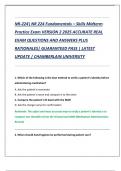
NR-224\ NR 224 Fundamentals – Skills Midterm
Practice Exam VERSION 2 2025 ACCURATE REAL
EXAM QUESTIONS AND ANSWERS PLUS
RATIONALES| GUARANTEED PASS | LATEST
UPDATE | CHAMBERLAIN UNIVERSITY
1. Which of the following is the best method to verify a patient’s identity before
administering medication?
A. Ask the patient's roommate
B. Ask the patient’s name and compare it to the chart
C. Compare the patient's ID band with the MAR
D. Ask the charge nurse for confirmation
Rationale: The safest and most accurate way to verify a patient’s identity is to
compare two identifiers from the ID band and MAR (Medication Administration
Record).
2. When should hand hygiene be performed during patient care?
,A. Before donning gloves only
B. Only after contact with bodily fluids
C. Before and after patient contact, and after removing gloves
D. Only after removing gloves
Rationale: Hand hygiene is essential to prevent healthcare-associated infections
and should be done before and after patient contact, after removing gloves, and
after contact with bodily fluids.
3. Which technique is correct when inserting an indwelling urinary catheter in a
female patient?
A. Cleanse the labia from back to front
B. Inflate the balloon before insertion
C. Insert the catheter until urine flows, then advance 1-2 inches
D. Use the same swab for all three cleansing strokes
Rationale: Advancing the catheter after urine return ensures balloon inflation
occurs inside the bladder, not the urethra.
4. What is the proper sequence for donning PPE?
A. Mask, gown, goggles, gloves
B. Gloves, goggles, mask, gown
C. Gown, mask, goggles, gloves
D. Gown, gloves, mask, goggles
,Rationale: The CDC recommends donning PPE in the order: gown, mask,
goggles/face shield, gloves.
5. What is the most important nursing action when assisting a patient with
ambulation who is at risk for falling?
A. Encourage rapid movements
B. Use a wheelchair instead
C. Use a gait belt and walk on the patient’s weak side
D. Hold the patient's arm firmly
Rationale: A gait belt provides stability, and walking on the weak side offers
better support and control during ambulation.
6. When collecting a clean-catch urine specimen, the patient should be
instructed to:
A. Collect the first urine voided
B. Void a small amount, stop, then collect the midstream urine
C. Use the toilet to void completely
D. Avoid cleaning the perineal area
Rationale: Midstream urine collection helps avoid contamination from urethral
flora, giving a more accurate specimen.
7. Which action is inappropriate during sterile field setup?
, A. Touching sterile items with sterile gloves
B. Keeping hands above the waist
C. Reaching over the sterile field
D. Avoiding turning your back on the field
Rationale: Reaching over a sterile field contaminates it. All movements should
be around the field to maintain sterility.
8. How should a nurse position a patient to insert a nasogastric (NG) tube?
A. Supine with head flat
B. Side-lying with head tilted
C. High Fowler’s with head slightly flexed
D. Prone with neck extended
Rationale: High Fowler’s position with head flexed closes the airway and opens
the esophagus for safer tube insertion.
9. Which of the following actions best prevents pressure ulcer formation?
A. Encourage fluid restriction
B. Reposition the patient at least every 2 hours
C. Use donut cushions
D. Massage reddened areas
Rationale: Regular repositioning reduces prolonged pressure that can impair
circulation and cause tissue breakdown.
Practice Exam VERSION 2 2025 ACCURATE REAL
EXAM QUESTIONS AND ANSWERS PLUS
RATIONALES| GUARANTEED PASS | LATEST
UPDATE | CHAMBERLAIN UNIVERSITY
1. Which of the following is the best method to verify a patient’s identity before
administering medication?
A. Ask the patient's roommate
B. Ask the patient’s name and compare it to the chart
C. Compare the patient's ID band with the MAR
D. Ask the charge nurse for confirmation
Rationale: The safest and most accurate way to verify a patient’s identity is to
compare two identifiers from the ID band and MAR (Medication Administration
Record).
2. When should hand hygiene be performed during patient care?
,A. Before donning gloves only
B. Only after contact with bodily fluids
C. Before and after patient contact, and after removing gloves
D. Only after removing gloves
Rationale: Hand hygiene is essential to prevent healthcare-associated infections
and should be done before and after patient contact, after removing gloves, and
after contact with bodily fluids.
3. Which technique is correct when inserting an indwelling urinary catheter in a
female patient?
A. Cleanse the labia from back to front
B. Inflate the balloon before insertion
C. Insert the catheter until urine flows, then advance 1-2 inches
D. Use the same swab for all three cleansing strokes
Rationale: Advancing the catheter after urine return ensures balloon inflation
occurs inside the bladder, not the urethra.
4. What is the proper sequence for donning PPE?
A. Mask, gown, goggles, gloves
B. Gloves, goggles, mask, gown
C. Gown, mask, goggles, gloves
D. Gown, gloves, mask, goggles
,Rationale: The CDC recommends donning PPE in the order: gown, mask,
goggles/face shield, gloves.
5. What is the most important nursing action when assisting a patient with
ambulation who is at risk for falling?
A. Encourage rapid movements
B. Use a wheelchair instead
C. Use a gait belt and walk on the patient’s weak side
D. Hold the patient's arm firmly
Rationale: A gait belt provides stability, and walking on the weak side offers
better support and control during ambulation.
6. When collecting a clean-catch urine specimen, the patient should be
instructed to:
A. Collect the first urine voided
B. Void a small amount, stop, then collect the midstream urine
C. Use the toilet to void completely
D. Avoid cleaning the perineal area
Rationale: Midstream urine collection helps avoid contamination from urethral
flora, giving a more accurate specimen.
7. Which action is inappropriate during sterile field setup?
, A. Touching sterile items with sterile gloves
B. Keeping hands above the waist
C. Reaching over the sterile field
D. Avoiding turning your back on the field
Rationale: Reaching over a sterile field contaminates it. All movements should
be around the field to maintain sterility.
8. How should a nurse position a patient to insert a nasogastric (NG) tube?
A. Supine with head flat
B. Side-lying with head tilted
C. High Fowler’s with head slightly flexed
D. Prone with neck extended
Rationale: High Fowler’s position with head flexed closes the airway and opens
the esophagus for safer tube insertion.
9. Which of the following actions best prevents pressure ulcer formation?
A. Encourage fluid restriction
B. Reposition the patient at least every 2 hours
C. Use donut cushions
D. Massage reddened areas
Rationale: Regular repositioning reduces prolonged pressure that can impair
circulation and cause tissue breakdown.


