

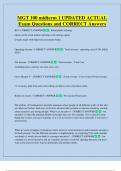
MGT 100 midterm 1 UPDATED ACTUAL
Exam Questions and CORRECT Answers
IPO - CORRECT ANSWER - Initial public offering
Opens on the stock market and helps with raising capital
Usually made with help from investment banks
Operating Income - CORRECT ANSWER - Total revenue - operating costs (COS, R&D,
SGA)
Net Income - CORRECT ANSWER - Total revenue - Total Cost
(including taxes, interest, one time costs, etc)
Gross Margin % - CORRECT ANSWER - (Total revenue - Cost of sales)/Total revenue
(% of money kept from sales after taking out direct costs of products sold)
Return on Assets - CORRECT ANSWER - Net income/Total assets
The authors of Freakonomics describe situations where people of all different walks of life who
are otherwise honest, find ways to cheat to advance their position or increase monetary rewards
when incentives are strong enough. What is an incentive? - CORRECT ANSWER - An
incentive is when the potential benefit outweighs the cost. For example, if it is your first time
being late to class, you get a warning, so it is ok to be late to class once especially if you have a
good reason.
What are some examples of situations where moral or social incentives and economic incentives
are both present? Are the different incentives complementary or competing? For each example
you think of, which do you think is a stronger incentive? - CORRECT ANSWER - An
example of a moral incentive and an economic incentive would be speeding because you don't
want a fine and you don't want to potentially kill another family.
, How did Paul Feldman set up his bagel business in Washington D.C.? How did it different from
most business models? - CORRECT ANSWER - He set up his bagel business based on
trust as he trusted people to pay for the bagels they took instead of not.
What do the authors of Freakonomics conclude from an analysis of Paul Feldman's bagel sales
data? Do these conclusions match with economists' expectations of human behavior? -
CORRECT ANSWER - The authors conclude that people's moral compasses will
generally make them act in the right way while economists say that if people have the
opportunity to cheat and get away with it, they will 100% of the time. Freakanomics so 87
percent of the time the moral compass works.
Planned Economy - CORRECT ANSWER - Government controls over all the goods and
factors of production
Ex: Communism
Market Economy - CORRECT ANSWER - Prices are determined by market forces
(Supply and demand)
Market Failure - CORRECT ANSWER - Happens when the market cannot accurately
price items
Ex: Market power (Monopolies, undersupply), Public Goods (National security, environmental
protection, infrastructure), Externalities, Inequality, discrimination, and injustice
Types of economic systems - CORRECT ANSWER - Pure capitalism
Pure command system
Mixed and transition economies (Ex: USA)
Role of Government - CORRECT ANSWER - Property rights, legal protection, antitrust,
supply of public goods, externalities, biases, standards and certification, resdestribution
Exam Questions and CORRECT Answers
IPO - CORRECT ANSWER - Initial public offering
Opens on the stock market and helps with raising capital
Usually made with help from investment banks
Operating Income - CORRECT ANSWER - Total revenue - operating costs (COS, R&D,
SGA)
Net Income - CORRECT ANSWER - Total revenue - Total Cost
(including taxes, interest, one time costs, etc)
Gross Margin % - CORRECT ANSWER - (Total revenue - Cost of sales)/Total revenue
(% of money kept from sales after taking out direct costs of products sold)
Return on Assets - CORRECT ANSWER - Net income/Total assets
The authors of Freakonomics describe situations where people of all different walks of life who
are otherwise honest, find ways to cheat to advance their position or increase monetary rewards
when incentives are strong enough. What is an incentive? - CORRECT ANSWER - An
incentive is when the potential benefit outweighs the cost. For example, if it is your first time
being late to class, you get a warning, so it is ok to be late to class once especially if you have a
good reason.
What are some examples of situations where moral or social incentives and economic incentives
are both present? Are the different incentives complementary or competing? For each example
you think of, which do you think is a stronger incentive? - CORRECT ANSWER - An
example of a moral incentive and an economic incentive would be speeding because you don't
want a fine and you don't want to potentially kill another family.
, How did Paul Feldman set up his bagel business in Washington D.C.? How did it different from
most business models? - CORRECT ANSWER - He set up his bagel business based on
trust as he trusted people to pay for the bagels they took instead of not.
What do the authors of Freakonomics conclude from an analysis of Paul Feldman's bagel sales
data? Do these conclusions match with economists' expectations of human behavior? -
CORRECT ANSWER - The authors conclude that people's moral compasses will
generally make them act in the right way while economists say that if people have the
opportunity to cheat and get away with it, they will 100% of the time. Freakanomics so 87
percent of the time the moral compass works.
Planned Economy - CORRECT ANSWER - Government controls over all the goods and
factors of production
Ex: Communism
Market Economy - CORRECT ANSWER - Prices are determined by market forces
(Supply and demand)
Market Failure - CORRECT ANSWER - Happens when the market cannot accurately
price items
Ex: Market power (Monopolies, undersupply), Public Goods (National security, environmental
protection, infrastructure), Externalities, Inequality, discrimination, and injustice
Types of economic systems - CORRECT ANSWER - Pure capitalism
Pure command system
Mixed and transition economies (Ex: USA)
Role of Government - CORRECT ANSWER - Property rights, legal protection, antitrust,
supply of public goods, externalities, biases, standards and certification, resdestribution


