
Accounting Crash Course Exam from Wall Street Prep Questions &Answers
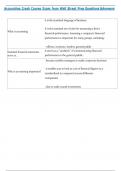
it is the standard language of business.
It is the standard set of rules for measuring a firm's
What is accounting
financial performance. Assessing a company's financial
performance is important for many groups, including:
- officers, investors, lenders, general public
Standard financial statements it serves as a "yardstick" of communicating financial
serve as ... performance to the general public.
- because enables managers to make corporate decisions
- it enables you to look at a set of financial figures in a
Why is accounting important?
standardized in compared across different
companies
- also to make sound investments
, 1. the US gov called the Securities and Exchange
Commission (SEC) authorizes the Financial
Accounting Standard Board (FASB) to determine
US accounting rules
2. the FASB then communicates these rules through
the issuance of statements of Financial Accounting
the order of Generally Standards (SFAS). These statements make up the
Accepted Accounting body of
Principles (GAAP) accounting rules known as the Generally Accepted Accounting
Principles (GAAP)
3. These rules have been developed to provide guidelines
for financial accounting in order to ensure that business
present their financial information in a fair, consistent,
and straightforward basis. Financial statements must be
prepared according the GAPP.
summary:
accounting follows GAAP which are guidelines for
measuring and presenting financial information in fair,
consistent, and straighforward basis.
about the International - over 100 countries, including the EU, UK, Canada,
Financial Reporting Australia, Russia have adopted a unified set of
Standards (IFRS) international accounting standards (IFRS)
, 1st assumption: A company is considered a seprate "living"
enterprise, apart from its owners.
- in other words, a corporation is a "fictional" being:
- has a name
- has incorporation date and place respectively ("birthdate and
birthplace"
- it is engaged in clearly-defined activities
- regularly reports its financial health (through financial reports)
to the general public
- pays taxes
2nd assumption: A company is considered a "going
concern" for the foreseeable future (value assets and
FASB bases GAAP on several
liabilites)
key
theoretical assumptions,
- in other words, a corporation is assumed to remain in existence
principles, and constraints -
indefinitely
some of the key underlying
assumptions: 3rd assumption: Financial statements must be reported in the
national monetary unit
- They can show only measurable activites of a
corporation such as its quantifiable resources, its
liabilites (money owed by it), amount of taxes facing
it, etc.
This excludes things like:
customer loyalty, employee satisfaction, environmental
awareness - as they are difficult to quantify
4th assumption: periodicity - companies are required to
file annual and interim reports (less than one year)
- quarterly reports and annual financial reports are required
it is the standard language of business.
It is the standard set of rules for measuring a firm's
What is accounting
financial performance. Assessing a company's financial
performance is important for many groups, including:
- officers, investors, lenders, general public
Standard financial statements it serves as a "yardstick" of communicating financial
serve as ... performance to the general public.
- because enables managers to make corporate decisions
- it enables you to look at a set of financial figures in a
Why is accounting important?
standardized in compared across different
companies
- also to make sound investments
, 1. the US gov called the Securities and Exchange
Commission (SEC) authorizes the Financial
Accounting Standard Board (FASB) to determine
US accounting rules
2. the FASB then communicates these rules through
the issuance of statements of Financial Accounting
the order of Generally Standards (SFAS). These statements make up the
Accepted Accounting body of
Principles (GAAP) accounting rules known as the Generally Accepted Accounting
Principles (GAAP)
3. These rules have been developed to provide guidelines
for financial accounting in order to ensure that business
present their financial information in a fair, consistent,
and straightforward basis. Financial statements must be
prepared according the GAPP.
summary:
accounting follows GAAP which are guidelines for
measuring and presenting financial information in fair,
consistent, and straighforward basis.
about the International - over 100 countries, including the EU, UK, Canada,
Financial Reporting Australia, Russia have adopted a unified set of
Standards (IFRS) international accounting standards (IFRS)
, 1st assumption: A company is considered a seprate "living"
enterprise, apart from its owners.
- in other words, a corporation is a "fictional" being:
- has a name
- has incorporation date and place respectively ("birthdate and
birthplace"
- it is engaged in clearly-defined activities
- regularly reports its financial health (through financial reports)
to the general public
- pays taxes
2nd assumption: A company is considered a "going
concern" for the foreseeable future (value assets and
FASB bases GAAP on several
liabilites)
key
theoretical assumptions,
- in other words, a corporation is assumed to remain in existence
principles, and constraints -
indefinitely
some of the key underlying
assumptions: 3rd assumption: Financial statements must be reported in the
national monetary unit
- They can show only measurable activites of a
corporation such as its quantifiable resources, its
liabilites (money owed by it), amount of taxes facing
it, etc.
This excludes things like:
customer loyalty, employee satisfaction, environmental
awareness - as they are difficult to quantify
4th assumption: periodicity - companies are required to
file annual and interim reports (less than one year)
- quarterly reports and annual financial reports are required


