2017 Fundamental PN Hesi Specialty V2
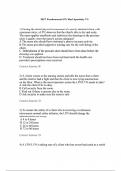
1) During the initial physical assessment of a newly admitted client with a pressure ulcer, a LPN observes that the client's skin is dry and scaly. The nurse applies emollients and reinforces the dressing on the pressure ulcer. Legally, were the nurse's actions adequate? A The nurse also should have instituted a plan to increase activity. B The nurse provided supportive nursing care for the well-being of the client. C Debridement of the pressure ulcer should have been done before the dressing was applied. D Treatment should not have been instituted until the health care provider's prescriptions were received. Correct Answer: B 2) A visitor comes to the nursing station and tells the nurse that a client and his relative had a fight and that the client is now lying unconscious on the floor. What is the most important action the LPN/LVN needs to take? A Ask the client if he is okay. B Call security from the room. C Find out if there is anyone else in the room. D Ask security to make sure the room is safe Correct Answer: D 3) To ensure the safety of a client who is receiving a continuous intravenous normal saline infusion, the LPN should change the administration set every: A 4 to 8 hours B 12 to 24 hours C 24 to 48 hours D 72 to 96 hours Correct Answer: D 4) A LPN/LVN is taking care of a client who has severe back pain as a result of a work injury. What nursing considerations should be made when determining the client's plan of care? Select all that apply. A Ask the client what is the client's acceptable level of pain. B Eliminate all activities that precipitate the pain. C Administer the pain medications regularly around the clock. D Use a different pain scale each time to promote patient education. E Assess the client's pain every 15 minutes Correct Answer: A, C 5) The LPN/LVN is preparing to administer eardrops to a client that has impacted cerumen. Before administering the drops, the nurse will assess the client for which contraindications? Select all that apply. A Allergy to the medication B Itching in the ear canal C Drainage from the ear canal D Tympanic membrane rupture E Partial hearing loss in the affected ear Correct Answer:A,C,D 6) What clinical indicators should the LPN/LVN expect a client with hyperkalemia to exhibit? Select all that apply. A Tetany B Seizures C Diarrhea D Weakness E Dysrhythmias Correct Answer:C,D,E 7) A health care provider has prescribed isoniazid (Laniazid) for a client. Which instruction should the LPN give the client about this medication? A Prolonged use can cause dark concentrated urine. B The medication is best absorbed when taken on an empty stomach. C Take the medication with aluminum hydroxide to minimize GI upset. D Drinking alcohol daily can cause drug-induced hepatitis Correct Answer:D 8) To minimize the side effects of the vincristine (Oncovin) that a client is receiving, what does the LPN/LVN expect the dietary plan to include? A Low in fat B High in iron C High in fluids D Low in residue Correct Answer:C 9) A postoperative client says to the nurse, "My neighbor, I mean the person in the next room, sings all night and keeps me awake." The neighboring client has dementia and is awaiting transfer to a nursing home. How can the LPN/LVN best handle this situation? A Tell the neighboring client to stop singing. B Close the doors to both clients' rooms at night. C Give the complaining client the prescribed as needed sedative. D Move the neighboring client to a room at the end of the hall Correct Answer:D 10) The nurse is providing postoperative care to a client who had a submucosal resection (SMR) for a deviated septum. The LPN should monitor for what complication associated with this type of surgery? A Occipital headache B Periorbital crepitus C Expectoration of blood D Changes in vocalization Correct Answer:C 11) A nurse is reviewing a plan of care for a client who was admitted with dehydration as a result of prolonged watery diarrhea. Which prescription should the LPN/LVN question? A Oral psyllium (Metamucil) B Oral potassium supplement C Parenteral half normal saline D Parenteral albumin (Albuminar) Correct Answer:D 12) A client is to have mafenide (Sulfamylon) cream applied to burned areas. For which serious side effect of mafenide therapy should the LPN/LVN monitor this client? A Curling ulcer B Renal shutdown C Metabolic acidosis D Hemolysis of red blood cells Correct Answer:C 13) A LPN is preparing to administer an ophthalmic medication to a client. What techniques should the nurse use for this procedure? Select all that apply. A Clean the eyelid and eyelashes. B Place the dropper against the eyelid. C Apply clean gloves before beginning of procedure. D Instill the solution directly onto cornea. E Press on the nasolacrimal duct after instilling the solution. Correct Answer:A,C,E 14) The LPN/LVN recognizes that which are important components of a neurovascular assessment? Select all that apply. A Orientation B Capillary refill C Pupillary response D Respiratory rate E Pulse and skin temperature F Movement and sensation Correct Answer: B,E,F
Document information
- Uploaded on
- May 19, 2025
- Number of pages
- 16
- Written in
- 2024/2025
- Type
- Exam (elaborations)
- Contains
- Questions & answers