MVU Nurs 623 Exam 2
Save
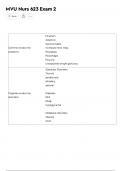
Hirsutism
Alopecia
Gynecomastia
Common endocrine Increased neck mass
problems Polydipsia
Polyphagia
Polyuria
Unexplaned weight gain/loss
Glandular Disorders
Thyroid
parathyroid
pituatary
adrenal
Organize endocrine Diabetes
disorders DM1
DM@
hypoglycemia
Metabolic disorders
Obesity
Gout
, the endocrine system's most influential gland. Under
the influence of the hypothalamus, it regulates growth
and controls other endocrine glands.
When thyroid hormone levels in the blood are low,
Pituatary gland the pituitary releases more TSH. When thyroid
hormone levels are high, the pituitary decreases TSH
production.
When theres a problem in the pituatary you will see
tsh and T4 both down.
What differentiates one from the other
How to differentiate •Causes
hypothyroid and •Clinical presentation
hyperthyroidism. •Diagnostic tests
•Treatment
•Excess secretion & synthesis of one or both:
Thyroxine (t4)
triiodothroinine (t3)
Hyperthyroidism Long term effects without treatment:
Heart disease
osteoporosis
Mental disease
infertility
, "Hot/buldging/fast"
-intolerance to heat
-thin fine hair
-bulging eyes (exopthalmus)
-thryomegaly
-tachycardia
Hyperthyroidism clinical
-HTN
findings
-weight loss
-Tremors.
-pretibial myxedema (thickening of skin on shins
usually)
-decreased visual acuity
-photophobia.
"cold/slow/tired"
-Intolerance to cold, coarse hair/ hair loss, extreme -
fatigue, lethargy, slow speech, constipation, brittle -
hair/ nails.
Hypothyroid clinical -High TSH
manifestations -Low free T4 levels
-Once confirmed diagnosis of hypothyroidism, -
thyroid peroxidase antibody (TPO) to confirm
-Hashimoto's thyroiditis (gold standard for diagnosis
of Hashimoto's)
Graves disease (diffuse toxic goiter) is most common.
hyperthyroidism causes Subacute or painless thyroiditis. Toxic nodular goiter.
Factitious hyperthyroidism.
Hashimoto thyroiditis (90% of cases)
Subacute painless lymphocytic thyroiditis
Hypothyroidism causes Hypopituitarism, iodine deficiency, enzyme deficiency
Drugs: Amiodarone, lithium, sulfonamides,
phenylbutazone
Hypothalamic dysfunction/hypopituitarism
, TSH
Free T 4
- meds can alter labs: Steroids, adrogens, estrogens,
Diagnostic tests for
salicylates, heparine, iodine containing coumpounds.
thyroid problems
If Ft4 normal, then do FT3
Also do CBC and LFT
TSH receptor antibody
Nuc med scan
Further testing after initial
24 hour iodine uptake
thyroid testing
ultrasound
fine needle biopsy
TSH would be low
Serum free T3 and T4 would be elevated.
Hyperthyroid (graves
disease) Labs
Remember the knocking on the door analogy:
the pituitary gland recognizes that the t3 and t4 are
TSH level would be __
elevated, so it will not send anyone to knock on the
T3/T4 would be ___
thyroids door to increase it (aka will not send out any
more TSH)
TSH level is high
Hypothyroidism T3& T4 are low.
(hashimotos's) labs
TSH level would be __ This is because the TSH is trying to get the thyroid to
T3/T4 would be ___ produce more T3 and T4, but the thyroid cant. Hence
the patient will need synthetic T4. (synthroid)
TSH would be elevated
Pituitary abnormality labs T3/T4 would also be elevated
TSH would be
and T3/T4 would be This is how you know its the pituitary because the
negative feedback system is failing.
Save
Hirsutism
Alopecia
Gynecomastia
Common endocrine Increased neck mass
problems Polydipsia
Polyphagia
Polyuria
Unexplaned weight gain/loss
Glandular Disorders
Thyroid
parathyroid
pituatary
adrenal
Organize endocrine Diabetes
disorders DM1
DM@
hypoglycemia
Metabolic disorders
Obesity
Gout
, the endocrine system's most influential gland. Under
the influence of the hypothalamus, it regulates growth
and controls other endocrine glands.
When thyroid hormone levels in the blood are low,
Pituatary gland the pituitary releases more TSH. When thyroid
hormone levels are high, the pituitary decreases TSH
production.
When theres a problem in the pituatary you will see
tsh and T4 both down.
What differentiates one from the other
How to differentiate •Causes
hypothyroid and •Clinical presentation
hyperthyroidism. •Diagnostic tests
•Treatment
•Excess secretion & synthesis of one or both:
Thyroxine (t4)
triiodothroinine (t3)
Hyperthyroidism Long term effects without treatment:
Heart disease
osteoporosis
Mental disease
infertility
, "Hot/buldging/fast"
-intolerance to heat
-thin fine hair
-bulging eyes (exopthalmus)
-thryomegaly
-tachycardia
Hyperthyroidism clinical
-HTN
findings
-weight loss
-Tremors.
-pretibial myxedema (thickening of skin on shins
usually)
-decreased visual acuity
-photophobia.
"cold/slow/tired"
-Intolerance to cold, coarse hair/ hair loss, extreme -
fatigue, lethargy, slow speech, constipation, brittle -
hair/ nails.
Hypothyroid clinical -High TSH
manifestations -Low free T4 levels
-Once confirmed diagnosis of hypothyroidism, -
thyroid peroxidase antibody (TPO) to confirm
-Hashimoto's thyroiditis (gold standard for diagnosis
of Hashimoto's)
Graves disease (diffuse toxic goiter) is most common.
hyperthyroidism causes Subacute or painless thyroiditis. Toxic nodular goiter.
Factitious hyperthyroidism.
Hashimoto thyroiditis (90% of cases)
Subacute painless lymphocytic thyroiditis
Hypothyroidism causes Hypopituitarism, iodine deficiency, enzyme deficiency
Drugs: Amiodarone, lithium, sulfonamides,
phenylbutazone
Hypothalamic dysfunction/hypopituitarism
, TSH
Free T 4
- meds can alter labs: Steroids, adrogens, estrogens,
Diagnostic tests for
salicylates, heparine, iodine containing coumpounds.
thyroid problems
If Ft4 normal, then do FT3
Also do CBC and LFT
TSH receptor antibody
Nuc med scan
Further testing after initial
24 hour iodine uptake
thyroid testing
ultrasound
fine needle biopsy
TSH would be low
Serum free T3 and T4 would be elevated.
Hyperthyroid (graves
disease) Labs
Remember the knocking on the door analogy:
the pituitary gland recognizes that the t3 and t4 are
TSH level would be __
elevated, so it will not send anyone to knock on the
T3/T4 would be ___
thyroids door to increase it (aka will not send out any
more TSH)
TSH level is high
Hypothyroidism T3& T4 are low.
(hashimotos's) labs
TSH level would be __ This is because the TSH is trying to get the thyroid to
T3/T4 would be ___ produce more T3 and T4, but the thyroid cant. Hence
the patient will need synthetic T4. (synthroid)
TSH would be elevated
Pituitary abnormality labs T3/T4 would also be elevated
TSH would be
and T3/T4 would be This is how you know its the pituitary because the
negative feedback system is failing.