

Physical Activity
Prof. Troosters
Assessment of physical fitness
Definition
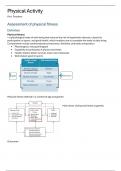
Physical fitness
= a physiological state of well-being that reduces the risk of hypokinetic disease, a basis for
participation in sports, and good health, which enables one to complete the tasks of daily living.
Components include cardiorespiratory endurance, flexibility, and body composition
• Physiological, not psychological
• Capability to participate in physical activities
• Health related: better survival, lower risk of diseases
• Skill related: good in sports
Physical fitness defined in a context of age and gender
Main driver of physical fitness is genetic
Outcomes
, • Quadriceps force: at a given age, in a given gender
o 70% of predicted value is not good, because it is not the normal result at their age
o Value: change the torque into the amount of kg a person can push away → better
understanding of patient
Assessing health related PF
Why?
• Inform patients on their HRPF related to age and gender matched norms in order to be able to
take action if needed (compared to cholesterol, blood pressure, other biomarkers)
• Map out deficits to develop individualized exercise prescription to address all relevant health-
fitness components
• Collect information to allow follow-up (progress or deterioration)
• Motivate participants (patients) to establish reasonable attainable goal
• Emphasis on global patient health rather than a specific PT related problem (e.g. mobility
impairment, pain, …)
General principles of assessment
Measurement error
• Typically a single observation is hard to interpret: it needs context (e.g. clinical presentation,
complaints, other measures, repeated observations)
• Some cut-off may be of clinical relevance
Calibration
• Instrument must be accurate
Standardization
• Encouragement must match exactly as during the reference test
Normal values (percent predicted or percentile → lower limit of normal)
• For the test as you conduct it
,Anamnesis around fitness assessment
Why consult?
• Ask the patient why he/she comes to see you
o Expectations (goals)
o Knowledge
o Motivation
• Use open ended questions and listen
Current PA/PF (top level)?
Physical activity short questionnaires
• Short questionnaires that give an indication of how physically active a patient is
• Correlation with objectively assessed PA is modest
• Good identification of inactive patients → triage instrument (gives indication of inactive vs
active patients)
• Less accurate to identify active patients
• Simple quick screening
• When PA as vital sign is assessed, better counselling and advice around PA is provided
, Growing market of ‘activity’ trackers
• Estimation of physical activity not accurate
o E.g. estimation is different with phone or fitbit
o Be a critical user of wearable data → make sure you understand the technology and its
limitations
Medical problems
CV/resp/metabolic/neurologic/muscular
→ Contra-indications for exercise(-testing)
• Also look at-risk profiles (smoking-obesity-hidden complaints)
• Document actual medication (and look up its pharmacologic action!)
CAVE: undiagnosed chronic disease with impact on exercise
• Smokers who have COPD but don’t know
Prof. Troosters
Assessment of physical fitness
Definition
Physical fitness
= a physiological state of well-being that reduces the risk of hypokinetic disease, a basis for
participation in sports, and good health, which enables one to complete the tasks of daily living.
Components include cardiorespiratory endurance, flexibility, and body composition
• Physiological, not psychological
• Capability to participate in physical activities
• Health related: better survival, lower risk of diseases
• Skill related: good in sports
Physical fitness defined in a context of age and gender
Main driver of physical fitness is genetic
Outcomes
, • Quadriceps force: at a given age, in a given gender
o 70% of predicted value is not good, because it is not the normal result at their age
o Value: change the torque into the amount of kg a person can push away → better
understanding of patient
Assessing health related PF
Why?
• Inform patients on their HRPF related to age and gender matched norms in order to be able to
take action if needed (compared to cholesterol, blood pressure, other biomarkers)
• Map out deficits to develop individualized exercise prescription to address all relevant health-
fitness components
• Collect information to allow follow-up (progress or deterioration)
• Motivate participants (patients) to establish reasonable attainable goal
• Emphasis on global patient health rather than a specific PT related problem (e.g. mobility
impairment, pain, …)
General principles of assessment
Measurement error
• Typically a single observation is hard to interpret: it needs context (e.g. clinical presentation,
complaints, other measures, repeated observations)
• Some cut-off may be of clinical relevance
Calibration
• Instrument must be accurate
Standardization
• Encouragement must match exactly as during the reference test
Normal values (percent predicted or percentile → lower limit of normal)
• For the test as you conduct it
,Anamnesis around fitness assessment
Why consult?
• Ask the patient why he/she comes to see you
o Expectations (goals)
o Knowledge
o Motivation
• Use open ended questions and listen
Current PA/PF (top level)?
Physical activity short questionnaires
• Short questionnaires that give an indication of how physically active a patient is
• Correlation with objectively assessed PA is modest
• Good identification of inactive patients → triage instrument (gives indication of inactive vs
active patients)
• Less accurate to identify active patients
• Simple quick screening
• When PA as vital sign is assessed, better counselling and advice around PA is provided
, Growing market of ‘activity’ trackers
• Estimation of physical activity not accurate
o E.g. estimation is different with phone or fitbit
o Be a critical user of wearable data → make sure you understand the technology and its
limitations
Medical problems
CV/resp/metabolic/neurologic/muscular
→ Contra-indications for exercise(-testing)
• Also look at-risk profiles (smoking-obesity-hidden complaints)
• Document actual medication (and look up its pharmacologic action!)
CAVE: undiagnosed chronic disease with impact on exercise
• Smokers who have COPD but don’t know


