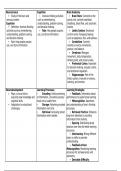
Neuroscience Cognition Brain Anatomy
Study of the brain and Involves thinking activities Brain Stem: Connects to the
nervous system. such as remembering, spinal cord, controls heartbeat,
Cognition understanding, problem-solving, breathing, blood flow, and automatic
Definition: Involves thinking and decision-making. actions.
activities such as remembering, Role: How people acquire, Limbic System: Emotional
understanding, problem-solving, use, and store information. control center managing feelings
and decision-making. such as happiness, fear, and sadness.
Role: How people acquire, Cerebellum: Controls
use, and store information. voluntary muscle movements,
posture, and balance.
Cerebrum: Manages
movement, body temperature,
thinking skills, and sensory tasks.
Prefrontal Cortex: Important
for decision-making, impulse control,
and emotional regulation.
Hippocampus: Part of the
limbic system, involved in memory,
learning, and emotion.
Neurodevelopment Learning Processes Learning Strategies
Plays a crucial role in Encoding: Initial processing Feedback: Information about
acquiring new knowledge and of information, converting sensory performance to guide future learning.
cognitive skills. input into a usable form. Metacognition: Awareness
Adaptation to educational Storage: Retaining encoded and understanding of one's thinking
challenges. information over time. processes.
Retrieval: Accessing stored Retrieval Practice: Enhances
information when needed. long-term retention by recalling
information from memory.
Spacing: Distributing study
sessions over time for better learning
outcomes.
Interleaving: Mixing different
topics or skills to promote
understanding.
Feedback-driven
Metacognition: Monitoring learning
processes for self-awareness and
autonomy.
Desirable Difficulty: