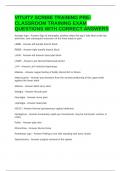
VITUITY SCRIBE TRAINING PRE-
CLASSROOM TRAINING EXAM
QUESTIONS WITH CORRECT ANSWERS
Kernig's sign - Answer-Sign of meningitis; positive when the leg is fully bent at the hip
and knee, and subsequent extension of the knee leads to pain
LBBB - Answer-left bundle branch block
RBBB - Answer-right bundle branch block
LAFB - Answer-left anterior fascicular block
LNMP - Answer-Last Normal Menstrual period
LVH - Answer-Left Ventricle Hypertropy
Malaise - Answer-vague feeling of bodily discomfort or illness
Malocclusion - Answer-any deviation from the normal positioning of the upper teeth
against the lower teeth
Melena - Answer-black tarry stool
Myalgia - Answer-Muscle pain
Neuralgia - Answer-nerve pain
cephalgia - Answer-head pain
NSVD - Answer-Normal spontaneous vaginal delievery
Nystagmus - Answer-Involuntary rapid eye movements; may be horizontal, vertical, or
rotary
Pallor - Answer-pale skin
Rhinorrhea - Answer-Runny Nose
Romberg's sign - Answer-Falling to one side standing with eyes closed
Splenectomy - Answer-surgical removal of the spleen
,Splenomegaly - Answer-an abnormal enlargement of the spleen
Splinting - Answer-muscle rigidity caused by pain
Status epilepticus - Answer-continuous seizure activity
stridor - Answer-Harsh or high-pitched respiratory sound, caused by an obstruction of
the air passages
TAH - Answer-total abdominal hysterectomy
Rovsing's sign - Answer-palpation of the left lower quadrant causes right lower quadrant
pain that may indicate appendicitis
Mcburney's point tenderness - Answer-tenderness to palpation in the mid-point of the
right lower quadrant (RLQ) which can indicate appendicitis
HIPAA - Answer-Health Insurance Portability and Accountability Act
CN - Answer-Cranial Nerves
TTP - Answer-tender to palpation
Four main components of the medical chart you are responsible for? - Answer-1. HPI
2. ROS
3. PMhxFhxShx
4. PE
Name the 8 elements of the HPI - Answer-1. Location
2. Quality
3. Severity
4. Context
5. Timing
6. Duration
7. associated signs and symptoms
8. modifying factors
True or False: The HPI and ROS are subjective - Answer-True: these are from the
patient's perspective
True or False: Patient's past surgeries should be documented in the Physical Exam
(PE)? - Answer-False: Should be in past medical history
True or False: Whether a patient smokes or not should be documented in the PMFSH?
- Answer-True: This is social history
, True or False: The physical exam is objective - Answer-True: From the doctor's point of
view
Fever - Answer-febrile
vomiting - Answer-emesis
pain with urination - Answer-dysuria
RRR - Answer-Regular Rate and Rhythm (cardio finding)
CVAT - Answer-Costal Vertebral Angle Tenderness (Back finding sometimes GU)
BS present - Answer-bowel sounds present
SNF - Answer-Skilled Nursing Facility
BIBA - Answer-brought in by ambulance
CP - Answer-chest pain, cerebral palsy
ATX - Answer-atelectasis
Pregnancy - Answer-Gravid
oophorectomy - Answer-surgical removal of one of both ovaries
Tubal pregnancy - Answer-Ectopic
Tying of tubes - Answer-tubal ligation
clipping of vas deferens - Answer-vasectomy
tonsil removal - Answer-tonsillectomy
CAD - Answer-Coronary Artery Disease
DVT - Answer-Deep Vein Thrombosis
PE - Answer-Pulmonary Embolism
PUD - Answer-Peptic Ulcer Disease
PTA - Answer-Prior to Arrival
NTG - Answer-Nitroglycerin
CLASSROOM TRAINING EXAM
QUESTIONS WITH CORRECT ANSWERS
Kernig's sign - Answer-Sign of meningitis; positive when the leg is fully bent at the hip
and knee, and subsequent extension of the knee leads to pain
LBBB - Answer-left bundle branch block
RBBB - Answer-right bundle branch block
LAFB - Answer-left anterior fascicular block
LNMP - Answer-Last Normal Menstrual period
LVH - Answer-Left Ventricle Hypertropy
Malaise - Answer-vague feeling of bodily discomfort or illness
Malocclusion - Answer-any deviation from the normal positioning of the upper teeth
against the lower teeth
Melena - Answer-black tarry stool
Myalgia - Answer-Muscle pain
Neuralgia - Answer-nerve pain
cephalgia - Answer-head pain
NSVD - Answer-Normal spontaneous vaginal delievery
Nystagmus - Answer-Involuntary rapid eye movements; may be horizontal, vertical, or
rotary
Pallor - Answer-pale skin
Rhinorrhea - Answer-Runny Nose
Romberg's sign - Answer-Falling to one side standing with eyes closed
Splenectomy - Answer-surgical removal of the spleen
,Splenomegaly - Answer-an abnormal enlargement of the spleen
Splinting - Answer-muscle rigidity caused by pain
Status epilepticus - Answer-continuous seizure activity
stridor - Answer-Harsh or high-pitched respiratory sound, caused by an obstruction of
the air passages
TAH - Answer-total abdominal hysterectomy
Rovsing's sign - Answer-palpation of the left lower quadrant causes right lower quadrant
pain that may indicate appendicitis
Mcburney's point tenderness - Answer-tenderness to palpation in the mid-point of the
right lower quadrant (RLQ) which can indicate appendicitis
HIPAA - Answer-Health Insurance Portability and Accountability Act
CN - Answer-Cranial Nerves
TTP - Answer-tender to palpation
Four main components of the medical chart you are responsible for? - Answer-1. HPI
2. ROS
3. PMhxFhxShx
4. PE
Name the 8 elements of the HPI - Answer-1. Location
2. Quality
3. Severity
4. Context
5. Timing
6. Duration
7. associated signs and symptoms
8. modifying factors
True or False: The HPI and ROS are subjective - Answer-True: these are from the
patient's perspective
True or False: Patient's past surgeries should be documented in the Physical Exam
(PE)? - Answer-False: Should be in past medical history
True or False: Whether a patient smokes or not should be documented in the PMFSH?
- Answer-True: This is social history
, True or False: The physical exam is objective - Answer-True: From the doctor's point of
view
Fever - Answer-febrile
vomiting - Answer-emesis
pain with urination - Answer-dysuria
RRR - Answer-Regular Rate and Rhythm (cardio finding)
CVAT - Answer-Costal Vertebral Angle Tenderness (Back finding sometimes GU)
BS present - Answer-bowel sounds present
SNF - Answer-Skilled Nursing Facility
BIBA - Answer-brought in by ambulance
CP - Answer-chest pain, cerebral palsy
ATX - Answer-atelectasis
Pregnancy - Answer-Gravid
oophorectomy - Answer-surgical removal of one of both ovaries
Tubal pregnancy - Answer-Ectopic
Tying of tubes - Answer-tubal ligation
clipping of vas deferens - Answer-vasectomy
tonsil removal - Answer-tonsillectomy
CAD - Answer-Coronary Artery Disease
DVT - Answer-Deep Vein Thrombosis
PE - Answer-Pulmonary Embolism
PUD - Answer-Peptic Ulcer Disease
PTA - Answer-Prior to Arrival
NTG - Answer-Nitroglycerin