

WGU C190- BIOLOGY: UNIT 2 EXAM
QUESTIONS AND ANSWERS
Parts of the Atom
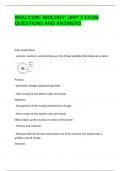
- protons, neutrons, and electrons are the 3 basic particles that make up an atom
Protons
- positively charged subatomic particles
- have a mass of one atomic mass unit (amu)
Neutrons
- the particles of the nucleus that have no charge
- have a mass of one atomic mass unit (amu)
What makes up the nucleus or center of the atom?
- Protons and neutrons
- Because both the proton and neutron are in the nucleus, the nucleus has a
positive overall charge.
Electrons
,- negatively charged subatomic particles
- Electrons have almost no mass (0 amu) and are found outside of the nucleus, in
zones that are called shells.
These shells are filled up in a specific way. The shells closest to the nucleus are
filled first, and then additional shells are filled as needed. The first shell has room
for two electrons.
Both the second and third shells have room for eight electrons each.
How do you determine the charge of an atom?
- When the number of protons equals the total number of electrons, then the
atom is electrically neutral. If the number of electrons differs from the number of
protons, then the atom has an electrical charge. That is, if there are more
protons, it will be positively charged; if there are more electrons, it will be
negatively charged.
An atom with a positive charge or a negative charge is called an ion.
An atom has six electrons and is electrically neutral. How many protons does the
atom have?
-6
- To be electrically neutral, the atom must have the same number of protons as
electrons.
An atom has 17 protons and 18 electrons. Is this atom an ion?
- Yes
- It has unequal numbers of protons and electrons.
If an atom has three protons and two electrons, what is the charge of the atom?
, - +1
- Three protons would have a charge of +3, and two electrons would have a
charge of -2.
- +3 + (-2) = +1
Periodic Table of Elements
- A table that classifies elements by their physical and chemical properties; rows
are called periods; columns are called groups
- The atomic number of an element is equal to the number of protons it has.
Example: Nitrogen (N) has an atomic number of 7 meaning it has 7 protons within
it's nucleus
In biological systems, what are the major elements?
- carbon (C), hydrogen (H), nitrogen (N), oxygen (O), phosphorus (P), and sulfur
(S). These elements represent more than 95% of the mass of a cell
Trace Elements
- elements found in relatively small amounts
- Examples include sodium (Na), potassium (K), chlorine (Cl), manganese (Mn),
and Zinc (Zn).
- Very important for the functioning of a cell
Covalent bond
QUESTIONS AND ANSWERS
Parts of the Atom
- protons, neutrons, and electrons are the 3 basic particles that make up an atom
Protons
- positively charged subatomic particles
- have a mass of one atomic mass unit (amu)
Neutrons
- the particles of the nucleus that have no charge
- have a mass of one atomic mass unit (amu)
What makes up the nucleus or center of the atom?
- Protons and neutrons
- Because both the proton and neutron are in the nucleus, the nucleus has a
positive overall charge.
Electrons
,- negatively charged subatomic particles
- Electrons have almost no mass (0 amu) and are found outside of the nucleus, in
zones that are called shells.
These shells are filled up in a specific way. The shells closest to the nucleus are
filled first, and then additional shells are filled as needed. The first shell has room
for two electrons.
Both the second and third shells have room for eight electrons each.
How do you determine the charge of an atom?
- When the number of protons equals the total number of electrons, then the
atom is electrically neutral. If the number of electrons differs from the number of
protons, then the atom has an electrical charge. That is, if there are more
protons, it will be positively charged; if there are more electrons, it will be
negatively charged.
An atom with a positive charge or a negative charge is called an ion.
An atom has six electrons and is electrically neutral. How many protons does the
atom have?
-6
- To be electrically neutral, the atom must have the same number of protons as
electrons.
An atom has 17 protons and 18 electrons. Is this atom an ion?
- Yes
- It has unequal numbers of protons and electrons.
If an atom has three protons and two electrons, what is the charge of the atom?
, - +1
- Three protons would have a charge of +3, and two electrons would have a
charge of -2.
- +3 + (-2) = +1
Periodic Table of Elements
- A table that classifies elements by their physical and chemical properties; rows
are called periods; columns are called groups
- The atomic number of an element is equal to the number of protons it has.
Example: Nitrogen (N) has an atomic number of 7 meaning it has 7 protons within
it's nucleus
In biological systems, what are the major elements?
- carbon (C), hydrogen (H), nitrogen (N), oxygen (O), phosphorus (P), and sulfur
(S). These elements represent more than 95% of the mass of a cell
Trace Elements
- elements found in relatively small amounts
- Examples include sodium (Na), potassium (K), chlorine (Cl), manganese (Mn),
and Zinc (Zn).
- Very important for the functioning of a cell
Covalent bond


