
D320 80 Question Version (JYO2)
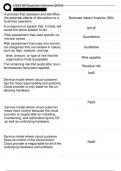
A process that assesses and identifies
the potential effects of disruptions to a Business Impact Analysis (BIA)
business operation.
A component or system that, if it fails, will
SPOF
cause the entire system to fail.
Risk assessment that uses specific nu-
Quantitative
merical values
Risk assessment that uses non-numeri-
cal categories that are relative in nature, Qualitative
such as high, medium, and low.
level, amount, or type of risk that the
Risk appetite
organization finds acceptable
The remaining risk that exists after coun-
Residual risk
termeasures have been applied.
IaaS
Service model where cloud customer
has the most responsibility and authority.
Cloud provider is only liable for the un-
derlying hardware.
PaaS
Service model where cloud customer
loses more control because the cloud
provider is responsible for installing,
maintaining, and administering the OS
as well as underlying hardware.
Service model where cloud customer
loses all control of the environment.
SaaS
Cloud provider is responsible for all of the
underlying hardware and software.
, D320 80 Question Version (JYO2)
A method of processing data in the cloud
Homomorphic encryption
while it remains encrypted.
A security strategy that involves imple-
menting multiple overlapping layers of
Defense in depth
security measures to protect an environ-
ment.
Organization that has collected or creat-
Data owner
ed the data.
Person or entity that is tasked with the
daily maintenance and administration of Data Custodian
the data.
Any org or person who manipulates,
stores, or moves the data on behalf of Data Processor
the data owner
The process of creating an inventory or
conducting e-discovery to identify and Data discovery
locate data.
A data discovery method that is aided by
Label-based discovery
labels created by the data owner.
A data discovery method that involves
discovering data using metadata traits Metadata-based discovery
and characteristics.
Refers to finding information or re-
sources based on their characteristics,
Content-based discovery
attributes, or content rather than relying
on predefined keywords or categories.
Structured data
, D320 80 Question Version (JYO2)
Data that is organized and formatted in a
way that is easily searchable and can be
processed by computers.
qualitative data; natural-language text;
incorporate media (audio, video, im-
ages); contains JSON, XML, binary ob-
Unstructured data
jects (images encoded as text strings);
important for data analytic strategies;
noSQL
A set of controls and technologies used
to protect certain types of assets, such
IRM (Information Rights Management)
as intellectual property or sensitive infor-
mation.
Legal protection for expressions of
ideas, such as literary, artistic, or musical Copyright
works.
Legislation that provides additional pro-
tections for creative works in digital for- DMCA (Digital Millennium Copyright Act)
mats.
Legal protection for specific words,
phrases, symbols, or designs that distin- Trademarks
guish a product or service.
A grant of exclusivity that gives the hold-
er the right to produce, sell, and import Patent
an invention.
A framework for secure communication
using cryptographic techniques, such as
PKI (Public Key Infrastructure)
digital certificates and public-private key
pairs.
A method of storing data as files and
folders, similar to how data is organized File-based storage
on a traditional file system.
Allocates a large chunk of storage for
access as a disk volume managed by the Block storage
operating system.
A process that assesses and identifies
the potential effects of disruptions to a Business Impact Analysis (BIA)
business operation.
A component or system that, if it fails, will
SPOF
cause the entire system to fail.
Risk assessment that uses specific nu-
Quantitative
merical values
Risk assessment that uses non-numeri-
cal categories that are relative in nature, Qualitative
such as high, medium, and low.
level, amount, or type of risk that the
Risk appetite
organization finds acceptable
The remaining risk that exists after coun-
Residual risk
termeasures have been applied.
IaaS
Service model where cloud customer
has the most responsibility and authority.
Cloud provider is only liable for the un-
derlying hardware.
PaaS
Service model where cloud customer
loses more control because the cloud
provider is responsible for installing,
maintaining, and administering the OS
as well as underlying hardware.
Service model where cloud customer
loses all control of the environment.
SaaS
Cloud provider is responsible for all of the
underlying hardware and software.
, D320 80 Question Version (JYO2)
A method of processing data in the cloud
Homomorphic encryption
while it remains encrypted.
A security strategy that involves imple-
menting multiple overlapping layers of
Defense in depth
security measures to protect an environ-
ment.
Organization that has collected or creat-
Data owner
ed the data.
Person or entity that is tasked with the
daily maintenance and administration of Data Custodian
the data.
Any org or person who manipulates,
stores, or moves the data on behalf of Data Processor
the data owner
The process of creating an inventory or
conducting e-discovery to identify and Data discovery
locate data.
A data discovery method that is aided by
Label-based discovery
labels created by the data owner.
A data discovery method that involves
discovering data using metadata traits Metadata-based discovery
and characteristics.
Refers to finding information or re-
sources based on their characteristics,
Content-based discovery
attributes, or content rather than relying
on predefined keywords or categories.
Structured data
, D320 80 Question Version (JYO2)
Data that is organized and formatted in a
way that is easily searchable and can be
processed by computers.
qualitative data; natural-language text;
incorporate media (audio, video, im-
ages); contains JSON, XML, binary ob-
Unstructured data
jects (images encoded as text strings);
important for data analytic strategies;
noSQL
A set of controls and technologies used
to protect certain types of assets, such
IRM (Information Rights Management)
as intellectual property or sensitive infor-
mation.
Legal protection for expressions of
ideas, such as literary, artistic, or musical Copyright
works.
Legislation that provides additional pro-
tections for creative works in digital for- DMCA (Digital Millennium Copyright Act)
mats.
Legal protection for specific words,
phrases, symbols, or designs that distin- Trademarks
guish a product or service.
A grant of exclusivity that gives the hold-
er the right to produce, sell, and import Patent
an invention.
A framework for secure communication
using cryptographic techniques, such as
PKI (Public Key Infrastructure)
digital certificates and public-private key
pairs.
A method of storing data as files and
folders, similar to how data is organized File-based storage
on a traditional file system.
Allocates a large chunk of storage for
access as a disk volume managed by the Block storage
operating system.


