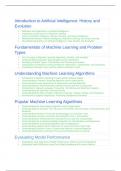
Introduction to Artificial Intelligence: History and
Evolution
Definition and Applications of Artificial Intelligence
Importance and Evolution of Machine Learning
Types of Artificial Intelligence: Narrow, General, and Super Intelligence
Relationship between Artificial Intelligence, Machine Learning, and Deep Learning
Real-World Applications of Artificial Intelligence: Case Studies and Examples
Fundamentals of Machine Learning and Problem
Types
Key Concepts in Machine Learning: Algorithms, Models, and Variables
Understanding Exploratory Data Analysis and Its Importance
Identifying Problem Types: Classification and Clustering Examples
Classification of Machine Learning Problems: Regression, Classification, and Clustering
Overfitting in Decision Trees and the Need for Random Forest
Understanding Machine Learning Algorithms
Introduction to Machine Learning Process and Its Various Stages
Understanding K-Means Clustering Algorithm and Its Applications
Understanding Linear Regression: A Supervised Learning Algorithm
Understanding the Reinforcement Learning Process and Key Components
Introduction to Natural Language Processing: Text Mining and Sentiment Analysis
Understanding the Machine Learning Process
Understanding the Role of Data in Machine Learning: Training, Testing, and Evaluation
Introduction to Logistic Regression: Predicting Categorical Outcomes
Popular Machine Learning Algorithms
Understanding the Naive Bayes Algorithm and Its Applications
Understanding the Decision Tree Structure: Root Node, Internal Nodes, Terminal Nodes, and
Branches
Understanding Random Forest and Its Advantage over Decision Trees
Understanding Activation Functions and Weighted Sum in Perceptrons
Understanding the Reinforcement Learning Process and Key Components
Understanding the K-Nearest Neighbor Algorithm for Classification and Regression
Understanding the Q-Learning Algorithm and Its Applications
Understanding Support Vector Machines for Linear and Non-Linear Data
Understanding Decision Trees: A Supervised Machine Learning Algorithm
Understanding Markov's Decision Process and Reinforcement Learning
Evaluating Model Performance
Evaluating Linear Regression Model Performance: Metrics and Considerations
Evaluating Model Efficiency using Out-of-Bag Sampling and Accuracy Metrics
Evolution
Definition and Applications of Artificial Intelligence
Importance and Evolution of Machine Learning
Types of Artificial Intelligence: Narrow, General, and Super Intelligence
Relationship between Artificial Intelligence, Machine Learning, and Deep Learning
Real-World Applications of Artificial Intelligence: Case Studies and Examples
Fundamentals of Machine Learning and Problem
Types
Key Concepts in Machine Learning: Algorithms, Models, and Variables
Understanding Exploratory Data Analysis and Its Importance
Identifying Problem Types: Classification and Clustering Examples
Classification of Machine Learning Problems: Regression, Classification, and Clustering
Overfitting in Decision Trees and the Need for Random Forest
Understanding Machine Learning Algorithms
Introduction to Machine Learning Process and Its Various Stages
Understanding K-Means Clustering Algorithm and Its Applications
Understanding Linear Regression: A Supervised Learning Algorithm
Understanding the Reinforcement Learning Process and Key Components
Introduction to Natural Language Processing: Text Mining and Sentiment Analysis
Understanding the Machine Learning Process
Understanding the Role of Data in Machine Learning: Training, Testing, and Evaluation
Introduction to Logistic Regression: Predicting Categorical Outcomes
Popular Machine Learning Algorithms
Understanding the Naive Bayes Algorithm and Its Applications
Understanding the Decision Tree Structure: Root Node, Internal Nodes, Terminal Nodes, and
Branches
Understanding Random Forest and Its Advantage over Decision Trees
Understanding Activation Functions and Weighted Sum in Perceptrons
Understanding the Reinforcement Learning Process and Key Components
Understanding the K-Nearest Neighbor Algorithm for Classification and Regression
Understanding the Q-Learning Algorithm and Its Applications
Understanding Support Vector Machines for Linear and Non-Linear Data
Understanding Decision Trees: A Supervised Machine Learning Algorithm
Understanding Markov's Decision Process and Reinforcement Learning
Evaluating Model Performance
Evaluating Linear Regression Model Performance: Metrics and Considerations
Evaluating Model Efficiency using Out-of-Bag Sampling and Accuracy Metrics