100% satisfaction guarantee Immediately available after payment Both online and in PDF No strings attached 4.2 TrustPilot
logo-home
Exam (elaborations)

CHAPTER 31: Fundamentals of Nursing, 2nd Edition – Active Learning for Collaborative Practice by Yoost & Crawford

Rating
-
Sold
-
Pages
9
Grade
A+
Uploaded on
06-05-2025
Written in
2024/2025

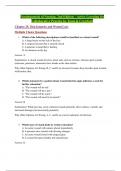
Fundamentals of Nursing, 2nd Edition – Active Learning for Collaborative Practice by Yoost & Crawford Chapter 31: Cognitive and Sensory Alterations Multiple Choice Questions 1. A nurse is caring for a stroke patient with visual alterations. Which brain region is most likely affected based on the patient's symptoms? A. Parietal lobes B. Frontal lobes C. Occipital lobes D. Temporal lobes Answer: C Explanation: The occipital lobes process visual information, making them the likely site of injury in patients with visual deficits post-stroke. Why Other Options Are Wrong: A controls tactile perception. B governs motor function and personality. D manages hearing and smell. 2. A patient states "I'm not the same person since my accident." Which brain area injury likely explains this personality change? A. Parietal lobes B. Frontal lobes C. Occipital lobes D. Temporal lobes Answer: B Explanation: The frontal lobes regulate personality, decision-making, and social behavior, so damage here can alter self-perception. Why Other Options Are Wrong: A affects touch perception. C processes vision. D manages auditory/smell senses. 3. Which family statement about delirium indicates a knowledge gap? A. "It can be caused by sensory overload." B. "It is reversible." C. "It is a mood disorder." D. "It causes acute confusion." Answer: C Explanation: Delirium is a transient cognitive disturbance, not a mood disorder like depression. Why Other Options Are Wrong: A, B, and D are accurate descriptors of delirium. 4. Which patient statement about depression requires correction? A. "Chemical brain changes cause depression." B. "Medication is the only treatment." C. "Depression is a mood disorder." D. "Symptoms can appear suddenly." Answer: B Explanation: Depression may also be treated with therapy or addressing underlying causes, not just medication. Why Other Options Are Wrong: A, C, and D are evidence-based facts about depression. 5. A patient reports hand tingling. The nurse recognizes this as a sign of which electrolyte imbalance? A. Hyponatremia B. Hypernatremia C. Hypocalcemia D. Hypercalcemia Answer: C Explanation: Tingling (paresthesia) around the mouth and extremities is classic for hypocalcemia. Why Other Options Are Wrong: A/B cause CNS symptoms like confusion. D causes muscle weakness. 6. Which patient statement about orthostatic hypotension requires correction? A. "I'll monitor my BP daily." B. "I should rise quickly to prevent dizziness." C. "I'll increase fluid intake." D. "I'll change positions slowly." Answer: B Explanation: Rapid position changes exacerbate orthostatic hypotension; slow transitions are recommended. Why Other Options Are Wrong: A, C, and D are appropriate self-management strategies. 7. What is the correct technique to assess hearing ability? A. Whisper while standing beside the patient B. Speak normally while standing beside the patient C. Speak normally while facing the patient D. Speak normally while standing behind the patient Answer: D Explanation: Standing behind the patient prevents lip-reading, ensuring accurate hearing assessment. Why Other Options Are Wrong: A may under-test hearing. B/C allow visual cues. 8. A patient holds reading material at arm's length. This suggests which condition? A. Retinopathy B. Presbyopia C. Cataracts D. Macular degeneration Answer: B Explanation: Presbyopia (age-related farsightedness) causes difficulty focusing on near objects. Why Other Options Are Wrong: A involves retinal damage. C causes cloudy vision. D affects central vision. 9. Which diabetic foot care statement requires correction? A. "I can go barefoot outdoors in summer." B. "I'll wear properly fitted shoes." C. "I won't soak my feet in hot water." D. "I'll moisturize my feet." Answer: A Explanation: Barefoot walking risks injury due to diabetic neuropathy; shoes should always be worn. Why Other Options Are Wrong: B, C, and D are correct foot care practices. 10. Which goal is most appropriate for a patient with acute confusion? A. Use call light before ambulating B. Use a calendar to recall dates C. Correctly identify location D. Remain within the unit Answer: C Explanation: Orienting to place is a priority for acute confusion. Other goals address chronic confusion or fall risk. Why Other Options Are Wrong: A targets fall prevention. B/D apply to chronic cognitive impairment. 11. Which goal best addresses social isolation? A. Complete cognitive exercises B. Interact with peers during activities C. Communicate needs via pictures D. Stay within the unit Answer: B Explanation: Social engagement directly reduces isolation. Other goals target cognition or safety. Why Other Options Are Wrong: A addresses cognition. C aids communication. D prevents wandering. 12. Which family statement about home safety for cognitive impairment needs correction? A. "I'll remove scissors." B. "I'll limit visitors." C. "I'll install push-button door locks." D. "24-hour supervision may be needed." Answer: C Explanation: Keyed locks are safer to prevent wandering; push-button locks are easily opened. Why Other Options Are Wrong: A, B, and D are appropriate safety measures. 13. Which UAP action for sensory overload requires correction? A. Reduce noise B. Cluster care C. Keep lights bright D. Allow family visits Answer: C Explanation: Dim lighting reduces sensory stimulation; bright lights exacerbate overload. Why Other Options Are Wrong: A, B, and D minimize sensory stress. 14. Which patient statement about vision loss requires correction? A. "I'll widen walkways." B. "I'll remove throw rugs." C. "I'll keep lights dim." D. "I'll use a mobility cane." Answer: C Explanation: Adequate lighting prevents falls; dim lighting is hazardous for visually impaired patients. Why Other Options Are Wrong: A, B, and D promote safety for vision loss. MULTIPLE RESPONSE QUESTIONS 1. Which cognitive changes in an older adult warrant further evaluation? A. Forgetting a son's address B. Inability to balance a checkbook C. Getting lost in an unfamiliar city D. Frequent word-finding difficulty E. Getting lost in a familiar store Answer: A, B, D, E Explanation: Memory loss, impaired calculations, and disorientation in familiar settings suggest cognitive decline beyond normal aging. Why Other Options Are Wrong: C may occur with normal aging due to reduced spatial navigation. 2. Which statements about dementia indicate accurate understanding? A. "It has a sudden onset." B. "Alzheimer's is the most common type." C. "Symptoms progressively worsen." D. "Wandering is a risk." E. "Evening agitation is common." Answer: B, C, D, E Explanation: Dementia has gradual onset (A is incorrect) but progresses, with Alzheimer's being predominant. Behavioral issues like wandering and sundowning are typical. Why Other Options Are Wrong: A confuses dementia with delirium. 3. Which safety measures are needed for a right-hemisphere stroke patient? A. Picture board for communication B. Call light on the left side C. Nightlight in bathroom D. Call light on the right side E. Remove tripping hazards Answer: C, D, E Explanation: Right-hemisphere strokes cause left-side neglect; call lights should be placed on the unaffected (right) side. Visual aids and fall prevention are universal needs. Why Other Options Are Wrong: A aids left-hemisphere (language) deficits. B ignores left neglect. 4. Which questions best assess cognition? A. "Can you drive to run errands?" B. "Do you have pain?" C. "Is your vision blurry?" D. "Can you smell foods?" E. "Do you struggle with math?" Answer: A, E Explanation: Driving and math skills evaluate executive function and calculation, key cognitive domains. Why Other Options Are Wrong: B assesses comfort. C/D test sensory function. 5. Which questions best assess sensory function? A. "Do you lose balance?" B. "Do you wear glasses?" C. "Do you enjoy reading?" D. "Can you feel temperature changes?" E. "Do you use hearing aids?" Answer: A, B, D, E Explanation: Balance, vision, tactile sensation, and hearing are sensory domains. C assesses preference, not function. Why Other Options Are Wrong: C does not directly evaluate sensory capacity. 6. Which complications may occur with poorly controlled diabetes? A. Sudden fainting B. Retinopathy C. Stroke D. Neuropathy E. Memory loss Answer: B, C, D, E Explanation: Chronic hyperglycemia damages nerves (D), eyes (B), and blood vessels (C), and may impair cognition (E). Why Other Options Are Wrong: A is associated with hypoglycemia, not chronic hyperglycemia. 7. Which interventions aid orientation in cognitively impaired patients? A. Family photos in room B. Wall clock C. Bright lighting D. Consistent room assignment E. Staff introductions Answer: A, B, D, E Explanation: Familiar objects, time cues, environmental consistency, and staff identification promote orientation. Why Other Options Are Wrong: C may cause sensory overload. 8. Which interventions help communicate with expressive aphasia? A. Simple phrases B. Loud speech C. Yes/no questions D. Picture board E. Patience Answer: C, D, E Explanation: Patients can respond to closed-ended questions (C) or visuals (D). Patience (E) reduces frustration. Why Other Options Are Wrong: A/B are ineffective for expressive deficits. 9. Which interventions help communicate with receptive aphasia? A. Simple phrases B. Loud speech C. Face-to-face position D. Picture board E. Patience Answer: A, C, D, E Explanation: Simplified language (A), visual cues (C/D), and patience (E) compensate for language comprehension deficits. Why Other Options Are Wrong: B does not improve comprehension. 10. Which instructions are appropriate for tactile deficits? A. Keep bathwater at 39.5°C B. Avoid extremity hot/cold therapy C. Wear sturdy shoes outdoors D. Report leg skin changes E. Prevent water heater scalding Answer: C, D, E Explanation: Shoes prevent injury (C), monitoring detects problems (D), and temperature control prevents burns (E). Why Other Options Are Wrong: A exceeds safe bath temperature. B is overly restrictive (therapy can be used cautiously). 11. Which instructions help patients with balance deficits? A. Install tub grab bars B. Use adequate lighting C. Change positions quickly D. Use mobility aids E. Ride in car back seats Answer: A, B, D Explanation: Grab bars (A), lighting (B), and canes/walkers (D) improve stability. Why Other Options Are Wrong: C worsens dizziness. E increases motion sickness (front seats are preferable).

Show more Read less
Institution
Fundamentals Of Nursing
Course
Fundamentals of Nursing


Whoops! We can’t load your doc right now. Try again or contact support.

Written for

Institution
Fundamentals of Nursing
Course
Fundamentals of Nursing

Document information

Uploaded on
May 6, 2025
Number of pages
9
Written in
2024/2025
Type
Exam (elaborations)
Contains
Questions & answers

Content preview

Fundamentals of Nursing, 2nd Edition – Active Learning for
Collaborative Practice by Yoost & Crawford
Chapter 31: Cognitive and Sensory Alterations
Multiple Choice Questions
1. A nurse is caring for a stroke patient with visual alterations. Which brain region is
most likely affected based on the patient's symptoms?
A. Parietal lobes
B. Frontal lobes
C. Occipital lobes
D. Temporal lobes
Answer: C

Explanation: The occipital lobes process visual information, making them the likely site of injury
in patients with visual deficits post-stroke.

Why Other Options Are Wrong: A controls tactile perception. B governs motor function and
personality. D manages hearing and smell.


2. A patient states "I'm not the same person since my accident." Which brain area
injury likely explains this personality change?
A. Parietal lobes
B. Frontal lobes
C. Occipital lobes
D. Temporal lobes

Answer: B
Explanation: The frontal lobes regulate personality, decision-making, and social behavior, so
damage here can alter self-perception.
Why Other Options Are Wrong: A affects touch perception. C processes vision. D manages
auditory/smell senses.


3. Which family statement about delirium indicates a knowledge gap?
A. "It can be caused by sensory overload."
B. "It is reversible."
C. "It is a mood disorder."
D. "It causes acute confusion."

, Answer: C

Explanation: Delirium is a transient cognitive disturbance, not a mood disorder like depression.

Why Other Options Are Wrong: A, B, and D are accurate descriptors of delirium.


4. Which patient statement about depression requires correction?
A. "Chemical brain changes cause depression."
B. "Medication is the only treatment."
C. "Depression is a mood disorder."
D. "Symptoms can appear suddenly."

Answer: B
Explanation: Depression may also be treated with therapy or addressing underlying causes, not
just medication.

Why Other Options Are Wrong: A, C, and D are evidence-based facts about depression.


5. A patient reports hand tingling. The nurse recognizes this as a sign of which
electrolyte imbalance?
A. Hyponatremia
B. Hypernatremia
C. Hypocalcemia
D. Hypercalcemia

Answer: C
Explanation: Tingling (paresthesia) around the mouth and extremities is classic for
hypocalcemia.

Why Other Options Are Wrong: A/B cause CNS symptoms like confusion. D causes muscle
weakness.


6. Which patient statement about orthostatic hypotension requires correction?
A. "I'll monitor my BP daily."
B. "I should rise quickly to prevent dizziness."
C. "I'll increase fluid intake."
D. "I'll change positions slowly."

Answer: B
Get to know the seller

Seller avatar
Reputation scores are based on the amount of documents a seller has sold for a fee and the reviews they have received for those documents. There are three levels: Bronze, Silver and Gold. The better the reputation, the more your can rely on the quality of the sellers work.
bmm7203 Harvard University
View profile
Follow You need to be logged in order to follow users or courses
Sold
105
Member since
3 year
Number of followers
81
Documents
789
Last sold
2 weeks ago

3.0

24 reviews

5
8
4
3
3
3
2
1
1
9

Recently viewed by you

Why students choose Stuvia

Created by fellow students, verified by reviews

Quality you can trust: written by students who passed their tests and reviewed by others who've used these notes.

Didn't get what you expected? Choose another document

No worries! You can instantly pick a different document that better fits what you're looking for.

Pay as you like, start learning right away

No subscription, no commitments. Pay the way you're used to via credit card and download your PDF document instantly.

Student with book image

“Bought, downloaded, and aced it. It really can be that simple.”

Alisha Student

Frequently asked questions