
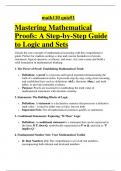
math110 quiz#1
Mastering Mathematical
Proofs: A Step-by-Step Guide
to Logic and Sets
Unlock the core concepts of mathematical reasoning with this comprehensive
guide. Perfect for students seeking a clear and concise breakdown of proofs,
statements, logical operators, set theory, and more. Ace your exams and build a
solid foundation in mathematical thinking
1. The Power of Proof: Establishing Mathematical Truth
Definition: A proof is a rigorous and logical argument demonstrating the
truth of a mathematical claim. It proceeds step-by-step, using clear reasoning
and established facts such as definitions (def.), theorems (thm.), and truth
tables, to provide irrefutable evidence.
Purpose: Proofs are essential for establishing the truth value of
mathematical statements with absolute certainty.
2. Statements: The Building Blocks of Logic
Definition: A statement is a declarative sentence that possesses a definitive
truth value – it must be either true or false, but not both.
Important Note: Not all mathematical sentences qualify as statements.
3. Conditional Statements: Exploring "If-Then" Logic
Definition: A conditional statement is a statement that can be expressed in
the form: If P, then Q; symbolically represented as P ⇒ Q; and read as "P
implies Q."
4. Fundamental Number Sets: Your Mathematical Toolkit
R: Real Numbers (ℝ): The comprehensive set of all real numbers,
encompassing both rational and irrational numbers.
, Q: Rational Numbers (ℚ): Numbers that can be expressed as a ratio of two
integers (a fraction), including terminating and repeating decimals (e.g., -2,
0, 3/4, 1.5).
N: Natural Numbers (ℕ): The set of positive counting numbers: {1, 2, 3,
...} (often considered synonymous with whole numbers in some contexts,
excluding zero).
Z: Integers (ℤ): The set of all whole numbers, including positive, negative,
and zero: {..., -3, -2, -1, 0, 1, 2, 3, ...}.
5. Logical Operators/Connectives: Combining Statements
Definition: A logical operator (or connective) is a word or combination of
words that joins one or more mathematical statements to create a new, more
complex mathematical statement (e.g., "and," "or," "not," "if...then," "if and
only if").
6. Compound Statements: Complex Logical Structures
Definition: A compound statement is a statement formed by combining
two or more simpler statements using one or more logical operators.
Example: P: "This room is 1111." Q: "It is raining." (P and Q) is a
compound statement.
7. Conjunction: The "And" Operator (∧)
Definition: The conjunction of two statements P and Q is "P and Q,"
denoted by P ∧ Q.
Truth Condition: P ∧ Q is true only when both P and Q are true.
8. Disjunction: The "Or" Operator (∨)
Definition: The disjunction of two statements P and Q is "P or Q," denoted
by P ∨ Q.
Truth Condition: P ∨ Q is false only when both P and Q are false. It is
true if at least one of P or Q is true.
9. Negation: The "Not" Operator (¬ or -)
Definition: The negation of a statement P is its opposite, denoted by ¬P or -
P.
Mastering Mathematical
Proofs: A Step-by-Step Guide
to Logic and Sets
Unlock the core concepts of mathematical reasoning with this comprehensive
guide. Perfect for students seeking a clear and concise breakdown of proofs,
statements, logical operators, set theory, and more. Ace your exams and build a
solid foundation in mathematical thinking
1. The Power of Proof: Establishing Mathematical Truth
Definition: A proof is a rigorous and logical argument demonstrating the
truth of a mathematical claim. It proceeds step-by-step, using clear reasoning
and established facts such as definitions (def.), theorems (thm.), and truth
tables, to provide irrefutable evidence.
Purpose: Proofs are essential for establishing the truth value of
mathematical statements with absolute certainty.
2. Statements: The Building Blocks of Logic
Definition: A statement is a declarative sentence that possesses a definitive
truth value – it must be either true or false, but not both.
Important Note: Not all mathematical sentences qualify as statements.
3. Conditional Statements: Exploring "If-Then" Logic
Definition: A conditional statement is a statement that can be expressed in
the form: If P, then Q; symbolically represented as P ⇒ Q; and read as "P
implies Q."
4. Fundamental Number Sets: Your Mathematical Toolkit
R: Real Numbers (ℝ): The comprehensive set of all real numbers,
encompassing both rational and irrational numbers.
, Q: Rational Numbers (ℚ): Numbers that can be expressed as a ratio of two
integers (a fraction), including terminating and repeating decimals (e.g., -2,
0, 3/4, 1.5).
N: Natural Numbers (ℕ): The set of positive counting numbers: {1, 2, 3,
...} (often considered synonymous with whole numbers in some contexts,
excluding zero).
Z: Integers (ℤ): The set of all whole numbers, including positive, negative,
and zero: {..., -3, -2, -1, 0, 1, 2, 3, ...}.
5. Logical Operators/Connectives: Combining Statements
Definition: A logical operator (or connective) is a word or combination of
words that joins one or more mathematical statements to create a new, more
complex mathematical statement (e.g., "and," "or," "not," "if...then," "if and
only if").
6. Compound Statements: Complex Logical Structures
Definition: A compound statement is a statement formed by combining
two or more simpler statements using one or more logical operators.
Example: P: "This room is 1111." Q: "It is raining." (P and Q) is a
compound statement.
7. Conjunction: The "And" Operator (∧)
Definition: The conjunction of two statements P and Q is "P and Q,"
denoted by P ∧ Q.
Truth Condition: P ∧ Q is true only when both P and Q are true.
8. Disjunction: The "Or" Operator (∨)
Definition: The disjunction of two statements P and Q is "P or Q," denoted
by P ∨ Q.
Truth Condition: P ∨ Q is false only when both P and Q are false. It is
true if at least one of P or Q is true.
9. Negation: The "Not" Operator (¬ or -)
Definition: The negation of a statement P is its opposite, denoted by ¬P or -
P.


