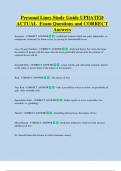
Personal Lines Study Guide UPDATED
ACTUAL Exam Questions and CORRECT
Answers
Insurance - CORRECT ANSWER - conditional contract which one party indemnifies, or
compensate (someone) for harm or loss, by paying for determinable losses.
Law of Large Numbers - CORRECT ANSWER - Statistical theory that states the larger
the number of people with the same risks the more predictable and accurate the estimate of
expected losses will be.
Insurable Risk - CORRECT ANSWER - actual, lawful, and substantial economic interest
in the safety or preservation of the subject of the insurance.
Risk - CORRECT ANSWER - The chance of loss.
Pure Risk - CORRECT ANSWER - Only a possibility of loss or no loss, no possibility of
gain. (only insurable risk)
Spectulative Risk - CORRECT ANSWER - Either a profit or a loss is possible. (not
insurable, ex. gambling)
Hazard - CORRECT ANSWER - Something that increases the chance of loss.
Moral Hazard - CORRECT ANSWER - Dishonest tendencies, behaviors that increase
likelihood of loss.
Ex. Insured burns down house to collect insurance money.
, Morale Hazard - CORRECT ANSWER - indifference to possible loss, attitude that
increase possibility of loss.
Ex. Running a red light or not locking your door when you leave home.
Physical Hazard - CORRECT ANSWER - Physical condition that increases probability of
loss.
Ex. Flammable material stored near the furnace.
Peril - CORRECT ANSWER - The cause of the loss.
*Listed in the INSURING AGREEMENT
Loss - CORRECT ANSWER - Disappearance of value.
Direct Loss - CORRECT ANSWER - Loss that is a direct result of a peril (cause of loss).
Indirect Loss - CORRECT ANSWER - Loss that is a result of an direct loss.
Ex. Additional living expenses when home is destroyed or loss of income due to injury.
Loss Valuation - CORRECT ANSWER - How pay out for a loss claim is determined.
Actual Cash Value - CORRECT ANSWER - The cost to replace an item or original cost at
the time of the loss MINUS depreciation for the condition or age of the item.
*Often used for valuation of PERSONAL PROPERTY AND CONTENTS.
ACTUAL Exam Questions and CORRECT
Answers
Insurance - CORRECT ANSWER - conditional contract which one party indemnifies, or
compensate (someone) for harm or loss, by paying for determinable losses.
Law of Large Numbers - CORRECT ANSWER - Statistical theory that states the larger
the number of people with the same risks the more predictable and accurate the estimate of
expected losses will be.
Insurable Risk - CORRECT ANSWER - actual, lawful, and substantial economic interest
in the safety or preservation of the subject of the insurance.
Risk - CORRECT ANSWER - The chance of loss.
Pure Risk - CORRECT ANSWER - Only a possibility of loss or no loss, no possibility of
gain. (only insurable risk)
Spectulative Risk - CORRECT ANSWER - Either a profit or a loss is possible. (not
insurable, ex. gambling)
Hazard - CORRECT ANSWER - Something that increases the chance of loss.
Moral Hazard - CORRECT ANSWER - Dishonest tendencies, behaviors that increase
likelihood of loss.
Ex. Insured burns down house to collect insurance money.
, Morale Hazard - CORRECT ANSWER - indifference to possible loss, attitude that
increase possibility of loss.
Ex. Running a red light or not locking your door when you leave home.
Physical Hazard - CORRECT ANSWER - Physical condition that increases probability of
loss.
Ex. Flammable material stored near the furnace.
Peril - CORRECT ANSWER - The cause of the loss.
*Listed in the INSURING AGREEMENT
Loss - CORRECT ANSWER - Disappearance of value.
Direct Loss - CORRECT ANSWER - Loss that is a direct result of a peril (cause of loss).
Indirect Loss - CORRECT ANSWER - Loss that is a result of an direct loss.
Ex. Additional living expenses when home is destroyed or loss of income due to injury.
Loss Valuation - CORRECT ANSWER - How pay out for a loss claim is determined.
Actual Cash Value - CORRECT ANSWER - The cost to replace an item or original cost at
the time of the loss MINUS depreciation for the condition or age of the item.
*Often used for valuation of PERSONAL PROPERTY AND CONTENTS.