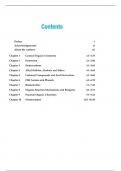
Contents
Preface v
Acknowledgements vi
About the Authors vii
PR
Chapter 1 General Organic Chemistry 1.1–1.78
Chapter 2 Isomerism 2.1–2.80
Chapter 3 Hydrocarbons 3.1–3.60
O
Chapter 4 Alkyl Halides, Alcohols and Ethers 4.1–4.68
FD
Chapter 5 Carbonyl Compounds and Acid Derivatives 5.1–5.68
Chapter 6 ESR Amines and Phenols 6.1–6.70
Chapter 7 Biomolecules 7.1–7.36
Chapter 8 Organic Reaction Mechanisms and Reagents 8.1–8.76
O
Chapter 9 Practical Organic Chemistry 9.1–9.12
C
Chapter 10 Nomenclature 10.1–10.20
, About the Authors
Akshay Choudhary, a renowned faculty of organic chemistry, teaches IIT-JEE
aspirants, assisting them to achieve their goal. Many students have been success-
ful under his guidance and achieved top ranks in the IIT–JEE exam. The author is
a postgraduate in chemistry as well as Junior Research Fellow from NCL, Pune.
His has keen interest in the subject and strives to present it to students in a lucid
PR
style to help them ace the exams effortlessly.
Mandakini Choudhary, specializes in reaction mechanisms and intermediates. She is a dedi-
cated teacher with four years’ experience and is popular among students for her zeal to help
them with their board examinations.
O
FD
O
C
, General Organic
CHAPTER
1 Chemistry
PR
Question Bank
O
FD
LEVEL 1
Arrange the items in Questions 1–38 in DECREASING ORDER (i.e., greatest, most etc.
first) with respect to the indicated property.
Use the following code to indicate your answers.
O
1. The acidity of the protons H in each of the following is
O O
C
(i) (ii) H C
C 3 C
H3C H O CH3
O O
(iii) H C CH3
3 C C
O
O CH2
(a) i > ii > iii (b) ii > iii > i (c) i > iii > ii (d) iii > i > ii
2. Rate of reaction of HNO3/H2SO4 with each of the following is
(i) OCH3 (ii) CN (iii) CH3
(a) i > ii > iii (b) ii > iii > i (c) i > iii > ii (d) iii > i > ii
, 1.2 chapter one
3. Reactivity towards hydrolysis using aqueous acid of the following is
CH3
H3C CH3 H3C Cl
(i) C (ii) H3C N (iii) C
C CH3
O O
O
(a) i > ii > iii (b) iii > ii > i (c) i > iii > ii (d) iii > i > ii
4. Reactivity of the following towards reaction with LiAlH4 is
O O
H3C Cl
(i) (ii) C (iii) OCH3
O
(a) ii > i > iii (b) ii > iii > i (c) i > iii > ii (d) iii > i> ii
PR
5. The relative yield of the following alkenyl bromides from the reaction of 1,3-butadiene
with HBr (dark, N2 atmosphere) at –15ºC is
(i) (ii) (iii)
Br
Br Br
(a) i > ii > iii (b) ii > iii > i (c) i > iii > ii (d) iii > i > ii
O
6. The amount of conjugate addition obtained in the reaction of the following with 3-butenone
is
FD
(i) CH3Li (ii) CH3MgBr (iii) CH3O2C– CH–CO2CH3
(a) i > ii > iii (b) ii > iii > i (c) i > iii > ii (d) iii > i > ii
7. The relative reactivity towards Br2 in CHCl3 of the following is
(i) CH2=CH–CO2CH3 (ii) CH2=CH–CH3 (iii) CH2=CH–O–CH3
(a) i > ii > iii (b) iii > ii > i (c) i > iii > ii (d) iii > i > ii
O
8. The % of the para product produced in the reaction of Br2/FeBr3 with each of the following
is
C
CH3 NO2 C(CH3)3
(i) (ii) (iii)
(a) i > ii > iii (b) ii > iii > i (c) i > iii > ii (d) iii > i > ii
9. The number of enolizable protons in each of the following is
O
O
O
(i) (ii) O (iii)
H C CH3
(a) i > ii > iii (b) ii > iii > i (c) i > iii > ii (d) iii > i > ii
Preface v
Acknowledgements vi
About the Authors vii
PR
Chapter 1 General Organic Chemistry 1.1–1.78
Chapter 2 Isomerism 2.1–2.80
Chapter 3 Hydrocarbons 3.1–3.60
O
Chapter 4 Alkyl Halides, Alcohols and Ethers 4.1–4.68
FD
Chapter 5 Carbonyl Compounds and Acid Derivatives 5.1–5.68
Chapter 6 ESR Amines and Phenols 6.1–6.70
Chapter 7 Biomolecules 7.1–7.36
Chapter 8 Organic Reaction Mechanisms and Reagents 8.1–8.76
O
Chapter 9 Practical Organic Chemistry 9.1–9.12
C
Chapter 10 Nomenclature 10.1–10.20
, About the Authors
Akshay Choudhary, a renowned faculty of organic chemistry, teaches IIT-JEE
aspirants, assisting them to achieve their goal. Many students have been success-
ful under his guidance and achieved top ranks in the IIT–JEE exam. The author is
a postgraduate in chemistry as well as Junior Research Fellow from NCL, Pune.
His has keen interest in the subject and strives to present it to students in a lucid
PR
style to help them ace the exams effortlessly.
Mandakini Choudhary, specializes in reaction mechanisms and intermediates. She is a dedi-
cated teacher with four years’ experience and is popular among students for her zeal to help
them with their board examinations.
O
FD
O
C
, General Organic
CHAPTER
1 Chemistry
PR
Question Bank
O
FD
LEVEL 1
Arrange the items in Questions 1–38 in DECREASING ORDER (i.e., greatest, most etc.
first) with respect to the indicated property.
Use the following code to indicate your answers.
O
1. The acidity of the protons H in each of the following is
O O
C
(i) (ii) H C
C 3 C
H3C H O CH3
O O
(iii) H C CH3
3 C C
O
O CH2
(a) i > ii > iii (b) ii > iii > i (c) i > iii > ii (d) iii > i > ii
2. Rate of reaction of HNO3/H2SO4 with each of the following is
(i) OCH3 (ii) CN (iii) CH3
(a) i > ii > iii (b) ii > iii > i (c) i > iii > ii (d) iii > i > ii
, 1.2 chapter one
3. Reactivity towards hydrolysis using aqueous acid of the following is
CH3
H3C CH3 H3C Cl
(i) C (ii) H3C N (iii) C
C CH3
O O
O
(a) i > ii > iii (b) iii > ii > i (c) i > iii > ii (d) iii > i > ii
4. Reactivity of the following towards reaction with LiAlH4 is
O O
H3C Cl
(i) (ii) C (iii) OCH3
O
(a) ii > i > iii (b) ii > iii > i (c) i > iii > ii (d) iii > i> ii
PR
5. The relative yield of the following alkenyl bromides from the reaction of 1,3-butadiene
with HBr (dark, N2 atmosphere) at –15ºC is
(i) (ii) (iii)
Br
Br Br
(a) i > ii > iii (b) ii > iii > i (c) i > iii > ii (d) iii > i > ii
O
6. The amount of conjugate addition obtained in the reaction of the following with 3-butenone
is
FD
(i) CH3Li (ii) CH3MgBr (iii) CH3O2C– CH–CO2CH3
(a) i > ii > iii (b) ii > iii > i (c) i > iii > ii (d) iii > i > ii
7. The relative reactivity towards Br2 in CHCl3 of the following is
(i) CH2=CH–CO2CH3 (ii) CH2=CH–CH3 (iii) CH2=CH–O–CH3
(a) i > ii > iii (b) iii > ii > i (c) i > iii > ii (d) iii > i > ii
O
8. The % of the para product produced in the reaction of Br2/FeBr3 with each of the following
is
C
CH3 NO2 C(CH3)3
(i) (ii) (iii)
(a) i > ii > iii (b) ii > iii > i (c) i > iii > ii (d) iii > i > ii
9. The number of enolizable protons in each of the following is
O
O
O
(i) (ii) O (iii)
H C CH3
(a) i > ii > iii (b) ii > iii > i (c) i > iii > ii (d) iii > i > ii