WGU statistics
Study online at https://quizlet.com/_1hu155
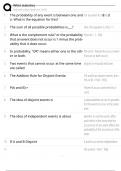
1. The probability of any event is between one and For any event A, 0 dP(A) d1.
o. What is the equation for this?
2. The sum of all possible probabilities is___? One, the equation is :P(S) = 1
3. What is the complement rule? or the probability P(not A) = 1 - P(A)
that an event does not occur is 1 minus the prob-
ability that it does occur.
4. In probability, "OR" means either one or the oth- P(A or B) = P(event A occurs or event
er or both. B occurs or both occur)
5. Two events that cannot occur at the same time disjoint or mutually exclusive
are called
6. The Addition Rule for Disjoint Events: If A and B are disjoint events, then
P(A or B) = P(A) + P(B).
7. P(A and B) = P(event A occurs and event B oc-
curs)
8. The idea of disjoint events is is about whether or not it is possible
for the events to occur at the same
time
9. The idea of independent events is about whether or not the events affect
each other in the sense that the
occurrence of one event affects the
probability of the occurrence of the
other
10. If A and B Disjoint A and B can not be indepentdent
11. P(A and B) = P(A) * P(B).
, WGU statistics
Study online at https://quizlet.com/_1hu155
If A and B are two independent events (Multipli-
cation Rule)
12. if A, B and C are three independent events, P(A and B and C) = P(A) * P(B) * P(C)
13. The Complement Rule, P(A) = 1 - P(not A),
14. P(L) = 1 - P(not L) = 1 - P(not O1 and not O2 and Applying the Multiplication
not O3 and not O4 and not O5 and not O6 and rule:Now, using the multiplication
not O7 and not O8 and not O9 and not O10). rule, = 1 - (.56 * .56 * .56 * .56 * .56
* .56 * .56 * .56 * .56 * .56) = 1 -
.003 = .997.
15. P(at least one person chosen has blood type O) P((O and O) or (O and not O) or (not
O and O)) = (.44 * .44) + (.44 * .56)
+ (.56 * .44) = .6864.
16. If A and B are disjoint events - P(A and B)= 0
17. The General Addition Rule states that for any two P(A or B) = P(A) + P(B) - P(A and B)
events,
18. When each of two outcomes has two possible there are four possible combina-
values (yes/no), tions altogether, which correspond
to the four possible outcomes.
19. How do we build a two-way table of probabili- Horizontally, A, not A and total, Ver-
ties? tically, B. not B and total
20. In a two-way table of probabilities, what is the 1
total of all outcomes (lower right corner?)
21. Two events A and B are independent if any one P(B | A) = P(B)
of the following hold:
Study online at https://quizlet.com/_1hu155
1. The probability of any event is between one and For any event A, 0 dP(A) d1.
o. What is the equation for this?
2. The sum of all possible probabilities is___? One, the equation is :P(S) = 1
3. What is the complement rule? or the probability P(not A) = 1 - P(A)
that an event does not occur is 1 minus the prob-
ability that it does occur.
4. In probability, "OR" means either one or the oth- P(A or B) = P(event A occurs or event
er or both. B occurs or both occur)
5. Two events that cannot occur at the same time disjoint or mutually exclusive
are called
6. The Addition Rule for Disjoint Events: If A and B are disjoint events, then
P(A or B) = P(A) + P(B).
7. P(A and B) = P(event A occurs and event B oc-
curs)
8. The idea of disjoint events is is about whether or not it is possible
for the events to occur at the same
time
9. The idea of independent events is about whether or not the events affect
each other in the sense that the
occurrence of one event affects the
probability of the occurrence of the
other
10. If A and B Disjoint A and B can not be indepentdent
11. P(A and B) = P(A) * P(B).
, WGU statistics
Study online at https://quizlet.com/_1hu155
If A and B are two independent events (Multipli-
cation Rule)
12. if A, B and C are three independent events, P(A and B and C) = P(A) * P(B) * P(C)
13. The Complement Rule, P(A) = 1 - P(not A),
14. P(L) = 1 - P(not L) = 1 - P(not O1 and not O2 and Applying the Multiplication
not O3 and not O4 and not O5 and not O6 and rule:Now, using the multiplication
not O7 and not O8 and not O9 and not O10). rule, = 1 - (.56 * .56 * .56 * .56 * .56
* .56 * .56 * .56 * .56 * .56) = 1 -
.003 = .997.
15. P(at least one person chosen has blood type O) P((O and O) or (O and not O) or (not
O and O)) = (.44 * .44) + (.44 * .56)
+ (.56 * .44) = .6864.
16. If A and B are disjoint events - P(A and B)= 0
17. The General Addition Rule states that for any two P(A or B) = P(A) + P(B) - P(A and B)
events,
18. When each of two outcomes has two possible there are four possible combina-
values (yes/no), tions altogether, which correspond
to the four possible outcomes.
19. How do we build a two-way table of probabili- Horizontally, A, not A and total, Ver-
ties? tically, B. not B and total
20. In a two-way table of probabilities, what is the 1
total of all outcomes (lower right corner?)
21. Two events A and B are independent if any one P(B | A) = P(B)
of the following hold: