

Written by students who passed Immediately available after payment Read online or as PDF Wrong document? Swap it for free 4.6 TrustPilot
logo-home
Document preview thumbnail
Preview 2 out of 7 pages
Exam (elaborations)

Geotechnical Engineering Exam 1Questions With All Complete Answers And Verified Solutions.

Document preview thumbnail
Preview 2 out of 7 pages

Water content, w - correct answer Ww/Ws (0 to 200%) Degree of Saturation, S - correct answer Vw/Vv (0 to 100%) Unit Weight, gamma - correct answer W/V (62.4 pcf or 9.81 kN/m3 for water) Mass Density, rho - correct answer M/V = gamma/gravity (1000 kg/m3 for water) Total (wet) Unit Weight - correct answer Wt/Vt = (Ws + Ww)/(Vs + Vv) = (1+w)*(dry unit weight) =Gs(1+w)(unit weight of water)/(1+e) Dry Unit Weight, gamma d - correct answer Ws/V (60 to 125 pcf) Saturated Unit Weight, gamma sat - correct answer (Ws + Ww)/V , Vair = 0 (90 to 140 pcf) ((Gs + e)/(1+e)) *(Unit Weight of water) Specific Gravity of Solids, Gs - correct answer Ws/Vs * 1/unit weight of water (2.6 to 2.8) Void Ratio, e - correct answer Vv/Vs (0.2 to 5.0) n/(1-n) = (Gs*(unit weight water) / Unit Weight dry) -1 Porosity, n - correct answer Vv/V (0.2 to 0.9) e/(1+e) Gs*w = - correct answer S*e Fines - correct answer Smaller than the #4 sieve Coarse - correct answer Everything retained on the #4 sieve % finer than d2 = - correct answer 100 * (wpan + w4 + w3)/Wt Best shape of soils for good strength? - correct answer Angular!! Roughest, sharpest, best shear strength Terminal Velocity, vs - correct answer Effective depth / elapsed time Gradation curve - correct answer Grain size (x axis), percent passing or percent finer (y) Well-graded soil - correct answer Linear gradation curve, slight s shape, good amount of every size of soil. Most ideal soil Uniform/poorly graded soil - correct answer Majority if the soil is in a narrow range of size. Creates a vertical part of the curve Gap-graded soil - correct answer Sample is missing a range of soil size, creates a horizontal part of the curve. Can have lots of fines and lots of gravel, but not a lot of medium size. Easy for the fines to get swept away Plasticity - correct answer Ability of soil to undergo unrecoverable deformations at a constant volume without cracking or crumbling Liquid Limit, LL - correct answer Limit in between plastic and liquid. Liquid is too soft. Water content at 25 blows Plastic limit, PL - correct answer Limit in between semi-solid and plastic. Plastic is good. Water content where the soil crumbles Shrinkage limit - correct answer Limit in between solid and semi-solid. Solid is chalky and too dry Atterberg limits - correct answer Do not change with the water content Plasticity Index, PI - correct answer PI = LL - PL Liquidity Index, LI - correct answer LI = (w - PL)/(LL - PL) Activity - correct answer Activity = PI/(percent finer than 0.002 mm), basically clay size G - correct answer Gravel S - correct answer Sand W - correct answer Well graded P - correct answer Poorly Graded C - correct answer Clayey M - correct answer Silty O - correct answer Organic H - correct answer High Plasticity L - correct answer Low Plasticity Coefficient of Uniformity, Cu - correct answer Cu = D60/D10 Coefficient of Curvature, Cc - correct answer Cc = (D30^2)/D60*D10 Hand Augers - correct answer Low cost, portable, can only go so deep Test Pits - correct answer Need space, very expensive, easy to do and not much time required Standard Penetration Test, SPT - correct answer Slow, lots of equipment, relatively expensive, collects real samples, produces lots of information, not repeatable Cone Penetration Test, CPT - correct answer Fast, less equipment, repeatable data, needs interpretation, does not produce real samples, not good in gravel Vane Shear Test - correct answer Used only for soft clays, measures shear strength Dilatometer - correct answer Has to be measured in the field, measure of pressure/force it takes to dilate the knife thing Bernoulli' Theorem - correct answer Total head, h = elevation head + pressure head + velocity head (velocity head is negligible Total head = - correct answer Z + U/(unit weight of water) Open standpipe piezometer - correct answer High compliance, good for sands Pressure transducer peizometer - correct answer Low compliance, good for clays Q - correct answer Flow rate m3/s Discharge velocity, V - correct answer Flow rate / area of cross section = Q/A Hydraulic Gradient, i - correct answer Change in head / distance between points = (delta h)/L V = - correct answer -ki (Darcy's law) Seepage velocity, Vs - correct answer Discharge velocity / porosity = V/n K - correct answer Hydraulic conductivity Constant Head HC Test - correct answer K =Q*(delta L) / A*(delta h) Falling Head HC Test - correct answer K = al*(ln(ho/h1)) / At Teton Dam - correct answer Failure caused by: Dam backfill was too dry Fractured bedrock abutments Piping erosion by seeping water Total Vertical Stress, sigma v - correct answer Sigma v = effective stress + pore water pressure = sigma'v + U Pore water pressure, U - correct answer U = Hp * unit weight of water Buoyant Unit Weight, Gamma b - correct answer Gamma b = gamma sat - gamma water Effective vertical stress, sigma'v - correct answer Sigma'v = sigma v - U If pore water pressure exceeds vertical stress, sigma v ( sigma'v 0) - correct answer FAILURE: liquefaction, quick sand, soil particles not in contact with each other Critical hydraulic gradient, i crit - correct answer I crit = buoyant unit weight / unit weight of water I i crit - correct answer Failure!! (Quick condition) Capillarity, hc - correct answer Hc = 4*Ts*cos(alpha) / d*(Unit Weight of water) Ts - correct answer Surface Tension Soil Compaction - correct answer Densification by removal of air, which occurs instantaneously!! Soil Consolidation - correct answer Removal of water (saturated conditions), time dependent (not instantaneous) fast for sand, slow for clay Purposes of soil compaction - correct answer Increased shear strength Improved quality control Increased stiffness Improved erosion resistance Decreased hydraulic conductivity Decreased liquefaction potential Lower void ratio - correct answer Denser soil Dry unit weight calculation - correct answer Gamma d = gamma t / (1 + w)

Content preview

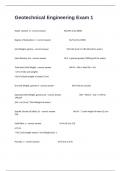
Geotechnical Engineering Exam 1

Water content, w - correct answer Ww/Ws (0 to 200%)


Degree of Saturation, S - correct answer Vw/Vv (0 to 100%)


Unit Weight, gamma - correct answer W/V (62.4 pcf or 9.81 kN/m3 for water)


Mass Density, rho - correct answer M/V = gamma/gravity (1000 kg/m3 for water)


Total (wet) Unit Weight - correct answer Wt/Vt = (Ws + Ww)/(Vs + Vv)

= (1+w)*(dry unit weight)

=Gs(1+w)(unit weight of water)/(1+e)


Dry Unit Weight, gamma d - correct answer Ws/V (60 to 125 pcf)


Saturated Unit Weight, gamma sat - correct answer (Ws + Ww)/V , Vair = 0 (90 to
140 pcf)

((Gs + e)/(1+e)) *(Unit Weight of water)


Specific Gravity of Solids, Gs - correct answer Ws/Vs * 1/unit weight of water (2.6 to
2.8)


Void Ratio, e - correct answer Vv/Vs (0.2 to 5.0)

n/(1-n)

= (Gs*(unit weight water) / Unit Weight dry) -1


Porosity, n - correct answer Vv/V (0.2 to 0.9)

, e/(1+e)


Gs*w = - correct answer S*e


Fines - correct answer Smaller than the #4 sieve


Coarse - correct answer Everything retained on the #4 sieve


% finer than d2 = - correct answer 100 * (wpan + w4 + w3)/Wt


Best shape of soils for good strength? - correct answer Angular!! Roughest, sharpest,
best shear strength


Terminal Velocity, vs - correct answer Effective depth / elapsed time


Gradation curve - correct answer Grain size (x axis), percent passing or percent finer
(y)


Well-graded soil - correct answer Linear gradation curve, slight s shape, good amount
of every size of soil. Most ideal soil


Uniform/poorly graded soil - correct answer Majority if the soil is in a narrow range
of size. Creates a vertical part of the curve


Gap-graded soil - correct answer Sample is missing a range of soil size, creates a
horizontal part of the curve. Can have lots of fines and lots of gravel, but not a lot of medium size. Easy
for the fines to get swept away


Plasticity - correct answer Ability of soil to undergo unrecoverable deformations at a
constant volume without cracking or crumbling


Document information

Uploaded on
April 26, 2025
Number of pages
7
Written in
2024/2025
Type
Exam (elaborations)
Contains
Questions & answers
$15.49

Wrong document? Swap it for free Within 14 days of purchase and before downloading, you can choose a different document. You can simply spend the amount again.
Written by students who passed
Immediately available after payment
Read online or as PDF

Seller avatar
Reputation scores are based on the amount of documents a seller has sold for a fee and the reviews they have received for those documents. There are three levels: Bronze, Silver and Gold. The better the reputation, the more your can rely on the quality of the sellers work.
RealGrades
4.0
(26)
Sold
197
Followers
52
Items
12331
Last sold
1 week ago


Why students choose Stuvia

Created by fellow students, verified by reviews

Quality you can trust: written by students who passed their tests and reviewed by others who've used these notes.

Didn't get what you expected? Choose another document

No worries! You can instantly pick a different document that better fits what you're looking for.

Pay as you like, start learning right away

No subscription, no commitments. Pay the way you're used to via credit card and download your PDF document instantly.

Student with book image

“Bought, downloaded, and aced it. It really can be that simple.”

Alisha Student

Working on your references?

Create accurate citations in APA, MLA and Harvard with our free citation generator.

Working on your references?

Frequently asked questions
