

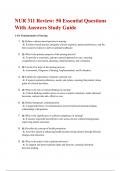
NUR 311 Review: 50 Essential Questions
With Answers Study Guide
1–10: Fundamentals of Nursing
1. Q: Define evidence-based practice in nursing.
A: Evidence-based practice integrates clinical expertise, patient preferences, and the
best research evidence to deliver optimal healthcare.
2. Q: What is the primary purpose of the nursing process?
A: To provide a systematic, patient-centered approach to care, ensuring
comprehensive assessment, planning, implementation, and evaluation.
3. Q: List the five steps of the nursing process.
A: Assessment, Diagnosis, Planning, Implementation, and Evaluation.
4. Q: Explain the importance of patient-centered care.
A: It respects patient preferences, needs, and values, ensuring that patient values
guide all clinical decisions.
5. Q: What is the role of critical thinking in nursing?
A: Critical thinking enables nurses to assess complex situations, make informed
decisions, and provide safe, effective care.
6. Q: Define therapeutic communication.
A: A purposeful form of communication used to build and maintain helping
relationships with patients.
7. Q: What is the significance of cultural competence in nursing?
A: It ensures respectful and effective care across diverse cultural backgrounds,
improving patient outcomes.
8. Q: Describe the concept of health promotion.
A: Activities aimed at enhancing health and preventing disease through lifestyle
changes and education.
9. Q: What is the nurse's role in patient advocacy?
A: To support and protect patient rights and interests, ensuring informed
decision-making.
, 10.Q: Explain the importance of documentation in nursing.
A: Accurate documentation ensures continuity of care, legal protection, and effective
communication among healthcare providers.
11–20: Medical-Surgical Nursing
11.Q: What are common signs of infection?
A: Fever, redness, swelling, pain, and loss of function at the affected site.
12.Q: Describe the pathophysiology of hypertension.
A: Elevated arterial pressure due to increased cardiac output or systemic vascular
resistance.
13.Q: What is the primary nursing intervention for a patient with dyspnea?
A: Positioning the patient to facilitate breathing, such as sitting upright, and
administering oxygen as prescribed.
14.Q: List risk factors for coronary artery disease.
A: Smoking, hypertension, high cholesterol, diabetes, sedentary lifestyle, and family
history.
15.Q: What is the significance of monitoring intake and output?
A: It helps assess fluid balance, kidney function, and detect potential imbalances.
16.Q: Define the term "edema."
A: Swelling caused by excess fluid trapped in the body's tissues.
17.Q: What are the stages of pressure ulcers?
A: Stage I: Non-blanchable redness; Stage II: Partial-thickness skin loss; Stage III:
Full-thickness tissue loss; Stage IV: Full-thickness tissue loss with exposed bone or
muscle.
18.Q: Explain the purpose of incentive spirometry.
A: To encourage deep breathing, prevent atelectasis, and improve lung function
postoperatively.
19.Q: What is the nurse's role in pain management?
A: Assessing pain, administering analgesics as prescribed, and evaluating
effectiveness.
With Answers Study Guide
1–10: Fundamentals of Nursing
1. Q: Define evidence-based practice in nursing.
A: Evidence-based practice integrates clinical expertise, patient preferences, and the
best research evidence to deliver optimal healthcare.
2. Q: What is the primary purpose of the nursing process?
A: To provide a systematic, patient-centered approach to care, ensuring
comprehensive assessment, planning, implementation, and evaluation.
3. Q: List the five steps of the nursing process.
A: Assessment, Diagnosis, Planning, Implementation, and Evaluation.
4. Q: Explain the importance of patient-centered care.
A: It respects patient preferences, needs, and values, ensuring that patient values
guide all clinical decisions.
5. Q: What is the role of critical thinking in nursing?
A: Critical thinking enables nurses to assess complex situations, make informed
decisions, and provide safe, effective care.
6. Q: Define therapeutic communication.
A: A purposeful form of communication used to build and maintain helping
relationships with patients.
7. Q: What is the significance of cultural competence in nursing?
A: It ensures respectful and effective care across diverse cultural backgrounds,
improving patient outcomes.
8. Q: Describe the concept of health promotion.
A: Activities aimed at enhancing health and preventing disease through lifestyle
changes and education.
9. Q: What is the nurse's role in patient advocacy?
A: To support and protect patient rights and interests, ensuring informed
decision-making.
, 10.Q: Explain the importance of documentation in nursing.
A: Accurate documentation ensures continuity of care, legal protection, and effective
communication among healthcare providers.
11–20: Medical-Surgical Nursing
11.Q: What are common signs of infection?
A: Fever, redness, swelling, pain, and loss of function at the affected site.
12.Q: Describe the pathophysiology of hypertension.
A: Elevated arterial pressure due to increased cardiac output or systemic vascular
resistance.
13.Q: What is the primary nursing intervention for a patient with dyspnea?
A: Positioning the patient to facilitate breathing, such as sitting upright, and
administering oxygen as prescribed.
14.Q: List risk factors for coronary artery disease.
A: Smoking, hypertension, high cholesterol, diabetes, sedentary lifestyle, and family
history.
15.Q: What is the significance of monitoring intake and output?
A: It helps assess fluid balance, kidney function, and detect potential imbalances.
16.Q: Define the term "edema."
A: Swelling caused by excess fluid trapped in the body's tissues.
17.Q: What are the stages of pressure ulcers?
A: Stage I: Non-blanchable redness; Stage II: Partial-thickness skin loss; Stage III:
Full-thickness tissue loss; Stage IV: Full-thickness tissue loss with exposed bone or
muscle.
18.Q: Explain the purpose of incentive spirometry.
A: To encourage deep breathing, prevent atelectasis, and improve lung function
postoperatively.
19.Q: What is the nurse's role in pain management?
A: Assessing pain, administering analgesics as prescribed, and evaluating
effectiveness.


