
AP CHEMISTRY TAYLOR UNIT 9
PROGRESS CHECK FRQ SCORING GUIDE.
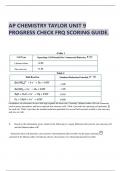
-Table 1
Cell Type Operating Cell Potential for Commercial Batteries,
Lithium-iodine
Zinc-mercury
Table 2
Half-Reaction Standard Reduction Potential,
Pacemakers are electronic devices that help regulate the heart rate. Currently, lithium-iodine cells are commonly
used to power pacemakers and have replaced zinc-mercury cells. Table 1 provides the operating cell potential, ,
for each cell. Table 2 provides the standard reduction potentials for several half-reactions related to zinc-mercury
and zinc-air cells.
1. Based on the information given, which of the following is a major difference between the zinc-mercury cell
and the lithium-iodine cell?
A
During the initial cell operation, each reaction is thermodynamically favorable, but the larger operating
potential of the lithium-iodine cell indicates that its cell reaction is less thermodynamically favorable.
, B During the initial cell operation, each reaction is thermodynamically favorable, but the larger operating
potential of the lithium-iodine cell indicates that its cell reaction is more thermodynamically favorable.
During the initial cell operation, the oxidation of iodine is thermodynamically favorable but the oxidation of
C
mercury is not.
During the initial cell operation, the oxidation of mercury is thermodynamically favorable but not the
D
oxidation of iodine is not.
2. On average, after one year of operation, the potential of a lithium-iodine cell decreases by 1%-2%. Which of
the following best helps to explain the cause for the decrease in cell potential?
3. The use of zinc-mercury cells in hearing aids has been replaced by zinc-air cells that operate using the
oxidation of by from the air, generating a potential of . Table 2 provides the standard reduction
potentials for the half-reactions used in zinc-mercury and zinc-air cells. Which of the following best explains
the modification to the cell design that is mostly responsible for the difference in standard cell potentials for
zinc-mercury and zinc-air cells?
A The greater standard cell potential of the cell compared to that of the zinc-mercury cell most likely
results from the thermodynamically more favorable reduction of compared to .
The greater standard cell potential of the cell compared to that of the zinc-mercury cell most
B
likely results from the greater number of moles of required to reduce compared to .
C
The greater standard cell potential of the cell compared to that of the zinc-mercury cell most
likely results from the thermodynamically less favorable reduction of compared to.
The greater standard cell potential of the cell compared to that of the zinc-mercury cell most likely
D results from the greater number of moles of hydroxide ions required to reduce compared to
.
, 4.
The diagrams above represent physical changes for potassium. Which of the following correctly identifies
the physical process and provides the correct for the process in the indicated diagram?
B
C
D
A
In diagram 1, the process is freezing and
is negative.
In diagram 2, the process is melting and is negative.
In diagram 3, the process is boiling and is negative.
In diagram 4, the process is condensation and is positive.
PROGRESS CHECK FRQ SCORING GUIDE.
-Table 1
Cell Type Operating Cell Potential for Commercial Batteries,
Lithium-iodine
Zinc-mercury
Table 2
Half-Reaction Standard Reduction Potential,
Pacemakers are electronic devices that help regulate the heart rate. Currently, lithium-iodine cells are commonly
used to power pacemakers and have replaced zinc-mercury cells. Table 1 provides the operating cell potential, ,
for each cell. Table 2 provides the standard reduction potentials for several half-reactions related to zinc-mercury
and zinc-air cells.
1. Based on the information given, which of the following is a major difference between the zinc-mercury cell
and the lithium-iodine cell?
A
During the initial cell operation, each reaction is thermodynamically favorable, but the larger operating
potential of the lithium-iodine cell indicates that its cell reaction is less thermodynamically favorable.
, B During the initial cell operation, each reaction is thermodynamically favorable, but the larger operating
potential of the lithium-iodine cell indicates that its cell reaction is more thermodynamically favorable.
During the initial cell operation, the oxidation of iodine is thermodynamically favorable but the oxidation of
C
mercury is not.
During the initial cell operation, the oxidation of mercury is thermodynamically favorable but not the
D
oxidation of iodine is not.
2. On average, after one year of operation, the potential of a lithium-iodine cell decreases by 1%-2%. Which of
the following best helps to explain the cause for the decrease in cell potential?
3. The use of zinc-mercury cells in hearing aids has been replaced by zinc-air cells that operate using the
oxidation of by from the air, generating a potential of . Table 2 provides the standard reduction
potentials for the half-reactions used in zinc-mercury and zinc-air cells. Which of the following best explains
the modification to the cell design that is mostly responsible for the difference in standard cell potentials for
zinc-mercury and zinc-air cells?
A The greater standard cell potential of the cell compared to that of the zinc-mercury cell most likely
results from the thermodynamically more favorable reduction of compared to .
The greater standard cell potential of the cell compared to that of the zinc-mercury cell most
B
likely results from the greater number of moles of required to reduce compared to .
C
The greater standard cell potential of the cell compared to that of the zinc-mercury cell most
likely results from the thermodynamically less favorable reduction of compared to.
The greater standard cell potential of the cell compared to that of the zinc-mercury cell most likely
D results from the greater number of moles of hydroxide ions required to reduce compared to
.
, 4.
The diagrams above represent physical changes for potassium. Which of the following correctly identifies
the physical process and provides the correct for the process in the indicated diagram?
B
C
D
A
In diagram 1, the process is freezing and
is negative.
In diagram 2, the process is melting and is negative.
In diagram 3, the process is boiling and is negative.
In diagram 4, the process is condensation and is positive.


