
• Wrong document? Swap it for free
  • Written by students who passed
  • Immediately available after payment
  • Read online or as PDF
Sell
Where do you study
Your language
Document preview thumbnail
Preview 2 out of 7 pages
Exam (elaborations)

Iowa Life and Health Insurance Test Certification Review Exam Questions And Answers Success Guaranteed.

Document preview thumbnail
Preview 2 out of 7 pages

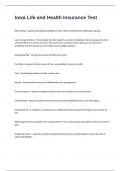
Risk Pooling - A group sharing the possibility of a loss. Risk transferred from individual to group. Law of Large Numbers - The principle that the larger the number of individual risks in a group, the more certainty there is as to the amount of loss incurred in any period. This is based on the science of probability and the experience of mortality and morbidity statistics. Speculative Risk - Involves the chance of both loss or gain. Pure Risk - Involves only the chance of loss, no possibility of a gain or profit. Peril - Immediate specific event that causes a loss. Hazard - Anything that increases the likelihood of loss through peril. Physical Hazard - a physical condition that increases the frequency or severity of loss Moral Hazard - When the actions of the insured increase the likelihood that a loss will happen Morale Hazard - A condition of carelessness or indifference that increases the frequency or severity of loss. Which type of risk is insurable? Pure or speculative? - Pure only because speculative involves a chance of gain. Reciprocal Insurer - Insurance company characterized by the fact its policyholders insure the risks of other policyholders. Reinsurer - an arrangement by which an insurance company transfers or sells a portion of the risk to another insurer. Domestic Insurer - An insurance company that conducts business in the state of incorporation. Foreign Insurer - An insurer licensed to operate in a state but incorporated in another state. Alien Insurer - An insurer domiciled in a country other than the United States. Twisting - A form of misrepresentation in which an agent persuades an insured/owner to cancel, lapse, or switch policies, even when it's to the insured's disadvantage. Misrepresentation - A false statement or lie about an insureds policy or a policy of a competitor. Misuse of Premiums - Diverting premiums for personal use. Rebating - when the insurer offers money or something of value in return for the customers service NAIC - National Association of Insurance Commissioners, an organization composed of insurance commissioners from all 50 states, the District of Columbia and the 4 U.S territories, formed to resolve insurance regulatory issues. Warranty - statement made by applicant to be totally true Representation - a statement made by the applicant that he or she believes to be true to the best of their knowledge Valued Contract - Pays a stated amount in the event of a loss Indemnity Contract - pays an amount equal to the loss Waiver - the voluntary relinquishment of a known legal right Estoppel - A legal impediment to denying a fact or restoring a right that has been previously waived. Which of the following is the authority an insurer gives to it's agents by means of a contract? A. Implied B. Expressed C. General - B An insurance company only has how many years to challenge the validity of a life insurance contract? - 2 years Term Life Insurance - Insurance that provides financial protection from losses resulting from a death during a definite period, or term. Whole Life Insurance - Insurance that is kept in force for a person's entire life and pays a benefit upon the person's death, whenever that may be. At age 100 what happens to a whole life policy if the policy holder is still living? - The policy is paid out as a living benefit and the policy terminates as this is when the cash value of the policy equals the death benefit amount. Term Life Insurance - Insurance that provides financial protection from losses resulting from a death during a definite period, or term. Whole Life Insurance - Insurance that is kept in force for a person's entire life and pays a benefit upon the person's death, up until age 100. Endowment Policy - An insurance product that pays out a lump sum after a specified term or if the insured person dies before the end of the term. Endowment policies are often used as a way of saving over the long term. Ron an insured under a $100,000 life insurance policy dies during the grace period, what happens considering he has not yet paid the premium? - Benefits are paid out to beneficiary, minus the premium amount. T/F when a whole life insurance policy is in place the owner can borrow from the cash value. - True-it is not expected to be paid back, but amount taken will be deducted from earnings at death. Beneficiary - a person who receives something good from someone else such as an inheritance Common Disaster Provision - Sometimes added to a policy and designed to provide an alternative beneficiary in the event that the insured as well as the original beneficiary die in the same accident. If there is not an alternate beneficiary, money will be paid to estate of policy holder. Can a minor be listed as a beneficiary? - Yes-in some cases the proceeds may be paid to a guardian, be placed in a trust, or be paid out when the child reaches adult age. What 3 general factors that help determine the premium of a life insurance policy? - Mortality, Interest, and Expense What are the other specific factors that can influence mortality and are also considered in a life insurance premium? - Age, Sex, Health, Occupation, Habits Is a life insurance policy taxable? - A policyowner is allowed to receive tax free an amount equal to what he or she paid into the policy over the years in form of a premium, but anything additional is taxable. Lump Sum Option - All policy proceeds paid out in a single cash settlement. Interest Only Option - Insurance company holds proceeds for a specific

Content preview

Iowa Life and Health Insurance Test

Risk Pooling - A group sharing the possibility of a loss. Risk transferred from individual to group.


Law of Large Numbers - The principle that the larger the number of individual risks in a group, the more
certainty there is as to the amount of loss incurred in any period. This is based on the science of
probability and the experience of mortality and morbidity statistics.


Speculative Risk - Involves the chance of both loss or gain.


Pure Risk - Involves only the chance of loss, no possibility of a gain or profit.


Peril - Immediate specific event that causes a loss.


Hazard - Anything that increases the likelihood of loss through peril.


Physical Hazard - a physical condition that increases the frequency or severity of loss


Moral Hazard - When the actions of the insured increase the likelihood that a loss will happen


Morale Hazard - A condition of carelessness or indifference that increases the frequency or severity of
loss.


Which type of risk is insurable? Pure or speculative? - Pure only because speculative involves a chance of
gain.


Reciprocal Insurer - Insurance company characterized by the fact its policyholders insure the risks of
other policyholders.

, Reinsurer - an arrangement by which an insurance company transfers or sells a portion of the risk to
another insurer.


Domestic Insurer - An insurance company that conducts business in the state of incorporation.


Foreign Insurer - An insurer licensed to operate in a state but incorporated in another state.


Alien Insurer - An insurer domiciled in a country other than the United States.


Twisting - A form of misrepresentation in which an agent persuades an insured/owner to cancel, lapse,
or switch policies, even when it's to the insured's disadvantage.


Misrepresentation - A false statement or lie about an insureds policy or a policy of a competitor.


Misuse of Premiums - Diverting premiums for personal use.


Rebating - when the insurer offers money or something of value in return for the customers service


NAIC - National Association of Insurance Commissioners, an organization composed of insurance
commissioners from all 50 states, the District of Columbia and the 4 U.S territories, formed to resolve
insurance regulatory issues.


Warranty - statement made by applicant to be totally true


Representation - a statement made by the applicant that he or she believes to be true to the best of
their knowledge


Valued Contract - Pays a stated amount in the event of a loss


Indemnity Contract - pays an amount equal to the loss

Document information

Uploaded on
April 25, 2025
Number of pages
7
Written in
2024/2025
Type
Exam (elaborations)
Contains
Questions & answers
$15.99

Wrong document? Swap it for free Within 14 days of purchase and before downloading, you can choose a different document. You can simply spend the amount again.
Written by students who passed
Immediately available after payment
Read online or as PDF

Seller avatar
Reputation scores are based on the amount of documents a seller has sold for a fee and the reviews they have received for those documents. There are three levels: Bronze, Silver and Gold. The better the reputation, the more your can rely on the quality of the sellers work.
RealGrades
4.0
(26)
Sold
200
Followers
52
Items
12335
Last sold
4 days ago


Why students choose Stuvia

Created by fellow students, verified by reviews

Quality you can trust: written by students who passed their tests and reviewed by others who've used these notes.

Didn't get what you expected? Choose another document

No worries! You can instantly pick a different document that better fits what you're looking for.

Pay as you like, start learning right away

No subscription, no commitments. Pay the way you're used to via credit card and download your PDF document instantly.

Student with book image

“Bought, downloaded, and aced it. It really can be that simple.”

Alisha Student

Working on your references?

Create accurate citations in APA, MLA and Harvard with our free citation generator.

Working on your references?

Frequently asked questions
