

Chapter 2
• Standard units of measurement (MKS)
o Length, meters
o Mass, kg
o Time, sec
o Angle, radians
§ Also use revolutions
o Speed of light = 300000km/sec
§ Used to define all standards
• Position
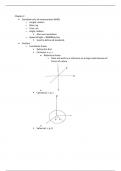
o Coordinate frame
§ Define this first
§ Cartesian: x, y, z
• Reference frame
o Does not work as a reference on a large scale because of
forces of nature
•
§ Cylindrical: r, f, z
•
§ Spherical: r, f, q
, •
o Displacement (m)
§ Difference in length
§
§ If you walk somewhere and back, displacement is 0
§ Vector
• Magnitude and direction
§ ∆𝑥 = 𝑥! − 𝑥"
o Distance (m)
§ How much length
§ If you walk somewhere and back, distance is 2x the length you walked
§ 𝑖𝑓 𝑥! − 𝑥" = 𝑑, 𝑥" − 𝑥! = 𝑑, 𝑡ℎ𝑒𝑛 𝑑#$#%& = 2𝑑
o Speed (m/s)
'()#%*+,
§ 𝑎𝑣𝑔 𝑠𝑝𝑒𝑒𝑑 = #(-,
'
§ Average speed: 𝑠̅ = #
o Velocity (± m/s)
§ Tells us how quickly position is changing
§ Need positive/negative to show direction
'().&%+,-,*#
§ 𝑎𝑣𝑒𝑟𝑎𝑔𝑒 𝑣𝑒𝑙𝑜𝑐𝑖𝑡𝑦 = #(-,
∆0
• Average velocity: 𝑣 = ∆#
0! 10"
• #! 1#"
§ Multiplying/dividing answer should have least number of sig figs
o Instantaneous speed and velocity
§ Average comes from knowing only end points
§ Instantaneous comes from knowing slope
,§
∆0
• 𝑠𝑙𝑜𝑝𝑒 = 𝑣̅ = ∆#
• In this case, instantaneous speed = instantaneous velocity
∆0 '0
• 𝑙𝑖𝑚∆#→3 < ∆# = = '#
o Slope of the tangent to the curve
o Derivative
'0
• Instantaneous velocity: 𝑣 = '#
o If you know x(t), you can derive instantaneous velocity
o Magnitude of instantaneous velocity always =
instantaneous speed
o If moving at a constant velocity, then instantaneous
velocity = average velocity
• Ex: x(t) = 5t
'
o '# (5𝑡) = 𝟓
o 5 m/s = slope, or instantaneous velocity
o In this case, average velocity = instantaneous velocity
• Ex: x(t) = ½t2 + 5t
' 4
o '# <5 𝑡 5 + 5𝑡= = 𝒕 + 𝟓
o If t=1, then slope = 5 m/s + (1 m/s2)t
§ Acceleration of t
, o
§ Velocity = slope
• Positive slope = positive velocity, etc.
o Acceleration
§ When velocity is changing, the object is accelerating
§ Tells how quickly velocity is changing
§ 6# 16$
§ Average acceleration: 𝑎D = #
∆6
• Or : 𝑎D = 7#
§ Instantaneous acceleration:
• Useful if velocity is variable with time
∆6 '6
• 𝑙𝑖𝑚∆#→3 < ∆# = = '#
'6
• Instantaneous acceleration: 𝑎 = '#
•
• Standard units of measurement (MKS)
o Length, meters
o Mass, kg
o Time, sec
o Angle, radians
§ Also use revolutions
o Speed of light = 300000km/sec
§ Used to define all standards
• Position
o Coordinate frame
§ Define this first
§ Cartesian: x, y, z
• Reference frame
o Does not work as a reference on a large scale because of
forces of nature
•
§ Cylindrical: r, f, z
•
§ Spherical: r, f, q
, •
o Displacement (m)
§ Difference in length
§
§ If you walk somewhere and back, displacement is 0
§ Vector
• Magnitude and direction
§ ∆𝑥 = 𝑥! − 𝑥"
o Distance (m)
§ How much length
§ If you walk somewhere and back, distance is 2x the length you walked
§ 𝑖𝑓 𝑥! − 𝑥" = 𝑑, 𝑥" − 𝑥! = 𝑑, 𝑡ℎ𝑒𝑛 𝑑#$#%& = 2𝑑
o Speed (m/s)
'()#%*+,
§ 𝑎𝑣𝑔 𝑠𝑝𝑒𝑒𝑑 = #(-,
'
§ Average speed: 𝑠̅ = #
o Velocity (± m/s)
§ Tells us how quickly position is changing
§ Need positive/negative to show direction
'().&%+,-,*#
§ 𝑎𝑣𝑒𝑟𝑎𝑔𝑒 𝑣𝑒𝑙𝑜𝑐𝑖𝑡𝑦 = #(-,
∆0
• Average velocity: 𝑣 = ∆#
0! 10"
• #! 1#"
§ Multiplying/dividing answer should have least number of sig figs
o Instantaneous speed and velocity
§ Average comes from knowing only end points
§ Instantaneous comes from knowing slope
,§
∆0
• 𝑠𝑙𝑜𝑝𝑒 = 𝑣̅ = ∆#
• In this case, instantaneous speed = instantaneous velocity
∆0 '0
• 𝑙𝑖𝑚∆#→3 < ∆# = = '#
o Slope of the tangent to the curve
o Derivative
'0
• Instantaneous velocity: 𝑣 = '#
o If you know x(t), you can derive instantaneous velocity
o Magnitude of instantaneous velocity always =
instantaneous speed
o If moving at a constant velocity, then instantaneous
velocity = average velocity
• Ex: x(t) = 5t
'
o '# (5𝑡) = 𝟓
o 5 m/s = slope, or instantaneous velocity
o In this case, average velocity = instantaneous velocity
• Ex: x(t) = ½t2 + 5t
' 4
o '# <5 𝑡 5 + 5𝑡= = 𝒕 + 𝟓
o If t=1, then slope = 5 m/s + (1 m/s2)t
§ Acceleration of t
, o
§ Velocity = slope
• Positive slope = positive velocity, etc.
o Acceleration
§ When velocity is changing, the object is accelerating
§ Tells how quickly velocity is changing
§ 6# 16$
§ Average acceleration: 𝑎D = #
∆6
• Or : 𝑎D = 7#
§ Instantaneous acceleration:
• Useful if velocity is variable with time
∆6 '6
• 𝑙𝑖𝑚∆#→3 < ∆# = = '#
'6
• Instantaneous acceleration: 𝑎 = '#
•


