

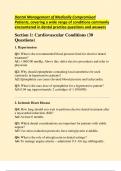
Dental Management of Medically Compromised
Patients, covering a wide range of conditions commonly
encountered in dental practice questions and answers
Section 1: Cardiovascular Conditions (30
Questions)
1. Hypertension
Q1: What is the recommended blood pressure limit for elective dental
treatment?
A1: <160/100 mmHg. Above this, defer elective procedures and refer to
physician.
Q2: Why should epinephrine-containing local anesthetics be used
cautiously in hypertensive patients?
A2: Epinephrine can cause elevated blood pressure and tachycardia.
Q3: What is the max dose of epinephrine for a hypertensive patient?
A3: 0.04 mg (approximately 2 cartridges of 1:100,000).
2. Ischemic Heart Disease
Q4: How long should you wait to perform elective dental treatment after
a myocardial infarction (MI)?
A4: At least 6 months.
Q5: Which dental considerations are important for patients with stable
angina?
A5: Use stress reduction protocols; have nitroglycerin available.
Q6: What is the role of nitroglycerin in dental settings?
A6: To manage angina attacks—administer 0.3–0.6 mg sublingually.
,3. Congestive Heart Failure (CHF)
Q7: What dental chair position is preferred for CHF patients?
A7: Semi-supine to avoid orthopnea.
Q8: Which medications used in CHF may cause xerostomia?
A8: Diuretics like furosemide.
Q9: What is a dental risk of digoxin toxicity?
A9: Hypersalivation, arrhythmias.
4. Patients with Pacemakers
Q10: Can ultrasonic scalers be used on patients with pacemakers?
A10: Avoid magnetostrictive devices in non-shielded pacemakers.
Q11: Are electronic apex locators safe with pacemakers?
A11: Generally yes, but consult cardiologist and manufacturer.
5. Anticoagulant Therapy
Q12: What INR level is considered safe for minor oral surgery?
A12: ≤3.5.
Q13: Should anticoagulant therapy be stopped before extractions?
A13: Not usually—INR within range is safe; consult physician.
Q14: What local hemostatic agents can be used?
A14: Tranexamic acid, collagen sponge, sutures.
, Section 8: Endocrine Disorders (Thyroid,
Adrenal) [15 Qs]
Q76: What dental risks are associated with untreated hyperthyroidism?
A: Risk of thyroid storm during stressful procedures.
Q77: What is thyroid storm?
A: A life-threatening emergency with fever, tachycardia, and delirium.
Q78: Which drugs are contraindicated in hyperthyroidism?
A: Epinephrine and other sympathomimetics.
Q79: What are oral signs of hypothyroidism?
A: Macroglossia, delayed tooth eruption, thick lips.
Q80: How does hypothyroidism affect local anesthetic metabolism?
A: May slow down drug metabolism due to reduced liver function.
Q81: What is Addison’s disease?
A: Chronic adrenal insufficiency with risk of adrenal crisis.
Q82: What is an adrenal crisis?
A: Acute hypotension, collapse, and possibly death if not treated.
Q83: When is steroid supplementation needed before dental treatment?
A: In patients on long-term steroids undergoing major surgery or stress.
Q84: What is the stress dose of steroids for minor oral surgery?
A: 5–10 mg prednisone equivalent before the procedure.
Q85: What is the Rule of Twos in steroid management?
A: ≥20 mg prednisone for ≥2 weeks in past 2 years may cause
suppression.
Patients, covering a wide range of conditions commonly
encountered in dental practice questions and answers
Section 1: Cardiovascular Conditions (30
Questions)
1. Hypertension
Q1: What is the recommended blood pressure limit for elective dental
treatment?
A1: <160/100 mmHg. Above this, defer elective procedures and refer to
physician.
Q2: Why should epinephrine-containing local anesthetics be used
cautiously in hypertensive patients?
A2: Epinephrine can cause elevated blood pressure and tachycardia.
Q3: What is the max dose of epinephrine for a hypertensive patient?
A3: 0.04 mg (approximately 2 cartridges of 1:100,000).
2. Ischemic Heart Disease
Q4: How long should you wait to perform elective dental treatment after
a myocardial infarction (MI)?
A4: At least 6 months.
Q5: Which dental considerations are important for patients with stable
angina?
A5: Use stress reduction protocols; have nitroglycerin available.
Q6: What is the role of nitroglycerin in dental settings?
A6: To manage angina attacks—administer 0.3–0.6 mg sublingually.
,3. Congestive Heart Failure (CHF)
Q7: What dental chair position is preferred for CHF patients?
A7: Semi-supine to avoid orthopnea.
Q8: Which medications used in CHF may cause xerostomia?
A8: Diuretics like furosemide.
Q9: What is a dental risk of digoxin toxicity?
A9: Hypersalivation, arrhythmias.
4. Patients with Pacemakers
Q10: Can ultrasonic scalers be used on patients with pacemakers?
A10: Avoid magnetostrictive devices in non-shielded pacemakers.
Q11: Are electronic apex locators safe with pacemakers?
A11: Generally yes, but consult cardiologist and manufacturer.
5. Anticoagulant Therapy
Q12: What INR level is considered safe for minor oral surgery?
A12: ≤3.5.
Q13: Should anticoagulant therapy be stopped before extractions?
A13: Not usually—INR within range is safe; consult physician.
Q14: What local hemostatic agents can be used?
A14: Tranexamic acid, collagen sponge, sutures.
, Section 8: Endocrine Disorders (Thyroid,
Adrenal) [15 Qs]
Q76: What dental risks are associated with untreated hyperthyroidism?
A: Risk of thyroid storm during stressful procedures.
Q77: What is thyroid storm?
A: A life-threatening emergency with fever, tachycardia, and delirium.
Q78: Which drugs are contraindicated in hyperthyroidism?
A: Epinephrine and other sympathomimetics.
Q79: What are oral signs of hypothyroidism?
A: Macroglossia, delayed tooth eruption, thick lips.
Q80: How does hypothyroidism affect local anesthetic metabolism?
A: May slow down drug metabolism due to reduced liver function.
Q81: What is Addison’s disease?
A: Chronic adrenal insufficiency with risk of adrenal crisis.
Q82: What is an adrenal crisis?
A: Acute hypotension, collapse, and possibly death if not treated.
Q83: When is steroid supplementation needed before dental treatment?
A: In patients on long-term steroids undergoing major surgery or stress.
Q84: What is the stress dose of steroids for minor oral surgery?
A: 5–10 mg prednisone equivalent before the procedure.
Q85: What is the Rule of Twos in steroid management?
A: ≥20 mg prednisone for ≥2 weeks in past 2 years may cause
suppression.


