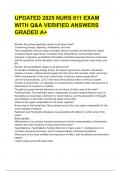
PDATED 2025 NURS 611 EXAM
U
WITH Q&A VERIFIED ANSWERS
GRADED A+
eview: the parasympathetic system is all about what?
R
Conserving energy, digesting, metabolism, and rest
The sympathetic nervous system primarily serves to protect an individual by doing?
Increases blood sugar levels, increases body temperature, and increases blood
pressure. In general, sympathetic stimulation promotes responses that are concerned
with the protection of the individual, which include increasing glucose, body temp, and
BP.
Review: the sympathetic system is all about what?
It's all about mobilizing energy stores, for instance glucose to muscles, decreased
release of insulin, redirects blood supply from the gut to the muscles, heart, and lungs.
Which characteristic is the most critical index of nervous system dysfunction?
Level of consciousness. LOC is the most critical clinical index of nervous system
function or dysfunction. An alteration in consciousness indicates either improvement or
deterioration of a person's condition.
Thought and goal-oriented behaviors are functions of which area of the brain?
Prefrontal lobe. The prefrontal area is responsible for goal-oriented behavior such as
the ability to concentrate, short-term or recall memory, and the elaboration of thought
and inhibition on the limbic (emotional) areas of the CNS.
Where is the region responsible for the motor aspects?
Broca area in the frontal lobe. Broca speech area is the only region responsible for the
motor aspects of speech.
Parkinson and Huntington diseases are associated with defects in which area of the
brain?
Basal ganglia
Maintenance of a constant internal environment and the implementation of behavioral
patterns are main functions of which area of the brain?
Hypothalamus. Hypothalamic function falls into 2 major areas: 1) maintenance of a
constant internal environment, and 2) implementation of behavioral patterns.
What parts of the brain mediate the expression of affect, both emotional and behavioral
states?
Limbic system and prefrontal cortex
, eflex activities concerned with heart rate, blood pressure, respirations, sneezing,
R
swallowing, and coughing are controlled by which area of the brain?
Medulla oblongata. The medulla oblongata makes up the myelencephalon and is the
lowest portion of the brainstem.
Which area of the brain assumes the responsibility for conscious and unconscious
muscle synergy and for maintaining balance and posture?
Cerebellum
The brain receives approximately what percentage of the cardiac output?
20% or 800 to 1000 ml of blood flow per minute
What evidence does the nurse expect to see when a patient experiences trauma to the
hypothalamus?
Uneven expression of mood, unstable blood glucose levels, and poor temp regulation.
The hypothalamus forms the base of the diencephalon. Hypothalamic function controls
autonomic nervous system function, regulation of body temp, endocrine function
(glucose levels), and regulation of emotional expression.
What is the first defense of our bodies?
Skin and mucous membranes
Which action is the purpose of the inflammatory process?
To prevent infection of the injured tissue. If the epithelial barrier is damaged, then a
highly efficient local and system response (inflammation) is mobilized to limit the extent
of damage, to protect against infection, and to initiate the repair of damaged tissue.
What are the 4 cardinal signs of infection?
Edema (tumor), warmth (calor), redness (rubor), and pain (dolar). There is a 5th sign
known as loss of function (functio laesa)
Which type of white blood cell is first to arrive at the site of infection?
Leukocytes
What causes the edema that occurs during the inflammatory process?
Increased capillary permeability. The increased flow and capillary permeability result in
a leakage of plasma from the vessels, causing swelling in the surrounding tissue and is
solely responsible for inflammation-induced edema.
What process causes heat and redness to occur during the inflammatory process?
Vasodilation of blood vessels. The increased blood flow, as a result of vasodilation and
increasing concentration of red cells at the site of inflammation cause locally increased
warmth and redness.
The chemotactic factor affects the inflammatory process by?
Directing leukocytes to the inflamed area
Two chemotactic factors, neutrophil chemotactic factor (NCF) and eosinophil
chemotactic factor of anaphylaxis (ECF-A), are released during mast cell degranulation.
NCF attracts neutrophils (a type of leukocytes), and ECF-A attracts eosinophils to the
site of inflammation.
, hat is pain mediated by?
W
Histamines, bradykinins, leukotrienes, and prostaglandins
The function of opsonization related to the complement cascade is to:
Tag the pathogenic microorganisms for destruction by neutrophils and macrophages.
C3b adheres to the surface of a pathogenic microorganism and serves as an efficient
opsonin. Opsonins are molecules that tag microorganisms for destruction by cells of the
inflammatory system, primarily neutrophils and macrophages.
During phagocytosis what is occurring during the step referred to as opsonization?
Phagocytes recognize and adhere to the bacteria. During phagocytosis, opsonization
involves only the recognition and adherence of phagocytes to bacteria.
What is the correct sequence of phagocytosis?
Recognition (opsonization), engulfment, fusion, and destruction.
Once the phagocytic cell enters the inflammatory site, the only correct sequence of
phagocytosis involves opsonization or recognition of the target and adherence of the
phagocyte to it, engulfment, or ingestion or endocytosis, and the formation of
phagosome, fusion with lysosomal granules within the phagocyte and destruction of the
target.
Which manifestations of inflammation is systemic?
Fever and leukocytosis.
The only primary systemic changes associated with the acute inflammatory response
are fever, leukocytosis (a transient increase in circulating leukocytes), and increased
levels in circulating plasma proteins.
The acute inflammatory response is characterized by fever that is produced by the
hypothalamus being affected by?
Endogenous pyrogens
Fever-causing cytokines are known as endogenous pyrogens.
When considering white blood cell differentials, acute inflammatory reactions are related
to elevations of which leukocyte?
Neutrophils
Only neutrophils are the predominant phagocytes in the early inflammatory site, arriving
within 6-12 hours after the initial injury, they ingest (phagocytose) bacteria, dead cells,
and cellular debris at the inflammatory site.
What occurs during the process of repair after tissue damage?
Nonfunctioning scar tissue replaces the destroyed tissue.
Repair is the replacement of destroyed tissue with scar tissue. Scar tissue is primarily
made up of collagen, which fills in the lesion and restores tensile strength but cannot
carry out the physiologic functions of the destroyed tissue.
When cellular damage occurs and regeneration is minor with no significant
complications, the process of returning the cells to pre-injury function is referred to as:
Resolution
U
WITH Q&A VERIFIED ANSWERS
GRADED A+
eview: the parasympathetic system is all about what?
R
Conserving energy, digesting, metabolism, and rest
The sympathetic nervous system primarily serves to protect an individual by doing?
Increases blood sugar levels, increases body temperature, and increases blood
pressure. In general, sympathetic stimulation promotes responses that are concerned
with the protection of the individual, which include increasing glucose, body temp, and
BP.
Review: the sympathetic system is all about what?
It's all about mobilizing energy stores, for instance glucose to muscles, decreased
release of insulin, redirects blood supply from the gut to the muscles, heart, and lungs.
Which characteristic is the most critical index of nervous system dysfunction?
Level of consciousness. LOC is the most critical clinical index of nervous system
function or dysfunction. An alteration in consciousness indicates either improvement or
deterioration of a person's condition.
Thought and goal-oriented behaviors are functions of which area of the brain?
Prefrontal lobe. The prefrontal area is responsible for goal-oriented behavior such as
the ability to concentrate, short-term or recall memory, and the elaboration of thought
and inhibition on the limbic (emotional) areas of the CNS.
Where is the region responsible for the motor aspects?
Broca area in the frontal lobe. Broca speech area is the only region responsible for the
motor aspects of speech.
Parkinson and Huntington diseases are associated with defects in which area of the
brain?
Basal ganglia
Maintenance of a constant internal environment and the implementation of behavioral
patterns are main functions of which area of the brain?
Hypothalamus. Hypothalamic function falls into 2 major areas: 1) maintenance of a
constant internal environment, and 2) implementation of behavioral patterns.
What parts of the brain mediate the expression of affect, both emotional and behavioral
states?
Limbic system and prefrontal cortex
, eflex activities concerned with heart rate, blood pressure, respirations, sneezing,
R
swallowing, and coughing are controlled by which area of the brain?
Medulla oblongata. The medulla oblongata makes up the myelencephalon and is the
lowest portion of the brainstem.
Which area of the brain assumes the responsibility for conscious and unconscious
muscle synergy and for maintaining balance and posture?
Cerebellum
The brain receives approximately what percentage of the cardiac output?
20% or 800 to 1000 ml of blood flow per minute
What evidence does the nurse expect to see when a patient experiences trauma to the
hypothalamus?
Uneven expression of mood, unstable blood glucose levels, and poor temp regulation.
The hypothalamus forms the base of the diencephalon. Hypothalamic function controls
autonomic nervous system function, regulation of body temp, endocrine function
(glucose levels), and regulation of emotional expression.
What is the first defense of our bodies?
Skin and mucous membranes
Which action is the purpose of the inflammatory process?
To prevent infection of the injured tissue. If the epithelial barrier is damaged, then a
highly efficient local and system response (inflammation) is mobilized to limit the extent
of damage, to protect against infection, and to initiate the repair of damaged tissue.
What are the 4 cardinal signs of infection?
Edema (tumor), warmth (calor), redness (rubor), and pain (dolar). There is a 5th sign
known as loss of function (functio laesa)
Which type of white blood cell is first to arrive at the site of infection?
Leukocytes
What causes the edema that occurs during the inflammatory process?
Increased capillary permeability. The increased flow and capillary permeability result in
a leakage of plasma from the vessels, causing swelling in the surrounding tissue and is
solely responsible for inflammation-induced edema.
What process causes heat and redness to occur during the inflammatory process?
Vasodilation of blood vessels. The increased blood flow, as a result of vasodilation and
increasing concentration of red cells at the site of inflammation cause locally increased
warmth and redness.
The chemotactic factor affects the inflammatory process by?
Directing leukocytes to the inflamed area
Two chemotactic factors, neutrophil chemotactic factor (NCF) and eosinophil
chemotactic factor of anaphylaxis (ECF-A), are released during mast cell degranulation.
NCF attracts neutrophils (a type of leukocytes), and ECF-A attracts eosinophils to the
site of inflammation.
, hat is pain mediated by?
W
Histamines, bradykinins, leukotrienes, and prostaglandins
The function of opsonization related to the complement cascade is to:
Tag the pathogenic microorganisms for destruction by neutrophils and macrophages.
C3b adheres to the surface of a pathogenic microorganism and serves as an efficient
opsonin. Opsonins are molecules that tag microorganisms for destruction by cells of the
inflammatory system, primarily neutrophils and macrophages.
During phagocytosis what is occurring during the step referred to as opsonization?
Phagocytes recognize and adhere to the bacteria. During phagocytosis, opsonization
involves only the recognition and adherence of phagocytes to bacteria.
What is the correct sequence of phagocytosis?
Recognition (opsonization), engulfment, fusion, and destruction.
Once the phagocytic cell enters the inflammatory site, the only correct sequence of
phagocytosis involves opsonization or recognition of the target and adherence of the
phagocyte to it, engulfment, or ingestion or endocytosis, and the formation of
phagosome, fusion with lysosomal granules within the phagocyte and destruction of the
target.
Which manifestations of inflammation is systemic?
Fever and leukocytosis.
The only primary systemic changes associated with the acute inflammatory response
are fever, leukocytosis (a transient increase in circulating leukocytes), and increased
levels in circulating plasma proteins.
The acute inflammatory response is characterized by fever that is produced by the
hypothalamus being affected by?
Endogenous pyrogens
Fever-causing cytokines are known as endogenous pyrogens.
When considering white blood cell differentials, acute inflammatory reactions are related
to elevations of which leukocyte?
Neutrophils
Only neutrophils are the predominant phagocytes in the early inflammatory site, arriving
within 6-12 hours after the initial injury, they ingest (phagocytose) bacteria, dead cells,
and cellular debris at the inflammatory site.
What occurs during the process of repair after tissue damage?
Nonfunctioning scar tissue replaces the destroyed tissue.
Repair is the replacement of destroyed tissue with scar tissue. Scar tissue is primarily
made up of collagen, which fills in the lesion and restores tensile strength but cannot
carry out the physiologic functions of the destroyed tissue.
When cellular damage occurs and regeneration is minor with no significant
complications, the process of returning the cells to pre-injury function is referred to as:
Resolution