

Written by students who passed Immediately available after payment Read online or as PDF Wrong document? Swap it for free 4.6 TrustPilot
logo-home
Document preview thumbnail
Preview 3 out of 23 pages
Exam (elaborations)

Antimicrobial Chapter 20: Medications Questions & Answers

Document preview thumbnail
Preview 3 out of 23 pages

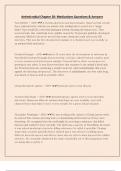
Antimicrobial Chapter 20: Medications Questions & Answers Paul Ehrlich - ANS-A German physician and bacteriologist. Observed that certain dyes stain bacterial cells but not animal cells, leading him to search for a "magic bullet" that would kill a microbial pathogen without harming the human host. They tested arsenic that could help treat syphilis caused by Treponema pallidum, developed salvarsan. Ehrlich's discovery proved that some chemicals could selectively kill microbes. This was the first documented example of a chemical used successfully as an antimicrobial medication Gerhard Domagk - ANS-almost 25 years after the development of salvarsan by Paul Ehrlich Gerhard Domagk discovered that a red dye called Prontosil could be used to treat streptococcal infections in animals. Prontosil had no effect on streptococci growing in test tubes. It was discovered later that enzymes in the animal's blood split the Prontosil molecule, producing a smaller molecule called sulfanilamide that acted against the infecting streptococci. The discovery of sulfanilamide, the first sulfa drug, was based on luck as well as scientific effort. Chemotherapeutic agents - ANS-chemicals used to treat disease Antimicrobial drugs - ANS-chemotherapeutic agents used to treat microbial infections. Numerous different antimicrobial drugs are now available, each with characteristics that make it more or less suitable for a given clinical situation Alexander Flemming - ANS-He was working with cultures of Staph aureus when he noticed that colonies growing near a contaminating mold looked as if they were dissolving. He recognized that the mold might be secreting a substance that killed bacteria and studied it more carefully. The mold was a species of Penicillium, he found it was indeed producing a bacteria-killing substance; he called it penicillin. Fleming wasn't able to purify penicillin but he showed that it was effective in killing many different bacterial species and did not cause adverse effects when injected into rabbits and mice. He eventually abandoned his study of penicillin out of discouragement from not being able to purify it.

Content preview

Antimicrobial Chapter 20: Medications Questions & Answers
✔✔


✔✔


✔✔


✔✔


✔✔

, ✔✔


✔✔


✔✔


✔✔


✔✔

, ✔✔


✔✔


✔✔


✔✔


✔✔

Document information

Uploaded on
April 9, 2025
Number of pages
23
Written in
2024/2025
Type
Exam (elaborations)
Contains
Questions & answers
$13.99

Wrong document? Swap it for free Within 14 days of purchase and before downloading, you can choose a different document. You can simply spend the amount again.
Written by students who passed
Immediately available after payment
Read online or as PDF

Seller avatar
Reputation scores are based on the amount of documents a seller has sold for a fee and the reviews they have received for those documents. There are three levels: Bronze, Silver and Gold. The better the reputation, the more your can rely on the quality of the sellers work.
BrainEdge
3.0
(23)
Sold
132
Followers
102
Items
4407
Last sold
5 days ago


Why students choose Stuvia

Created by fellow students, verified by reviews

Quality you can trust: written by students who passed their tests and reviewed by others who've used these notes.

Didn't get what you expected? Choose another document

No worries! You can instantly pick a different document that better fits what you're looking for.

Pay as you like, start learning right away

No subscription, no commitments. Pay the way you're used to via credit card and download your PDF document instantly.

Student with book image

“Bought, downloaded, and aced it. It really can be that simple.”

Alisha Student

Working on your references?

Create accurate citations in APA, MLA and Harvard with our free citation generator.

Working on your references?

Frequently asked questions

