

NR 228-Nutrition Exam 1
Study online at https://quizlet.com/_2yzifo
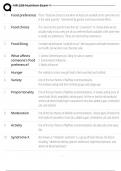
1. Food preference Those *foods we choose to eat when all foods are available at the same time and
in the same quantity*. Determined by genetic and environmental effects.
2. Food choice This concerns the specific foods that are *convenient* to choose when we are
actually ready to eat; rarely are all our preferred foods available at the same time
to satisfy our preferences. These are restricted by convenience.
3. Food liking Considers what food we *really like to eat*. We may want to eat foods that enhance
our health, but we like to eat chocolate cake.
4. What affects 1. Genetic Determinants (ex. liking for salts or sweets)
someone's food 2. Environmental influences
preference? 3. Media influences
5. Hunger The inability to access enough food to feel nourished and satisfied.
6. Variety One of the four themes of MyPlate recommendations.
This involves eating food from all food groups and subgroups.
7. Proportionality One of the four themes of MyPlate recommendations. It involves eating more of
some foods (fruits, vegetables, whole grains, fat-free or low-fat milk products)
and less of others (foods high in saturated or trans fats, added sugars, cholesterol
salt, and alcohol).
8. Moderation One of the four themes of MyPlate recommendations. Choose types of foods that
limit intake of saturated or trans fats, added sugars, cholesterol, salt, and alcohol.
9. Activity One of the four themes of MyPlate recommendations. Be physically active every
day.
10. Syndrome X Also known as "metabolic syndrome" is a group of heart disease risk factors
including *abdominal obesity, glucose intolerance, high blood pressure, and
abnormal blood lipid levels*
, NR 228-Nutrition Exam 1
Study online at https://quizlet.com/_2yzifo
11. Healing foods The ___________ ________ __________ emphasizes foods with restorative
pyramid benefits and/or essential nutrients in natural forms. The core of dietary intake is
primarily plant-based foods, with small amounts of animal foods. the "healing"
aspect of this also applies to the production of the food supply.
12. Experimental Type of research. Consists of an *experimental group* receiving treatment (or di-
study etary change) and a *control group* receiving no treatment (no dietary change);
differences, if any, are then noted. called clinical or laboratory study.
13. Case study Type of research. analyzes an *individual case* of a disease or health difference
to determine how factors may influence health; a naturalistic study because no
manipulation of dietary intake or behavior occurs.
14. Epidemiologic Type of research. *Studies populations*; tracks the occurrence of health or disease
study processes among populations; may use historical data, surveys, and/or medical
records to determine possible factors influencing the health of a group of people.
15. Irradiation A procedure by which *food is exposed to radiation* that destroys microorgan-
isms, insect growth, and parasites that could spoil food or cause illness. This food
preservation technology results in an increase of international and domestic food
trade. These foods may have a *longer shelf life*
16. Glycogen Carbohydrate energy stored in the liver and in the muscles.
17. Glycogenolysis Process when glycogen stored in the liver and muscle tissue is converted back to
glucose.
18. Gluconeogenesis The process of producing glucose from fat.
19. Ketone bodies Created when fatty acids are broken down for energy when sufficient carbohy-
drates are unavailable.
20. Insulin A hormone produced by the beta cells of the islets of Langerhans, lowers blood
glucose levels by enhancing the conversion of excess glucose to glycogen through
Study online at https://quizlet.com/_2yzifo
1. Food preference Those *foods we choose to eat when all foods are available at the same time and
in the same quantity*. Determined by genetic and environmental effects.
2. Food choice This concerns the specific foods that are *convenient* to choose when we are
actually ready to eat; rarely are all our preferred foods available at the same time
to satisfy our preferences. These are restricted by convenience.
3. Food liking Considers what food we *really like to eat*. We may want to eat foods that enhance
our health, but we like to eat chocolate cake.
4. What affects 1. Genetic Determinants (ex. liking for salts or sweets)
someone's food 2. Environmental influences
preference? 3. Media influences
5. Hunger The inability to access enough food to feel nourished and satisfied.
6. Variety One of the four themes of MyPlate recommendations.
This involves eating food from all food groups and subgroups.
7. Proportionality One of the four themes of MyPlate recommendations. It involves eating more of
some foods (fruits, vegetables, whole grains, fat-free or low-fat milk products)
and less of others (foods high in saturated or trans fats, added sugars, cholesterol
salt, and alcohol).
8. Moderation One of the four themes of MyPlate recommendations. Choose types of foods that
limit intake of saturated or trans fats, added sugars, cholesterol, salt, and alcohol.
9. Activity One of the four themes of MyPlate recommendations. Be physically active every
day.
10. Syndrome X Also known as "metabolic syndrome" is a group of heart disease risk factors
including *abdominal obesity, glucose intolerance, high blood pressure, and
abnormal blood lipid levels*
, NR 228-Nutrition Exam 1
Study online at https://quizlet.com/_2yzifo
11. Healing foods The ___________ ________ __________ emphasizes foods with restorative
pyramid benefits and/or essential nutrients in natural forms. The core of dietary intake is
primarily plant-based foods, with small amounts of animal foods. the "healing"
aspect of this also applies to the production of the food supply.
12. Experimental Type of research. Consists of an *experimental group* receiving treatment (or di-
study etary change) and a *control group* receiving no treatment (no dietary change);
differences, if any, are then noted. called clinical or laboratory study.
13. Case study Type of research. analyzes an *individual case* of a disease or health difference
to determine how factors may influence health; a naturalistic study because no
manipulation of dietary intake or behavior occurs.
14. Epidemiologic Type of research. *Studies populations*; tracks the occurrence of health or disease
study processes among populations; may use historical data, surveys, and/or medical
records to determine possible factors influencing the health of a group of people.
15. Irradiation A procedure by which *food is exposed to radiation* that destroys microorgan-
isms, insect growth, and parasites that could spoil food or cause illness. This food
preservation technology results in an increase of international and domestic food
trade. These foods may have a *longer shelf life*
16. Glycogen Carbohydrate energy stored in the liver and in the muscles.
17. Glycogenolysis Process when glycogen stored in the liver and muscle tissue is converted back to
glucose.
18. Gluconeogenesis The process of producing glucose from fat.
19. Ketone bodies Created when fatty acids are broken down for energy when sufficient carbohy-
drates are unavailable.
20. Insulin A hormone produced by the beta cells of the islets of Langerhans, lowers blood
glucose levels by enhancing the conversion of excess glucose to glycogen through


