

Written by students who passed Immediately available after payment Read online or as PDF Wrong document? Swap it for free 4.6 TrustPilot
logo-home
Document preview thumbnail
Preview 2 out of 6 pages
Exam (elaborations)

PHTY1023 Heat and Cold Therapy Exam with Correct Answers 2025

Document preview thumbnail
Preview 2 out of 6 pages

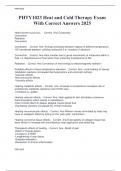
Heat transfer occurs by... - Correct Ans-Conduction Convection Radiation Conversion Conduction. - Correct Ans--Energy exchange between regions of different temperature. -KE transferred between colliding molecules (i.e. increase of vibration) Convection. - Correct Ans-Heat transfer due to gross movements of molecules within a fluid. i.e. displacement of fluid rather than molecular transference of KE. Radiation. - Correct Ans-Conversion of heat energy to electromagnetic radiation Possible effects of tissue temperature elevation. - Correct Ans--Local heating of tissues -Metabolic reactions (increased thermodynamics and enzymatic activity) -Vascular effects. -Neuromuscular effects -Viscosity effects Heating metabolic effects. - Correct Ans--Increase in temperature increases rate of endothermic metabolic reactions (Van't Hoff's law). -Increases O₂ uptake. Heating vascular effects. - Correct Ans--Heat applied to skin stimulates cutaneous thermoreceptors which results in vasodilation. -Has minimal effect on deeper skeletal muscle blood flow -Decreases viscosity (increased KE of fluid molcules) Heating neuromuscular effects. - Correct Ans-Afferent nerves stimulated by heat may have an analgesic effect by acting on the "pain gate" mechanism. Heating connective tissue effects. - Correct Ans-Extensability of collagen tissue has been shown to increase with simultaneous heat application and stretching. Therapeutic effects of heating. - Correct Ans--Relief of pain -Relief of muscle spasm -Increase in jt ROM -Lengthening of scar tissue -Sedation/relaxation -Resolution of chronic inflammation. Therapeutic methods of heat application. - Correct Ans--Superficial heating Conduction -Deep heating Conversion Methods of superficial conductive heat application - Correct Ans--hot packs -parrafin wax -hot water bottle -hot water baths -electric heat pads -hydrotherapy Advantages and disadvantages of hot packs. - Correct Ans-Advantages. -Ease of preparation and application -Variety of shapes and sizes -Moist comfortable heat -Relatively inexpensive Disadvantages -No method of temperature control once applied to patient -Do not conform to body parts -Can be awkward to secure -Passive treatment -May be too heavy Hot packs as passive treatment. - Correct Ans-Physiotherapists are encouraged to apply active treatments. Hot packs can be effective as an initial treatment to reduce pain so that further treatments can be performed. Advantages and disadvantages of Paraffin wax. - Correct Ans-Advantages -Even distribution -Adds moisture to the skin -Can be used as exercise tool after treatment -Comfortable moist heat -Relatively inexpensive Disadvantages -Only used for distal extremities (hands and occasionally feet) -No method of temperature control once applied Contraindications for superficial heating - Correct Ans--Circulatory insufficiency -Risk of dissemination (Heat spreading too far) -Exacerbation of existing conditions -To eyes or testes -Broken skin -DO NOT apply heat over transdermal drug patches or implants as it may increases absorption of the drug. Precautions for superficial heating. - Correct Ans--Ability to communicate -Sensory loss Thermal sensitivity test - Correct Ans-Tests the patient's ability to discriminate hot from cold at the area to be treated. Demonstrate on non-affected area first. Usually with test tubes filled with hot and cool water. Warning for hot and cold therapy. - Correct Ans-Inform patient of: -What you should feel -What you should not feel -What you should do if this happens -What is the danger -Check Understanding -Do you have any questions -Obtain verbal consent Monitoring of hot pack during application. - Correct Ans--Check skin immediately after application (should be no initial temp change) and again after 8 mins and regularly thereafter. -Observe skin and ask patient regarding the temperature of the pack. Short wave diathermy. - Correct Ans-Deep, conversive heating Continuous and pulse SWD CSWD produces tissue heating, PSWD does not. CSWD physiological effects. - Correct Ans--Increased cellular metabolic rate -Decreased fluid viscosity -Increased extensibility of collagen -Increased blood flow -Effects on NS. Pain relief, muscle relaxation. CSWD therapeutic uses. - Correct Ans--Accelerate resolution of chronic inflammation -Accelerate healing -Relieve pain -Reduce muscle spasm/tension -Increase extensibility of CT -Resolution of chronic infections, e.g. sinusitis Pulsed short wave diathermy. - Correct Ans-AC signal (27.12 MHz) supplied in bursts. PSWD is considered a "non-thermal" treatment modality PSWD physiological effects - Correct Ans--Increased cell activity -Reabsorption of haematoma -Reduced inflammation -Reduced swelling -Increased rate of fibrin deposition and orientation -Increased collagen deposition and orientation -Increased nerve growth and soft tissue repair. PSWD therapeutic uses - Correct Ans--Recent tissue trauma -Acute infections -Peripheral nerve lesions -Pain relief -Wound healing -Ulcers SWD dosage. - Correct Ans-Little evidence or agreement on treatment parameters. Clinical lore says 20-30 min CSWD, 60 mins PSWD SWD contraindications - Correct Ans-•Circulatory insufficiency •Risk of dissemination •Exacerbation of existing conditions •To eyes or testes •Unable to communicate •Sensory loss •Metal within the field •Pregnancy (patient and physio) •Inbuilt stimulator (e.g. pacemaker) •Within 3 metres of operating electrical stimulation or biofeedback •Drug patches SWD precautions - Correct Ans--remove hearing aids -turn off mobile phones within 3m. -SWD operators ensure 1m from applicators and 0.5m from leads. In cryotherapy, local temperature drop is reliant on... - Correct Ans--Temp difference between cooling source and area being cooled. -Cooling sources temperature consistency (ice bath vs gel pack) -barriers to cooling -Thermal conductivity of tissue (muscle vs skin/adipose) -thermal conductivity of substance used -duration of application (balancing of thermal differential) -Size of area being cooled (↑area, ↑heat loss from body) Physiological changes due to cooling. - Correct Ans--↓skin temp -↓muscle temp -Hunting reaction -↓deeper tissue blood flow -↓tissue metabolic rate -PNS -Motor system Time and cryotherapy - Correct Ans-Deeper the tissue, the longer it takes for a cooling effect to take place. Superficial (2.5cm) muscle 20mins, Deep (4cm) muscle 30min. Need to consider this clinically when considering treatment. Hunting reaction - Correct Ans-Superficial cutaneous blood flow decreases during first minutes of cold application due to vasoconstriction. After 5-10 mins, vasodilation occurs. May last 15 mins before vasoconstriction occurs again. Alternate vasoconstriction/dilation = Hunting reaction Thought to be a mechanism to prevent tissue damage from prolonged cooling and ischemia Cryotherapy & tissue metabolism. - Correct Ans--↓metabolic rate 2 sources of damge in acute injury -from primary injury (cell death, blood supply disruption) -secondary hypoxia & post trauma enzyme activity Cooling increases survival chance of cells by ↓metabolic demand and ↓ necrotic enzyme release. -also reduces oedema, reducing secondary damage Cryotherapy and PNS - Correct Ans--reduces conduction velocity -Fast pain slowed more than slower chronic pain receptors. -reduced motor skill -reduced motor nerve conduction -effects depend on amount and duration of cooling & may differ with pathology Therapeutic uses of cryotherapy - Correct Ans--Recent injuries -Relief of pain -Treatment of acute injury -Postoperative uses -Relief of muscle spasms -Treatment of chronic inflammatory conditions -Treatment of oedema Recent injury and cryotherapy - Correct Ans-Decreases inflammatory response via vasoconstriction and increasing viscosity of blood. Combined with pressure over wound→homeostasis ↓pain due to ↓inflammatory response Pain and cryotherapy - Correct Ans-Proposed to decrease pain via several mechanisms -decreased neural conduction velocity -↓release of pain irritants (↓inflm. response) -Action on "pain-gate" mechanism -Release of endorphins and encephalins 2 ways tissue injury may occur with cryotherapy. - Correct Ans-Excessive cold causing damage to normal tissue. Normal local cooling causing damage due to a predisposing pathological condition. Excessive local cold on normal tissue. - Correct Ans-Ice burn -Mild: erythema and skin tenderness a few hours after treatment -Severe: fatty necrosis. Bruising and more tenderness. Can last up to 3 weeks. Peripheral nerve damage. Extreme cold can cause cell death. Slower extreme cooling can lead to ECF freezing and drawing water from cells → frost bite. Reduced peripheral vascular supply. - Correct Ans-Peripheral vascular disease, vasospasm, blockages or pressure caused by posture. Restricted blood supply ↑ risk of tissue damge in crytherapy. Rate of perfusion ↓ so oxygenation of cells can be affected. Vasospasm - Correct Ans-Cold sensitivity (Raynaud's phenomenon). Excessive vasoconstriction, triggered by cold, occurs in digital arteries. Cryoglobiaemia - Correct Ans-Abnormal protein in blood forms precipitate at lower temperatures causing ischeamia. Associated with CT disorders such as rheumatoid arthritis. Cold urticaria - Correct Ans-Cold releases histamine from mast cells. Local weals form and may ↓ BP an

Content preview

PHTY1023


PHTY1023 Heat and Cold Therapy Exam
With Correct Answers 2025
Heat transfer occurs by... - Correct Ans-Conduction
Convection
Radiation
Conversion

Conduction. - Correct Ans--Energy exchange between regions of different temperature.
-KE transferred between colliding molecules (i.e. increase of vibration)

Convection. - Correct Ans-Heat transfer due to gross movements of molecules within a
fluid. i.e. displacement of fluid rather than molecular transference of KE.

Radiation. - Correct Ans-Conversion of heat energy to electromagnetic radiation

Possible effects of tissue temperature elevation. - Correct Ans--Local heating of tissues
-Metabolic reactions (increased thermodynamics and enzymatic activity)
-Vascular effects.
-Neuromuscular effects
-Viscosity effects

Heating metabolic effects. - Correct Ans--Increase in temperature increases rate of
endothermic metabolic reactions (Van't Hoff's law).
-Increases O₂ uptake.

Heating vascular effects. - Correct Ans--Heat applied to skin stimulates cutaneous
thermoreceptors which results in vasodilation.
-Has minimal effect on deeper skeletal muscle blood flow
-Decreases viscosity (increased KE of fluid molcules)

Heating neuromuscular effects. - Correct Ans-Afferent nerves stimulated by heat may
have an analgesic effect by acting on the "pain gate" mechanism.

Heating connective tissue effects. - Correct Ans-Extensability of collagen tissue has
been shown to increase with simultaneous heat application and stretching.

Therapeutic effects of heating. - Correct Ans--Relief of pain
-Relief of muscle spasm
-Increase in jt ROM
-Lengthening of scar tissue
-Sedation/relaxation
-Resolution of chronic inflammation.

PHTY1023

, PHTY1023


Therapeutic methods of heat application. - Correct Ans--Superficial heating
Conduction
-Deep heating
Conversion

Methods of superficial conductive heat application - Correct Ans--hot packs
-parrafin wax
-hot water bottle
-hot water baths
-electric heat pads
-hydrotherapy

Advantages and disadvantages of hot packs. - Correct Ans-Advantages.
-Ease of preparation and application
-Variety of shapes and sizes
-Moist comfortable heat
-Relatively inexpensive
Disadvantages
-No method of temperature control once applied to patient
-Do not conform to body parts
-Can be awkward to secure
-Passive treatment
-May be too heavy

Hot packs as passive treatment. - Correct Ans-Physiotherapists are encouraged to
apply active treatments.
Hot packs can be effective as an initial treatment to reduce pain so that further
treatments can be performed.

Advantages and disadvantages of Paraffin wax. - Correct Ans-Advantages
-Even distribution
-Adds moisture to the skin
-Can be used as exercise tool after treatment
-Comfortable moist heat
-Relatively inexpensive
Disadvantages
-Only used for distal extremities (hands and occasionally feet)
-No method of temperature control once applied

Contraindications for superficial heating - Correct Ans--Circulatory insufficiency
-Risk of dissemination (Heat spreading too far)
-Exacerbation of existing conditions
-To eyes or testes
-Broken skin


PHTY1023

Document information

Uploaded on
April 7, 2025
Number of pages
6
Written in
2024/2025
Type
Exam (elaborations)
Contains
Questions & answers
$8.19

Wrong document? Swap it for free Within 14 days of purchase and before downloading, you can choose a different document. You can simply spend the amount again.
Written by students who passed
Immediately available after payment
Read online or as PDF

Seller avatar
Reputation scores are based on the amount of documents a seller has sold for a fee and the reviews they have received for those documents. There are three levels: Bronze, Silver and Gold. The better the reputation, the more your can rely on the quality of the sellers work.
AlexScorer
2.5
(2)
Sold
11
Followers
0
Items
1800
Last sold
2 days ago


Why students choose Stuvia

Created by fellow students, verified by reviews

Quality you can trust: written by students who passed their tests and reviewed by others who've used these notes.

Didn't get what you expected? Choose another document

No worries! You can instantly pick a different document that better fits what you're looking for.

Pay as you like, start learning right away

No subscription, no commitments. Pay the way you're used to via credit card and download your PDF document instantly.

Student with book image

“Bought, downloaded, and aced it. It really can be that simple.”

Alisha Student

Working on your references?

Create accurate citations in APA, MLA and Harvard with our free citation generator.

Working on your references?

Frequently asked questions

