Human Anatomy & Physiology, 8e (Marieb/Hoehn)
Chapter 15 The Special Senses
Matching Questions
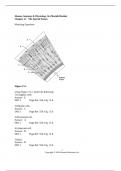
Figure 15.1
Using Figure 15.1, match the following:
1) Ganglion cells.
Answer: E
Diff: 1 Page Ref: 554; Fig. 15.6
2) Bipolar cells.
Answer: C
Diff: 1 Page Ref: 554; Fig. 15.6
3) Horizontal cell.
Answer: A
Diff: 1 Page Ref: 554; Fig. 15.6
4) Amacrine cell.
Answer: D
Diff: 1 Page Ref: 554; Fig. 15.6
5) Rod.
Answer: B
Diff: 1 Page Ref: 554; Fig. 15.6
1
Copyright © 2010 Pearson Education, Inc.
,Figure 15.2
Using Figure 15.2, match the following:
6) Protects and shapes the eyeball; provides a sturdy anchoring site for extrinsic eye muscles.
Answer: A
Diff: 1 Page Ref: 551; Fig. 15.4
7) Blood vessels supply nutrition to all eye layers.
Answer: B
Diff: 1 Page Ref: 551; Fig. 15.4
8) Contains only cones; provides detailed color vision.
Answer: D
Diff: 1 Page Ref: 553; Fig. 15.4
9) Lacks photoreceptors; where optic nerve exits the eye.
Answer: E
Diff: 1 Page Ref: 553; Fig. 15.4
10) Consists of a pigmented layer and a neural layer.
Answer: C
Diff: 1 Page Ref: 553; Fig. 15.4
2
Copyright © 2010 Pearson Education, Inc.
, Figure 15.3
Using Figure 15.3, match the following:
11) Acts as a reflexively activated diaphragm to vary pupil size.
Answer: C
Diff: 2 Page Ref: 551; Fig. 15.4
12) The only tissue in the body that can be transplanted from one person to another with little or
no rejection.
Answer: B
Diff: 2 Page Ref: 551; Fig. 15.4
13) Controls lens shape.
Answer: A
Diff: 2 Page Ref: 551; Fig. 15.4
14) Holds the retina firmly against the pigmented layer.
Answer: E
Diff: 2 Page Ref: 555; Fig. 15.4
15) Fluid blockages cause glaucoma.
Answer: D
Diff: 2 Page Ref: 555; Fig. 15.4
3
Copyright © 2010 Pearson Education, Inc.
Chapter 15 The Special Senses
Matching Questions
Figure 15.1
Using Figure 15.1, match the following:
1) Ganglion cells.
Answer: E
Diff: 1 Page Ref: 554; Fig. 15.6
2) Bipolar cells.
Answer: C
Diff: 1 Page Ref: 554; Fig. 15.6
3) Horizontal cell.
Answer: A
Diff: 1 Page Ref: 554; Fig. 15.6
4) Amacrine cell.
Answer: D
Diff: 1 Page Ref: 554; Fig. 15.6
5) Rod.
Answer: B
Diff: 1 Page Ref: 554; Fig. 15.6
1
Copyright © 2010 Pearson Education, Inc.
,Figure 15.2
Using Figure 15.2, match the following:
6) Protects and shapes the eyeball; provides a sturdy anchoring site for extrinsic eye muscles.
Answer: A
Diff: 1 Page Ref: 551; Fig. 15.4
7) Blood vessels supply nutrition to all eye layers.
Answer: B
Diff: 1 Page Ref: 551; Fig. 15.4
8) Contains only cones; provides detailed color vision.
Answer: D
Diff: 1 Page Ref: 553; Fig. 15.4
9) Lacks photoreceptors; where optic nerve exits the eye.
Answer: E
Diff: 1 Page Ref: 553; Fig. 15.4
10) Consists of a pigmented layer and a neural layer.
Answer: C
Diff: 1 Page Ref: 553; Fig. 15.4
2
Copyright © 2010 Pearson Education, Inc.
, Figure 15.3
Using Figure 15.3, match the following:
11) Acts as a reflexively activated diaphragm to vary pupil size.
Answer: C
Diff: 2 Page Ref: 551; Fig. 15.4
12) The only tissue in the body that can be transplanted from one person to another with little or
no rejection.
Answer: B
Diff: 2 Page Ref: 551; Fig. 15.4
13) Controls lens shape.
Answer: A
Diff: 2 Page Ref: 551; Fig. 15.4
14) Holds the retina firmly against the pigmented layer.
Answer: E
Diff: 2 Page Ref: 555; Fig. 15.4
15) Fluid blockages cause glaucoma.
Answer: D
Diff: 2 Page Ref: 555; Fig. 15.4
3
Copyright © 2010 Pearson Education, Inc.