Human Anatomy & Physiology, 8e (Marieb/Hoehn)
Chapter 13 The Peripheral Nervous System and Reflex Activity
Matching Questions
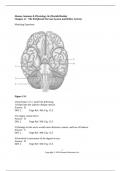
Figure 13.1
Using Figure 13.1, match the following:
1) Innervates the superior oblique muscle.
Answer: B
Diff: 2 Page Ref: 496; Fig. 13.5
2) Longest cranial nerve.
Answer: D
Diff: 2 Page Ref: 500; Fig. 13.5
3) Damage to this nerve would cause dizziness, nausea, and loss of balance.
Answer: C
Diff: 2 Page Ref: 499; Fig. 13.5
4) Involved in movement of the digestive tract.
Answer: D
Diff: 2 Page Ref: 500; Fig. 13.5
1
Copyright © 2010 Pearson Education, Inc.
,5) Damage to this nerve would cause difficulty in speech and swallowing, but no effect on
visceral organs.
Answer: E
Diff: 2 Page Ref: 501; Fig. 13.5
6) Damage to this nerve would keep the eye from rotating inferolaterally.
Answer: B
Diff: 2 Page Ref: 496; Fig. 13.5
Figure 13.2
Using Figure 13.2, identify the following components of the reflex arc:
7) Integration center.
Answer: E
Diff: 1 Page Ref: 514; Fig. 13.14
8) Sensory neuron.
Answer: C
Diff: 1 Page Ref: 514; Fig. 13.14
9) Effector.
Answer: B
Diff: 1 Page Ref: 514; Fig. 13.14
10) Motor neuron.
Answer: D
Diff: 1 Page Ref: 514; Fig. 13.14
11) Receptor.
Answer: A
Diff: 1 Page Ref: 514; Fig. 13.14
2
Copyright © 2010 Pearson Education, Inc.
, Match the following:
A) Accessory
B) Vagus
C) Vestibulocochlear
D) Olfactory
E) Abducens
12) Formed by the union of a cranial and a spinal root.
Diff: 2 Page Ref: 501
13) Receptors located in epithelium of the nasal cavity.
Diff: 1 Page Ref: 495
14) Serves the senses of hearing and equilibrium.
Diff: 2 Page Ref: 499
15) Helps to regulate blood pressure and digestion.
Diff: 3 Page Ref: 500
16) Turns the eyeball laterally.
Diff: 2 Page Ref: 498
Answers: 12) A 13) D 14) C 15) B 16) E
Match the following reflexes to their function:
A) Crossed-extensor
B) Plantar
C) Golgi tendon
D) Stretch
E) Flexor
17) Tests both upper and lower motor pathways. The sole of the foot is stimulated with a dull
instrument.
Diff: 2 Page Ref: 519
18) Consists of an ipsilateral withdrawal reflex and a contralateral extensor reflex; important
in maintaining balance.
Diff: 2 Page Ref: 519
19) Produces a rapid withdrawal of the body part from a painful stimulus; ipsilateral.
Diff: 2 Page Ref: 518-519
20) Prevents muscle overstretching and maintains muscle tone.
Diff: 2 Page Ref: 515; Fig. 13.17
3
Copyright © 2010 Pearson Education, Inc.
Chapter 13 The Peripheral Nervous System and Reflex Activity
Matching Questions
Figure 13.1
Using Figure 13.1, match the following:
1) Innervates the superior oblique muscle.
Answer: B
Diff: 2 Page Ref: 496; Fig. 13.5
2) Longest cranial nerve.
Answer: D
Diff: 2 Page Ref: 500; Fig. 13.5
3) Damage to this nerve would cause dizziness, nausea, and loss of balance.
Answer: C
Diff: 2 Page Ref: 499; Fig. 13.5
4) Involved in movement of the digestive tract.
Answer: D
Diff: 2 Page Ref: 500; Fig. 13.5
1
Copyright © 2010 Pearson Education, Inc.
,5) Damage to this nerve would cause difficulty in speech and swallowing, but no effect on
visceral organs.
Answer: E
Diff: 2 Page Ref: 501; Fig. 13.5
6) Damage to this nerve would keep the eye from rotating inferolaterally.
Answer: B
Diff: 2 Page Ref: 496; Fig. 13.5
Figure 13.2
Using Figure 13.2, identify the following components of the reflex arc:
7) Integration center.
Answer: E
Diff: 1 Page Ref: 514; Fig. 13.14
8) Sensory neuron.
Answer: C
Diff: 1 Page Ref: 514; Fig. 13.14
9) Effector.
Answer: B
Diff: 1 Page Ref: 514; Fig. 13.14
10) Motor neuron.
Answer: D
Diff: 1 Page Ref: 514; Fig. 13.14
11) Receptor.
Answer: A
Diff: 1 Page Ref: 514; Fig. 13.14
2
Copyright © 2010 Pearson Education, Inc.
, Match the following:
A) Accessory
B) Vagus
C) Vestibulocochlear
D) Olfactory
E) Abducens
12) Formed by the union of a cranial and a spinal root.
Diff: 2 Page Ref: 501
13) Receptors located in epithelium of the nasal cavity.
Diff: 1 Page Ref: 495
14) Serves the senses of hearing and equilibrium.
Diff: 2 Page Ref: 499
15) Helps to regulate blood pressure and digestion.
Diff: 3 Page Ref: 500
16) Turns the eyeball laterally.
Diff: 2 Page Ref: 498
Answers: 12) A 13) D 14) C 15) B 16) E
Match the following reflexes to their function:
A) Crossed-extensor
B) Plantar
C) Golgi tendon
D) Stretch
E) Flexor
17) Tests both upper and lower motor pathways. The sole of the foot is stimulated with a dull
instrument.
Diff: 2 Page Ref: 519
18) Consists of an ipsilateral withdrawal reflex and a contralateral extensor reflex; important
in maintaining balance.
Diff: 2 Page Ref: 519
19) Produces a rapid withdrawal of the body part from a painful stimulus; ipsilateral.
Diff: 2 Page Ref: 518-519
20) Prevents muscle overstretching and maintains muscle tone.
Diff: 2 Page Ref: 515; Fig. 13.17
3
Copyright © 2010 Pearson Education, Inc.