

NUR 2502 EXAM 2/NUR2502 EXAM 2 LATEST EXAM ALL QUESTIONS AND CORRECT
ANSWERS/MDC3 EXAM 2 /MULTIDIMENSIONAL CARE 3 EXAM 2 |ALREADY GRADED
A+|RASMUSSEN COLLEGE
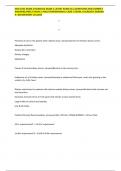
Priorities of care in the patient with a kidney stone -(answer)Control of infection (strain urine).
Adequate hydration
Dietary NA+ restriction
Dietary changes
Medication
Causes of struvite kidney stones -(answer)Bacteria in the urinary tract.
Subjective s/s of a kidney stone -(answer)Hematuria, abdominal flank pain, renal colic (passing in the
ureter) n/v, chills, fever
Dietary restrictions for patients with calcium oxalate kidney stones -(answer)Proteins that increase uric
acid excretion.
Excessive amounts of tea or fruit juices that elevate urinary oxalate level.
Large intake of calcium and oxalate.
Low fluid intake.
Parkland formula fluid calculation -(answer)4 ML x WT KG x %TBSA BURNED = 24 hour fluid
24 hr requirement/2 = 1st 8 hr requirement
1st 8hr requirement/2 = 2nd & 3rd 8hr requirement
, NUR 2502 EXAM 2/NUR2502 EXAM 2 LATEST EXAM ALL QUESTIONS AND CORRECT
ANSWERS/MDC3 EXAM 2 /MULTIDIMENSIONAL CARE 3 EXAM 2 |ALREADY GRADED
A+|RASMUSSEN COLLEGE
Clinical manifestations of Stevens-Johnson syndrome or toxic epidermal necrolysis (TEN). -
(answer)Conjunctivitis, itching, tenderness, fever, cough, sore throat, headache, and pain.
Followed by rapid onset of rash and blisters involving most of the skin and mucous membranes.
Clinical manifestations of pityriasis rosea -(answer)Scaly rash that sweeps outward like the branches of a
pine tree.
Adverse effects of external mechanical forces that contribute to the development of pressure ulcers. -
(answer)Pressure, shear, friction, moisture.
Common causes of autonomic dysreflexia -(answer)Occurs in persons with spinal cord lesions above T6
Occurs after spinal shock has resolved and may occur years after the injury.
Clinical manifestations of a Brown-Sequard spinal cord injury -(answer)Loss of motor function,
proprioception, and vibration sense on side of injury, loss of pain and temperature opposite side of
injury.
S/s of neurogenic shock -(answer)BP HR Cardiac Output decrease, venous pooling, paralyzed portions of
the body don't sweat.
Clinical manifestations immediately noted after complete spinal cord injury -(answer)Loss of all motor
and sensory function below the level of the injury
Bilateral external rotation of the legs
Loss of bowel and bladder function
May develop spinal or neurogenic shock
ANSWERS/MDC3 EXAM 2 /MULTIDIMENSIONAL CARE 3 EXAM 2 |ALREADY GRADED
A+|RASMUSSEN COLLEGE
Priorities of care in the patient with a kidney stone -(answer)Control of infection (strain urine).
Adequate hydration
Dietary NA+ restriction
Dietary changes
Medication
Causes of struvite kidney stones -(answer)Bacteria in the urinary tract.
Subjective s/s of a kidney stone -(answer)Hematuria, abdominal flank pain, renal colic (passing in the
ureter) n/v, chills, fever
Dietary restrictions for patients with calcium oxalate kidney stones -(answer)Proteins that increase uric
acid excretion.
Excessive amounts of tea or fruit juices that elevate urinary oxalate level.
Large intake of calcium and oxalate.
Low fluid intake.
Parkland formula fluid calculation -(answer)4 ML x WT KG x %TBSA BURNED = 24 hour fluid
24 hr requirement/2 = 1st 8 hr requirement
1st 8hr requirement/2 = 2nd & 3rd 8hr requirement
, NUR 2502 EXAM 2/NUR2502 EXAM 2 LATEST EXAM ALL QUESTIONS AND CORRECT
ANSWERS/MDC3 EXAM 2 /MULTIDIMENSIONAL CARE 3 EXAM 2 |ALREADY GRADED
A+|RASMUSSEN COLLEGE
Clinical manifestations of Stevens-Johnson syndrome or toxic epidermal necrolysis (TEN). -
(answer)Conjunctivitis, itching, tenderness, fever, cough, sore throat, headache, and pain.
Followed by rapid onset of rash and blisters involving most of the skin and mucous membranes.
Clinical manifestations of pityriasis rosea -(answer)Scaly rash that sweeps outward like the branches of a
pine tree.
Adverse effects of external mechanical forces that contribute to the development of pressure ulcers. -
(answer)Pressure, shear, friction, moisture.
Common causes of autonomic dysreflexia -(answer)Occurs in persons with spinal cord lesions above T6
Occurs after spinal shock has resolved and may occur years after the injury.
Clinical manifestations of a Brown-Sequard spinal cord injury -(answer)Loss of motor function,
proprioception, and vibration sense on side of injury, loss of pain and temperature opposite side of
injury.
S/s of neurogenic shock -(answer)BP HR Cardiac Output decrease, venous pooling, paralyzed portions of
the body don't sweat.
Clinical manifestations immediately noted after complete spinal cord injury -(answer)Loss of all motor
and sensory function below the level of the injury
Bilateral external rotation of the legs
Loss of bowel and bladder function
May develop spinal or neurogenic shock


