
MODULE 3 EXAM (ANSWER KEY)
Question 1:
Explain why a patient with liver disease would have intolerance to fatty foods.
- A patient with liver disease would have intolerance to fatty food because insufficient
bile production from the liver limits proper fat breakdown.
Question 2:
Explain in detail how the stomach contents enter the small intestine.
- The stomach contents exit into the small intestine through the pyloric sphincter, which
acts as a gatekeeper. When it relaxes, a small amount of chyme is released into the small
intestine. Once the chyme enters, a reflex triggers the sphincter to contract and close.
This process repeats, with the sphincter alternating between relaxing to allow more
chyme in and tightening to control the flow.
Question 3:
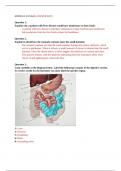
Look carefully at the diagram below. Label the following 5 organs of the digestive system.
To receive credit for the intestines you must label the specific region.
1: Liver
2: Pancreas
5: Duodenum
6: Ilium
8: Ascending colon
, Question 4:
A doctor is looking to prescribe a larger dose of a vitamin that would not easily cause
vitamin toxicity. What type of vitamin mostly likely would be the best to prescribe?
Explain your answer.
A. Water soluble vitamin
B. Fat soluble vitamin
A. Water soluble vitamin
• Fat soluble vitamins are more challenging for the body to eliminate because
they are stored in fat
Question 5:
Explain which digestive system functions are carried out by the large intestine.
- Absorption - the large intestine absorbs electrolytes and water while it absorbs vitamins
- Defecation - Feces move through the rectum before exiting through the anus
Question 6:
Note: Essay answers must clearly be in your own words.
Answer the following essay question:
Describe parietal cells and chief cells: name their location, secretions and purposes.
- Parietal cells in the stomach wall produce hydrochloric acid, resulting in a highly acidic
environment with a pH of 1.3 to 3.5. This acidity not only kills many bacteria present in
food but also deactivates salivary amylase and is vital for activating pepsin.
- Chief cells are responsible for secreting pepsinogen, an inactive form of the enzyme.
When hydrochloric acid from parietal cells is present, pepsinogen is converted into active
pepsin, which then begins the digestion of proteins in the stomach.
Question 7:
Match the digestive organ with the one substance it
produces: Pancreas - Lipase
Liver - Urea
Mouth - Salivary amylase


