

Domestic Division of Labour
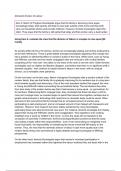
Item A; March of Progress Sociologists argue that the family is becoming more equal.
Increasingly today, both parents are likely to have jobs outside of the home and they both
carry out household chores and provide childcare. However, feminist sociologists reject this
claim. They argue that the family is still patriarchal today and that women carry a dual burden
Using Item A, evaluate the view that the division of labour in couples is now equal [20
marks]
As society shifts into the 21st century, women are increasingly seeking out full time employment,
as the Item references. There is great debate amongst sociologists regarding if this change has
had a positive or detrimental effect on women’s duties in the home. While some, such as Young
and Willmott, see that now this means conjugated roles are more joint, with nuclear families
comprising of the “new man” who takes on his share of the work is now the norm. Other feminist
sociologists such as Oakley and Boulton disagree, and believe that there is no significant shift in
domestic equality - men continue to exploit women’s labour in the home, with an unequal
division, as is inevitable under patriarchy.
On the one hand, as the item says, March of progress Sociologists take a positive outlook of the
modern family; they see that family life is gradually improving for its members due to a long term
trend towards equality and democracy. One of the most prevalent studies that support this view
is Young and Willmott’s ideas surrounding the symmetrical family. The conclusions they drew
from their study of the modern family was that it had become a more equal - or symmetrical- for
its members. Referencing Bott’s conjugal roles, they concluded that there had been a shift to
more joint conjugal roles, as couples began to spend their leisure time together, perhaps due to
greater advancements in technology that meant time on domestic tasks could be saved. Other
elements of the symmetrical family included that an increased amount of women were
participating in paid employment, and an increased amount of men helped with housework and
childcare. However, their research has been widely questioned by many Sociologists,
particularly those who take the feminist view point. For instance, feminist sociologist Ann Oakley
argued that Young and Willmott’s claims were exaggerated - they regarded a man cooking
breakfast once a week as “helpful in the home”, so thus the study did not represent a fair
conception of symmetry. Furthermore, feminist sociologist Boulton pointed out that the study
only looked at tasks rather than responsibilities - even if men were taking on marginally more
house hold tasks, the responsibility of maintaining the house overall still fell heavily on the
women. Thus, the view that the domestic division of labour is split more equally due to the
modern family being more symmetrical is highly debated amongst sociologists of differing
perspectives.
On the other hand, feminist Sociologists argue that women's increased participation in
employment has increased rather than lightened the labour workload they are faced with in the
Item A; March of Progress Sociologists argue that the family is becoming more equal.
Increasingly today, both parents are likely to have jobs outside of the home and they both
carry out household chores and provide childcare. However, feminist sociologists reject this
claim. They argue that the family is still patriarchal today and that women carry a dual burden
Using Item A, evaluate the view that the division of labour in couples is now equal [20
marks]
As society shifts into the 21st century, women are increasingly seeking out full time employment,
as the Item references. There is great debate amongst sociologists regarding if this change has
had a positive or detrimental effect on women’s duties in the home. While some, such as Young
and Willmott, see that now this means conjugated roles are more joint, with nuclear families
comprising of the “new man” who takes on his share of the work is now the norm. Other feminist
sociologists such as Oakley and Boulton disagree, and believe that there is no significant shift in
domestic equality - men continue to exploit women’s labour in the home, with an unequal
division, as is inevitable under patriarchy.
On the one hand, as the item says, March of progress Sociologists take a positive outlook of the
modern family; they see that family life is gradually improving for its members due to a long term
trend towards equality and democracy. One of the most prevalent studies that support this view
is Young and Willmott’s ideas surrounding the symmetrical family. The conclusions they drew
from their study of the modern family was that it had become a more equal - or symmetrical- for
its members. Referencing Bott’s conjugal roles, they concluded that there had been a shift to
more joint conjugal roles, as couples began to spend their leisure time together, perhaps due to
greater advancements in technology that meant time on domestic tasks could be saved. Other
elements of the symmetrical family included that an increased amount of women were
participating in paid employment, and an increased amount of men helped with housework and
childcare. However, their research has been widely questioned by many Sociologists,
particularly those who take the feminist view point. For instance, feminist sociologist Ann Oakley
argued that Young and Willmott’s claims were exaggerated - they regarded a man cooking
breakfast once a week as “helpful in the home”, so thus the study did not represent a fair
conception of symmetry. Furthermore, feminist sociologist Boulton pointed out that the study
only looked at tasks rather than responsibilities - even if men were taking on marginally more
house hold tasks, the responsibility of maintaining the house overall still fell heavily on the
women. Thus, the view that the domestic division of labour is split more equally due to the
modern family being more symmetrical is highly debated amongst sociologists of differing
perspectives.
On the other hand, feminist Sociologists argue that women's increased participation in
employment has increased rather than lightened the labour workload they are faced with in the


