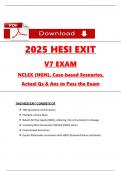
2025 HESI EXIT
V7 EXAM
NCLEX (NGN), Case-based Scenarios,
Actual Qs & Ans to Pass the Exam
THIS HESI EXIT CONSISTS OF
160 Questions and Answers
Multiple-choice Style
Select All That Apply (SATA), ordering, fill-in-the-blank for dosage
including Next Generation NCLEX (NGN) items
Case-based Scenarios
Expert Rationales consistent with HESI−Elsevier/Evolve standards.
,QUESTION 1 (Single Choice – NGN: Behavior and Mental Health)
───────────────────────────────────────────────────────
─
A group of nursing students is touring an inpatient psychiatric unit when a male client
who is in a manic state shouts, “Want to see a crazy person?” and begins to jump up
and down, flap his arms, and cluck like a chicken. Which action is best for the nurse to
take?
A. Direct the students to continue the tour without responding to the client’s behavior.
B. Medicate the client with a PRN prescription for an antianxiety agent.
C. Restrict the client to his room until he can control his behaviors.
D. Redirect the client’s acting-out behavior by asking him to perform a unit task.
ANSWER: D
EXPERT-VERIFIED EXPLANATION:
• Redirecting a manic client’s excess energy toward a constructive task is therapeutic.
• Restricting or ignoring can escalate agitation or reinforce negative behaviors.
• Medication may be warranted if redirection fails, but the nurse should use the least
restrictive intervention first.
• Occupying the client with a goal-directed, structured activity helps channel energy and
maintain the client’s dignity.
───────────────────────────────────────────────────────
─
QUESTION 2 (Single Choice – NGN: Neurologic Trauma & Priority)
───────────────────────────────────────────────────────
─
An adult male client is brought to the emergency department (ED) by ambulance
following a motorcycle collision. He was not wearing a helmet and presents with
,periorbital bruising and bloody drainage from both ears. Which assessment finding
warrants immediate intervention by the nurse?
A. Rebound abdominal tenderness
B. Diminished bilateral breath sounds
C. Nausea with projectile vomiting
D. Rib pain with deep inspiration
ANSWER: C
EXPERT-VERIFIED EXPLANATION:
• Periorbital bruising (raccoon eyes) plus bloody ear drainage suggests a basilar skull
fracture.
• Projectile vomiting indicates increased intracranial pressure, requiring urgent
intervention to prevent herniation and worsening head injury.
• While other symptoms matter, managing potential ICP elevation takes priority here.
───────────────────────────────────────────────────────
─
QUESTION 3 (Select All That Apply – NGN: Pharmacology & Teaching)
───────────────────────────────────────────────────────
─
A client diagnosed with Parkinson’s disease receives a prescription for carbidopa-
levodopa controlled-release (CR) 25/100 mg PO daily each morning. Which information
should the nurse include in the client’s teaching plan? (Select all that apply.)
A. Parkinson symptoms should diminish within one week.
B. Avoid sunlight and wear sunglasses while outdoors.
C. A change in urine color to dark red often occurs while taking this drug.
D. An upset stomach may occur as a side effect of this medication.
, E. The medication should only be taken during a meal.
ANSWERS: C, D
EXPERT-VERIFIED EXPLANATION:
• Carbidopa-levodopa often darkens body fluids (urine, sweat, saliva).
• GI upset is common; taking the medication with or shortly after food can help.
• Therapeutic effects typically take weeks. Photosensitivity is not a primary concern.
───────────────────────────────────────────────────────
─
QUESTION 4 (Dosage Calculation – NGN: IV Infusion Regulation)
───────────────────────────────────────────────────────
─
The healthcare provider (HCP) prescribes 500 mL of 0.45% normal saline with 100 units
regular insulin to infuse at 15 units/hour. The drop factor is 20 gtt/mL. The nurse
should regulate the IV to deliver how many gtt/minute? (Enter numerical value only.)
ANSWER: 25
EXPERT-VERIFIED EXPLANATION:
• 15 units/hour out of 100 units in 500 mL = 75 mL/hour.
• Using a 20 gtt/mL set: (75 mL/hr × 20 gtt/mL) / 60 = 25 gtt/min.
───────────────────────────────────────────────────────
─
QUESTION 5 (Single Choice – NGN: Psychiatric/Mental Health Interventions)
───────────────────────────────────────────────────────
─
V7 EXAM
NCLEX (NGN), Case-based Scenarios,
Actual Qs & Ans to Pass the Exam
THIS HESI EXIT CONSISTS OF
160 Questions and Answers
Multiple-choice Style
Select All That Apply (SATA), ordering, fill-in-the-blank for dosage
including Next Generation NCLEX (NGN) items
Case-based Scenarios
Expert Rationales consistent with HESI−Elsevier/Evolve standards.
,QUESTION 1 (Single Choice – NGN: Behavior and Mental Health)
───────────────────────────────────────────────────────
─
A group of nursing students is touring an inpatient psychiatric unit when a male client
who is in a manic state shouts, “Want to see a crazy person?” and begins to jump up
and down, flap his arms, and cluck like a chicken. Which action is best for the nurse to
take?
A. Direct the students to continue the tour without responding to the client’s behavior.
B. Medicate the client with a PRN prescription for an antianxiety agent.
C. Restrict the client to his room until he can control his behaviors.
D. Redirect the client’s acting-out behavior by asking him to perform a unit task.
ANSWER: D
EXPERT-VERIFIED EXPLANATION:
• Redirecting a manic client’s excess energy toward a constructive task is therapeutic.
• Restricting or ignoring can escalate agitation or reinforce negative behaviors.
• Medication may be warranted if redirection fails, but the nurse should use the least
restrictive intervention first.
• Occupying the client with a goal-directed, structured activity helps channel energy and
maintain the client’s dignity.
───────────────────────────────────────────────────────
─
QUESTION 2 (Single Choice – NGN: Neurologic Trauma & Priority)
───────────────────────────────────────────────────────
─
An adult male client is brought to the emergency department (ED) by ambulance
following a motorcycle collision. He was not wearing a helmet and presents with
,periorbital bruising and bloody drainage from both ears. Which assessment finding
warrants immediate intervention by the nurse?
A. Rebound abdominal tenderness
B. Diminished bilateral breath sounds
C. Nausea with projectile vomiting
D. Rib pain with deep inspiration
ANSWER: C
EXPERT-VERIFIED EXPLANATION:
• Periorbital bruising (raccoon eyes) plus bloody ear drainage suggests a basilar skull
fracture.
• Projectile vomiting indicates increased intracranial pressure, requiring urgent
intervention to prevent herniation and worsening head injury.
• While other symptoms matter, managing potential ICP elevation takes priority here.
───────────────────────────────────────────────────────
─
QUESTION 3 (Select All That Apply – NGN: Pharmacology & Teaching)
───────────────────────────────────────────────────────
─
A client diagnosed with Parkinson’s disease receives a prescription for carbidopa-
levodopa controlled-release (CR) 25/100 mg PO daily each morning. Which information
should the nurse include in the client’s teaching plan? (Select all that apply.)
A. Parkinson symptoms should diminish within one week.
B. Avoid sunlight and wear sunglasses while outdoors.
C. A change in urine color to dark red often occurs while taking this drug.
D. An upset stomach may occur as a side effect of this medication.
, E. The medication should only be taken during a meal.
ANSWERS: C, D
EXPERT-VERIFIED EXPLANATION:
• Carbidopa-levodopa often darkens body fluids (urine, sweat, saliva).
• GI upset is common; taking the medication with or shortly after food can help.
• Therapeutic effects typically take weeks. Photosensitivity is not a primary concern.
───────────────────────────────────────────────────────
─
QUESTION 4 (Dosage Calculation – NGN: IV Infusion Regulation)
───────────────────────────────────────────────────────
─
The healthcare provider (HCP) prescribes 500 mL of 0.45% normal saline with 100 units
regular insulin to infuse at 15 units/hour. The drop factor is 20 gtt/mL. The nurse
should regulate the IV to deliver how many gtt/minute? (Enter numerical value only.)
ANSWER: 25
EXPERT-VERIFIED EXPLANATION:
• 15 units/hour out of 100 units in 500 mL = 75 mL/hour.
• Using a 20 gtt/mL set: (75 mL/hr × 20 gtt/mL) / 60 = 25 gtt/min.
───────────────────────────────────────────────────────
─
QUESTION 5 (Single Choice – NGN: Psychiatric/Mental Health Interventions)
───────────────────────────────────────────────────────
─