

NM704_Exam_1_Study_Guide
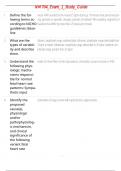
1. Define the fol- mean FHR rounded to the nearest 5 bpm during a 10 minute time period exclud-
lowing terms ac- ing: periodic or episodic changes, periods of marked FHR variability, segments of
cording to NICHD baseline that differ by more than 25 beats per minute;
guidelines: Base-
line
2. What are the Absent: amplitude range undetectable; Minimal: amplitude range detectable but
types of variabil- 5 bpm or fewer; Moderate: amplitude range detectable 6-25 bpm; Marked: am-
ity and describe plitude range greater than 25 bpm
them.
3. Understand the made of nerve fibers in the myocardium, stimulation causes increase in FHR;
following phys-
iologic mecha-
nisms responsi-
ble for normal
fetal heart rate
patterns: Sympa-
thetic input
4. Identify the stimulation of vagus nerve with rapid decent, vaginal exam;
proposed
cause(s),
physiologic
and/or
pathophysiolog-
ic mechanism,
and clinical
significance of
the following
variant fetal
heart rate
, patterns:
Bradycardia
5. Identify the maternal fever, stress response;
proposed
cause(s),
physiologic
and/or
pathophysiolog-
ic mechanism,
and clinical
significance of
the following
variant fetal
heart rate
patterns:
Tachycardia
6. Identify the head compression;
proposed
cause(s),
physiologic
and/or
pathophysiolog-
ic mechanism,
and clinical
significance of
the following
variant fetal
heart rate
patterns: Early
deceleration
, 7. Identify the deficiency of uteroplacental perfusion;
proposed
cause(s),
physiologic
and/or
pathophysiolog-
ic mechanism,
and clinical
significance of
the following
variant fetal
heart rate
patterns: Late
deceleration
with or without
variability
8. Identify the cord compression;
proposed
cause(s),
physiologic
and/or
pathophysiolog-
ic mechanism,
and clinical
significance of
the following
variant fetal
heart rate
patterns:
Variable
deceleration
1. Define the fol- mean FHR rounded to the nearest 5 bpm during a 10 minute time period exclud-
lowing terms ac- ing: periodic or episodic changes, periods of marked FHR variability, segments of
cording to NICHD baseline that differ by more than 25 beats per minute;
guidelines: Base-
line
2. What are the Absent: amplitude range undetectable; Minimal: amplitude range detectable but
types of variabil- 5 bpm or fewer; Moderate: amplitude range detectable 6-25 bpm; Marked: am-
ity and describe plitude range greater than 25 bpm
them.
3. Understand the made of nerve fibers in the myocardium, stimulation causes increase in FHR;
following phys-
iologic mecha-
nisms responsi-
ble for normal
fetal heart rate
patterns: Sympa-
thetic input
4. Identify the stimulation of vagus nerve with rapid decent, vaginal exam;
proposed
cause(s),
physiologic
and/or
pathophysiolog-
ic mechanism,
and clinical
significance of
the following
variant fetal
heart rate
, patterns:
Bradycardia
5. Identify the maternal fever, stress response;
proposed
cause(s),
physiologic
and/or
pathophysiolog-
ic mechanism,
and clinical
significance of
the following
variant fetal
heart rate
patterns:
Tachycardia
6. Identify the head compression;
proposed
cause(s),
physiologic
and/or
pathophysiolog-
ic mechanism,
and clinical
significance of
the following
variant fetal
heart rate
patterns: Early
deceleration
, 7. Identify the deficiency of uteroplacental perfusion;
proposed
cause(s),
physiologic
and/or
pathophysiolog-
ic mechanism,
and clinical
significance of
the following
variant fetal
heart rate
patterns: Late
deceleration
with or without
variability
8. Identify the cord compression;
proposed
cause(s),
physiologic
and/or
pathophysiolog-
ic mechanism,
and clinical
significance of
the following
variant fetal
heart rate
patterns:
Variable
deceleration


