
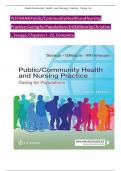
Public/Community q Health q and q Nursing q Practice: q Caring q for
q Populations
TEST BANK Public/Community Health and Nursing
q Practice:Caring for Populations 3rd Edition by Christine
L. Savage, Chapters 1 - 22, Complete
, Public/Community q Health q and q Nursing q Practice: q Caring q for
q Populations
TABLE OF CONTENTS
q q q
I. Basis qfor qPublic qHealth qNursing qKnowledge qand qSkills
1. Public qHealth qand qNursing qPractice
2. Optimizing qPopulation qHealth
3. Epidemiology qand qNursing qPractice
4. Introduction qto q Community q Assessment
5. Health qProgram qPlanning
6. Environmental q Health
II. Community qHealth q Across qPopulations: qPublic qHealth qIssues
7. Health qDisparities qand qthe qSocial qDeterminants qof qHealth
8. Health qand qVulnerable qPopulations
9. Communicable q Diseases
10. Noncommunicable q Diseases
11. Mental qHealth
12. Substance qUse qand qthe qHealth qof qCommunities
13. Injury qand qViolence
III. Public qHealth qPlanning
14. Health qPlanning qfor qLocal qPublic qHealth qDepartments
15. Health qPlanning qfor qAcute qCare qSettings
16. Health qPlanning qfor qPrimary qCare qSettings
17. Health qPlanning qwith qRural qand qUrban qCommunities
18. Health qPlanning qfor q Maternal-Infant q and qChild qHealth qSettings
19. Health qPlanning qfor q School qSettings
20. Health qPlanning qfor q Occupational qand qEnvironmental qHealth
21. Health qPlanning, qPublic qHealth qPolicy, qand q Finance
22. Health qPlanning qfor q Emergency qPreparedness q and qDisaster qManagement
, Public/Community q Health q and q Nursing q Practice: q Caring q for
q Populations
Chapter 1: Public Health and NursingPractice
q q q q q q
Multiple Choice q
Answers are at the end of Each q q q q q q
chapter
q
Identify the choice that best completes the statement or answers the question.
q q q q q q q q q q q
1. Public health nurses (PHNs) know they must approach a public health
q q q q q q q q q q q
q issuewith an understanding of the related underlying risk factors to
q q q q q q q q q
q develop effective nursing interventions. They evaluate these risk
q q q q q q q
q factors from two perspectives:
q q q
1. Disease; individual q
2. Intervention; government q
3. Epidemic; population q
4. Individual; population q
2. A nursing student is studying public health. She learns that, according to
q q q q q q q q q q q q
C.E.A. Winslow’s definition, some of the goals of public health
q q q q q q q q q
q include disease prevention, promoting health, control of
q q q q q q
q communicable infections,and q _.
1. Risk assessment for disease
q q q
2. Promotion of primary care q q q
, Public/Community q Health q and q Nursing q Practice: q Caring q for
q Populations
3. Organization of medical and nursing services for q q q q q q
the earlydiagnosis and preventive treatment of
q q q q q q
q disease
4. Governmental safety regulations q q
3. If the international medical community was working to contain
q q q q q q q q q
several worldwide pandemics, they would look to the World Health
q q q q q q q q q q
q Organization(WHO), which is: q q
1. The public health arm of the United Nations.
q q q q q q q
2. Working to improve health and well-being for
q q q q q q
the globalpopulation.
q q
3. Working with nurses to promote public health interventions.
q q q q q q q
4. All of the above. q q q
4. The Institute of Medicine (IOM), now known as the Health and
q q q q q q q q q q q
Medicine Division (HMD) of the National Academies of Sciences,
q q q q q q q q q
q Engineering, and Medicine, stated in their report, The Future of the
q q q q q q q q q q
q Public’s Health, that there are three core functions that society
q q q q q q q q q
q carries out to collectively supportthe optimum conditions for public
q q q q q q q q
q health. Which one of the following is notone of these functions?
q q q q q q q q q q
1. Prevention
2. Assessment
q Populations
TEST BANK Public/Community Health and Nursing
q Practice:Caring for Populations 3rd Edition by Christine
L. Savage, Chapters 1 - 22, Complete
, Public/Community q Health q and q Nursing q Practice: q Caring q for
q Populations
TABLE OF CONTENTS
q q q
I. Basis qfor qPublic qHealth qNursing qKnowledge qand qSkills
1. Public qHealth qand qNursing qPractice
2. Optimizing qPopulation qHealth
3. Epidemiology qand qNursing qPractice
4. Introduction qto q Community q Assessment
5. Health qProgram qPlanning
6. Environmental q Health
II. Community qHealth q Across qPopulations: qPublic qHealth qIssues
7. Health qDisparities qand qthe qSocial qDeterminants qof qHealth
8. Health qand qVulnerable qPopulations
9. Communicable q Diseases
10. Noncommunicable q Diseases
11. Mental qHealth
12. Substance qUse qand qthe qHealth qof qCommunities
13. Injury qand qViolence
III. Public qHealth qPlanning
14. Health qPlanning qfor qLocal qPublic qHealth qDepartments
15. Health qPlanning qfor qAcute qCare qSettings
16. Health qPlanning qfor qPrimary qCare qSettings
17. Health qPlanning qwith qRural qand qUrban qCommunities
18. Health qPlanning qfor q Maternal-Infant q and qChild qHealth qSettings
19. Health qPlanning qfor q School qSettings
20. Health qPlanning qfor q Occupational qand qEnvironmental qHealth
21. Health qPlanning, qPublic qHealth qPolicy, qand q Finance
22. Health qPlanning qfor q Emergency qPreparedness q and qDisaster qManagement
, Public/Community q Health q and q Nursing q Practice: q Caring q for
q Populations
Chapter 1: Public Health and NursingPractice
q q q q q q
Multiple Choice q
Answers are at the end of Each q q q q q q
chapter
q
Identify the choice that best completes the statement or answers the question.
q q q q q q q q q q q
1. Public health nurses (PHNs) know they must approach a public health
q q q q q q q q q q q
q issuewith an understanding of the related underlying risk factors to
q q q q q q q q q
q develop effective nursing interventions. They evaluate these risk
q q q q q q q
q factors from two perspectives:
q q q
1. Disease; individual q
2. Intervention; government q
3. Epidemic; population q
4. Individual; population q
2. A nursing student is studying public health. She learns that, according to
q q q q q q q q q q q q
C.E.A. Winslow’s definition, some of the goals of public health
q q q q q q q q q
q include disease prevention, promoting health, control of
q q q q q q
q communicable infections,and q _.
1. Risk assessment for disease
q q q
2. Promotion of primary care q q q
, Public/Community q Health q and q Nursing q Practice: q Caring q for
q Populations
3. Organization of medical and nursing services for q q q q q q
the earlydiagnosis and preventive treatment of
q q q q q q
q disease
4. Governmental safety regulations q q
3. If the international medical community was working to contain
q q q q q q q q q
several worldwide pandemics, they would look to the World Health
q q q q q q q q q q
q Organization(WHO), which is: q q
1. The public health arm of the United Nations.
q q q q q q q
2. Working to improve health and well-being for
q q q q q q
the globalpopulation.
q q
3. Working with nurses to promote public health interventions.
q q q q q q q
4. All of the above. q q q
4. The Institute of Medicine (IOM), now known as the Health and
q q q q q q q q q q q
Medicine Division (HMD) of the National Academies of Sciences,
q q q q q q q q q
q Engineering, and Medicine, stated in their report, The Future of the
q q q q q q q q q q
q Public’s Health, that there are three core functions that society
q q q q q q q q q
q carries out to collectively supportthe optimum conditions for public
q q q q q q q q
q health. Which one of the following is notone of these functions?
q q q q q q q q q q
1. Prevention
2. Assessment


