
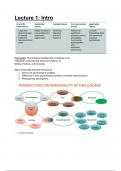
Lecture 1: Intro
Personality: Psychological qualities that contribute to an
individual’s enduring and distinctive patterns of
feeling, thinking, and behaving
Many personality theories because of:
1. Amount of psychological qualities
2. Difference in how psychological qualities contribute (determinants)
3. Philosophical assumptions
,PBL 1: Personality and it’s
intrapsychic forces
Learning goals
What is personality?
- How is personality developed and formed?
What are personality types based on and how do they differ?
What is Jung's perspective on personality?
- How can Jung’s perspective be critiqued?
readings
- Engler, B. (2013). Personality Theories: An introduction (9th).
Wadsworth, Cengage Learning. Chapter 3.
- Neher, A. (1996) Jung’s theory of archetypes: A critique. Journal of
Humanistic Psychology, 36(2), 61-91
reflection tables
Where does Jung’s theory stand on the philosophical assumptions?
Freedom vs Determinism
Hereditary vs Environment
Unique vs Universal
Proactive vs Reactive
Optimism vs Pessimism
To what extent is Jung’s theory scientific?
low avera high
ge
obser
vation
s
syste
matic
testab
le
compr
ehens
, ive
theory
to
applic
ation
Personality theories: an introduction chapter 3
● The nature and Structure of Personality
The structure of personality: a complex network of interacting systems that
strive toward eventual harmony.
- The ego: one’s conscious mind, the part of the psyche that selects
perceptions, thoughts, feelings, and memories that may enter
consciousness.
- The personal unconscious with its complexes.
- The collective unconscious and its archetypes.
Psyche: total personality, or all psychological processes (conscious and
unconscious).
● Psychic Energy
libido: psychic energy, or an undifferentiated life energy.
-> Jung Argued that the phallus represents mana or power as well as
sexuality.
-> sexuality is symbolic
● The personal Unconscious and its Complexes
, The conscious aspect of our personality is always visible whereas the
personal unconscious is mostly invisible but can be uncovered. Experiences in
the personal unconscious are grouped into clusters, which Jung calls
complexes.
Complex: an organized group of thoughts, feelings, and memories about a
particular concept.
constellating power: the complex has the ability to draw new ideas into itself
and interpret them. The more constellating power a complex has, the more
powerful the complex may become.
-> A complex may act like an independent person, behaving independently of
our conscious self and intentions.
● Collective Unconscious
Collective consciousness: consists of certain potentialities that we all share
because we are human and is transpersonal.
-> All humans have certain emotions, and develop some form of family life or
society in which roles are assigned to various members.
Archetype (primordial images): universal thought form or predisposition to
respond to the world in certain ways that lies within the collective unconscious.
-> Predisposition emphasizes potentialities, for archetypes represent different
potential ways in which we may express our humanness.
-> Efforts to deny or destroy archetypes place us at risk of becoming
unbalanced or one-sided.
-> Archetypes can never be fully known or described because they never fully
enter con- sciousness.
-> Jung wrote, “The archetype is a kind of readiness to produce over and over
again the same or similar mythical ideas. Hence it seems as though what is
impressed upon the unconscious were exclusively the subjective
fantasy—ideas aroused by the physical pro- cess. We may therefore assume
that the archetypes are recurrent impressions made by subjective reasons”
(1954).
Influential archetypes:
- Persona: the social role that one assumes in society and one’s under-
standing of it. This role is chosen or assigned. The persona represents
a compromise between one’s true identity and social identity. Changes
in persona lead to dissonance.
- Shadow: unsocial thoughts, feelings, and behaviors that we potentially
possess and other characteristics that we do not accept. opposite to
persona. The shadow cannot be avoided and can also be projected
onto others.
- Anima and Animus: the anima archetype is the feminine side of the
male psyche, and the animus archetype is the masculine side of the
female psyche. One’s anima or animus reflects collective and
individual human experiences throughout the ages pertain- ing to one’s
opposite sex. Expressing opposite-sex characteristics aids in avoiding
Personality: Psychological qualities that contribute to an
individual’s enduring and distinctive patterns of
feeling, thinking, and behaving
Many personality theories because of:
1. Amount of psychological qualities
2. Difference in how psychological qualities contribute (determinants)
3. Philosophical assumptions
,PBL 1: Personality and it’s
intrapsychic forces
Learning goals
What is personality?
- How is personality developed and formed?
What are personality types based on and how do they differ?
What is Jung's perspective on personality?
- How can Jung’s perspective be critiqued?
readings
- Engler, B. (2013). Personality Theories: An introduction (9th).
Wadsworth, Cengage Learning. Chapter 3.
- Neher, A. (1996) Jung’s theory of archetypes: A critique. Journal of
Humanistic Psychology, 36(2), 61-91
reflection tables
Where does Jung’s theory stand on the philosophical assumptions?
Freedom vs Determinism
Hereditary vs Environment
Unique vs Universal
Proactive vs Reactive
Optimism vs Pessimism
To what extent is Jung’s theory scientific?
low avera high
ge
obser
vation
s
syste
matic
testab
le
compr
ehens
, ive
theory
to
applic
ation
Personality theories: an introduction chapter 3
● The nature and Structure of Personality
The structure of personality: a complex network of interacting systems that
strive toward eventual harmony.
- The ego: one’s conscious mind, the part of the psyche that selects
perceptions, thoughts, feelings, and memories that may enter
consciousness.
- The personal unconscious with its complexes.
- The collective unconscious and its archetypes.
Psyche: total personality, or all psychological processes (conscious and
unconscious).
● Psychic Energy
libido: psychic energy, or an undifferentiated life energy.
-> Jung Argued that the phallus represents mana or power as well as
sexuality.
-> sexuality is symbolic
● The personal Unconscious and its Complexes
, The conscious aspect of our personality is always visible whereas the
personal unconscious is mostly invisible but can be uncovered. Experiences in
the personal unconscious are grouped into clusters, which Jung calls
complexes.
Complex: an organized group of thoughts, feelings, and memories about a
particular concept.
constellating power: the complex has the ability to draw new ideas into itself
and interpret them. The more constellating power a complex has, the more
powerful the complex may become.
-> A complex may act like an independent person, behaving independently of
our conscious self and intentions.
● Collective Unconscious
Collective consciousness: consists of certain potentialities that we all share
because we are human and is transpersonal.
-> All humans have certain emotions, and develop some form of family life or
society in which roles are assigned to various members.
Archetype (primordial images): universal thought form or predisposition to
respond to the world in certain ways that lies within the collective unconscious.
-> Predisposition emphasizes potentialities, for archetypes represent different
potential ways in which we may express our humanness.
-> Efforts to deny or destroy archetypes place us at risk of becoming
unbalanced or one-sided.
-> Archetypes can never be fully known or described because they never fully
enter con- sciousness.
-> Jung wrote, “The archetype is a kind of readiness to produce over and over
again the same or similar mythical ideas. Hence it seems as though what is
impressed upon the unconscious were exclusively the subjective
fantasy—ideas aroused by the physical pro- cess. We may therefore assume
that the archetypes are recurrent impressions made by subjective reasons”
(1954).
Influential archetypes:
- Persona: the social role that one assumes in society and one’s under-
standing of it. This role is chosen or assigned. The persona represents
a compromise between one’s true identity and social identity. Changes
in persona lead to dissonance.
- Shadow: unsocial thoughts, feelings, and behaviors that we potentially
possess and other characteristics that we do not accept. opposite to
persona. The shadow cannot be avoided and can also be projected
onto others.
- Anima and Animus: the anima archetype is the feminine side of the
male psyche, and the animus archetype is the masculine side of the
female psyche. One’s anima or animus reflects collective and
individual human experiences throughout the ages pertain- ing to one’s
opposite sex. Expressing opposite-sex characteristics aids in avoiding


