
• Wrong document? Swap it for free
  • Written by students who passed
  • Immediately available after payment
  • Read online or as PDF
Sell
Where do you study
Your language
Document preview thumbnail
Preview 4 out of 93 pages
Exam (elaborations)

Certified Professional In Patient Safety Exam. Questions With 100% Correct Answers.

Document preview thumbnail
Preview 4 out of 93 pages

CERCLA Short-term removal Actions may be taken to address releases or threatened releases requiring prompt response CERCLA Long-term remedial response action which permanently and significantly reduce the dangers associated with releases or threats of releases of hazardous substances that are serious, but not immediately life threatening. These actions can be conducted only at sites listed on EPA's National Priorities List (NPL). Superfund Amendment and Reauthorization Act of 1986 Amended the CERCLA on October 17, 1986. SARA included several important changes: Stressed the importance of permanent remedies and innovative treatment technologies in cleaning up hazardous waste sites • Required Superfund actions to consider the standards and requirements found in other State and Federal environmental laws and regulations • Provided new enforcement authorities and settlement tools • Increased State involvement in every phase of the Superfund program • Increased the focus on human health problems posed by hazardous waste sites • Encouraged greater citizen participation in making decisions on how sites should be cleaned up • Increased the size of the trust fund to $8.5 billion Toxic Substances Control Act Became law on October 11, 1976 -Authorized the EPA to secure information on all new and existing chemical substances, as well as to control any of the substances that were determined to cause unreasonable risk to public health or the environment. Emergency Planning and Community Right to Know Act Enacted by Congress on October 17, 1986. -Covered the national public disclosure of emergency information regarding chemical emergencies and dangers. Federal Insecticide, Fungicide, and Rodenticide Act -Enacted in 1972. -Amended initial act to specify methods and standards of control in greater detail. -Clarified duties and responsibilities of the EPA. Asbestos Hazard Emergency Response Act Signed into law in 1986 as Title II of the Toxic Substances Control Act Asbestos School Hazard Abatement Reauthorization Act Enacted in 1990. Required accreditation of personnel working on asbestos activities in schools and public and commercial buildings. 29 CFR 1910.1200 Hazard Communication Standard -Purpose of this standard is to ensure that the hazards of all chemicals produced or imported are evaluated and that information concerning their hazards are transmitted to employers and employees. Ionizing radiation -Occurs as the result of particles or electromagnetic waves having enough energy to detach electrons from atoms or molecules, thereby causing ionization of the atom. -Ionizing radiation comes from radioactive materials, X-ray tubes, particle accelerators and is present in the natural environment. -There are two ways to cause ionization: direct and indirect Direct ionization Occurs as a result of charged particle interaction with matter. Indirect ionization Occurs as a result of uncharged particle interaction with matter through collision. Particle Radiation Three types include: Alpha Beta Neutron Alpha Radiation -Is a helium nucleus that has two neutrons and two protons. -Causes radiation through direct ionization. -It will not penetrate a layer of skin and does not pose any known external radiation hazard. -Major hazard is potential for internal damage. Beta Radiation Particles are excess electrons. Beta particles cannot penetrate the body. They can penetrate dead outer layer skin and result in damage to live skin cells. Can also cause damage to the lenses of the eyes. Neutron Radiation Indirect ionizing radiation Electromagnetic Radiation The two types of electromagnetic radiation are: Gamma X-rays Gamma Radiation -Many beta emitters also Emmett gamma rays. -Rays have no charge and are highly penetrating to tissue. -Three ways gamma rays interact with matter: Photoelectric Compton effect Pair production X-rays Properties are the same as gamma rays but have less energy. Radioactive half-life The half-life of a radioactive element is the time it takes for one-half of the atoms of that substance to disintegrate into another nuclear form. This can range from seconds to billions of year 29 CFR 1910.1096 Standards for ionizing radiation Non ionizing radiation Includes spectrum of: ultraviolet Visible light Infrared (IR) Microwave (MW) Radio frequency (RF) Extremely low frequency (ELF) Lasers commonly operate in the UV, visible, and IR frequencies. LASER Light amplification by stimulated emission of radiation Effective radiance The measurement of some radiometers used to measure actinic UV. SMART Specific Measurable Attainable Realistic/relevant Time-bound National Environmental Policy Act Established January 1, 1970 by Richard Nixon Established national environmental policy and goals for protection, maintenance, and enhancements of the environment and provides a process for implementing these goals within federal agencies. Resource Conservation Recovery Act -The nations primary law governing the disposal of solid and hazardous waste. -Congress passed on October 21, 1976. Established to address the increasing problem the nation faced from our growing volume of municipal and industrial waste. Established three distinct and interrelated programs: -The solid waste program -The hazardous waste program -The underground storage tank program Focuses on active and future facilities, not historical sites EPA Oil Management Criteria Origin Use Contaminants Chemical hygiene plan Provides guidelines for prudent practices and procedures for the use of chemicals in the laboratory. Lab Safety Record keeping Employers must maintain worker exposure records for 30 years and medical records for the duration of the workers employment plus 30 year Botulism Cases of botulism are usually associated with consumption of preserved foods. However, botulinum toxins are currently among the most common compounds explored by terrorists for use as biological weapons. Botulinum neurotoxins, the causative agents of botulism, are HHS/CDC select agents. Hantavirus Hantaviruses are transmitted to humans from the dried droppings, urine, or saliva of mice and rats. Animal laboratory workers and persons working in infested buildings are at increased risk to this disease. Ricin Ricin is one of the most toxic and easily produced plant toxins. It has been used in the past as a bioterrorist weapon and remains a serious threat. Ricin is an HHS/CDC select toxin. Tularemia Tularemia is also known as "rabbit fever" or "deer fly fever" and is extremely infectious. Relatively few bacteria are required to cause the disease, which is why it is an attractive weapon for use in bioterrorism. Francis Ella tularensis, the causative agent for tularemia, is an HHS/CDC select agent.

Content preview

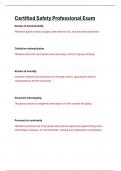
Certified Safety Professional Exam
Illusion of invulnerability
Members ignore obvious danger, take extreme risk, and are overly optimistic


Collective rationalization
Members discredit and explain away warning contrary to group thinking.


Illusion of morality
members believe their decisions are morally correct, ignoring the ethical
consequences of their decisions


Excessive stereotyping
The group constructs negative stereotypes of rivals outside the group.


Pressure for conformity
Members pressure any in the group who express arguments against the group's
stereotypes, illusions, or commitments, viewing such opposition as disloyalty.

,Self-censorship
Members withhold their dissenting views and counter-arguments


Illusion of unanimity
Members perceive falsely that everyone agrees with the group's decision; silence is
seen as consent.


Mind guards
Some members appoint themselves to the role of protecting the group from adverse
information that might threaten group complacency


Coliform
a type of bacteria found in human and animal wastes that are not harmful to
humans. They can be an indicator of the presence of other harmful bacteria.


Common oxidizing agents
Fluorine
Chlorine
Ozone
Sulfuric acid

,Hydrogen peroxide
Oxygen
Perchloric acid
Hypochlorous acid
Metallic iodates
Metal chlorates
Bromine
Lead dioxide
Ferric salts
Metallic permanganates
Iodine
Metallic dichromates
Sulfur
Nitric acid
Stannic salts


Compound LELs

, The International Maritime Organization (IMO)
United Nations specialized agency with responsibility for the safety and security of
shipping and the prevention of marine pollution by ships.


International Maritime Dangerous Goods Code
Relates to the safe carriage of dangerous goods by sea


United Nations Environment Programme (UNEP)
Coordinates its environmental activities, assisting developing countries in
implementing environmentally sound policies and practices.


International Association for Impact Assessment (IAIA)
International association of professionals involved with impact assessment,
including both social impact assessment and environmental impact assessment.


Document information

Uploaded on
March 18, 2025
Number of pages
93
Written in
2024/2025
Type
Exam (elaborations)
Contains
Questions & answers
$11.49

Wrong document? Swap it for free Within 14 days of purchase and before downloading, you can choose a different document. You can simply spend the amount again.
Written by students who passed
Immediately available after payment
Read online or as PDF

Seller avatar
Reputation scores are based on the amount of documents a seller has sold for a fee and the reviews they have received for those documents. There are three levels: Bronze, Silver and Gold. The better the reputation, the more your can rely on the quality of the sellers work.
jhaque
4.0
(67)
Sold
793
Followers
708
Items
804
Last sold
1 month ago


Why students choose Stuvia

Created by fellow students, verified by reviews

Quality you can trust: written by students who passed their tests and reviewed by others who've used these notes.

Didn't get what you expected? Choose another document

No worries! You can instantly pick a different document that better fits what you're looking for.

Pay as you like, start learning right away

No subscription, no commitments. Pay the way you're used to via credit card and download your PDF document instantly.

Student with book image

“Bought, downloaded, and aced it. It really can be that simple.”

Alisha Student

Working on your references?

Create accurate citations in APA, MLA and Harvard with our free citation generator.

Working on your references?

Frequently asked questions
