

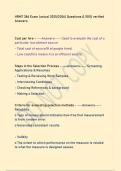
HRMT 386 Exam (actual 2025/2026) Questions & 100% verified
Answers
Cost per hire - ---Answers---- Used to evaluate the cost of a
particular recruitment source
- Total cost of source/# of people hired.
- Low cost/hire means it is an efficient source.
Steps in the Selection Process - ---Answers---- Screening
Applications & Resumes
- Testing & Reviewing Work Samples
- Interviewing Candidates
- Checking References & background
- Making a Selection
Criteria for evaluating selection methods - ---Answers----
Reliability
o Type of measurement indicates how free that measurement
is from random error.
o Generates consistent results.
- Validity
o The extent to which performance on the measure is related
to what the measure is designed assess.
,o To determine validity - compare many peoples scores on
that score with their job performance.
- Correlation Coefficient
o The statistics that measure the degree with which two sets
of numbers are related.
o A higher correlation signifies a stronger relationship.
Criterion-Related Validity - ---Answers---- Measure of
validity based on showing a substantial correlation between
test scores and job performance scores.
Predictive validation - ---Answers---- Uses test scores of all
applicants & looks for a relationship between the scores &
future performance.
- Administers the test, waits, then measures the performance
of the applicants hired.
Concurrent validation - ---Answers---- Administers a test to
people who currently hold a job then compare their scores to
existing measures of job performance.
- If those who score higher on the test also do better on the
test then it is assumed to be valid.
Content Validity - ---Answers---- Consistency between the
test items or problems & the kinds of situations or problems
that occur on the job.
,- Exposes the applicant to situations that are likely to occur on
the job.
- Tests if they have the knowledge, skills, abilities or other
competencies to handle the situations.
Construct Validity - ---Answers---- Establishing that tests to
measure intelligence, leadership ability show that mastery of
these areas are associated with successful performance on
the job.
Legal Requirements for Employee Selection - ---Answers----
When selection a new employee or a promotion
- The election process needs to be conducted in a way that
avoids human rights & privacy complaints.
- Interview needs to be conducted in a way that candidates can
be assessed without drawing out info that is not relevant to
the job being filled.
- Can't gather info that is about prohibited grounds of
discrimination.
- Interview notes can't contain discriminatory details.
- Candidates must provide consent before a background or
reference check can be conducted.
Why do organizations and individuals enter into employment
relationships? - ---Answers---- Economic Relationship
o Employers hire workers to accomplish tasks.
o There is an exchange of value between the worker &
employer.
, o Exchange time & skills (labour) for remuneration (wages &
benefits)
o Workers enter into the relationship because they must
exchange their labour with someone to acquire money by
which they purchase the necessities of life.
o Duties & obligations are asymmetrical: the employer issues
orders & the employee obeys
o Employers must profit or fail - so pressures to decrease
labour cost.
o Maximize profits while workers try to increase wages and
control work conditions.
- Social Relationship
o By accepting employment, the workers are accepting
managerial authority and agreeing to comply with the rules &
direction.
o Employment entails cooperation between workers and
employers (labour & capital)
o Both parties benefit from a profitable business.
o Diverging interests create conflict (profit vs. wages,
determining how & how quickly work will be done)
What does the word resource in the term human resource
management suggest about the nature of the employment
relationship? - ---Answers---- People are valuable.
- People provide a competitive advantage to the organizations
- Their characteristics: training, experience, judgement,
intelligence, relationship & insight can add economic value to
the organization.
Answers
Cost per hire - ---Answers---- Used to evaluate the cost of a
particular recruitment source
- Total cost of source/# of people hired.
- Low cost/hire means it is an efficient source.
Steps in the Selection Process - ---Answers---- Screening
Applications & Resumes
- Testing & Reviewing Work Samples
- Interviewing Candidates
- Checking References & background
- Making a Selection
Criteria for evaluating selection methods - ---Answers----
Reliability
o Type of measurement indicates how free that measurement
is from random error.
o Generates consistent results.
- Validity
o The extent to which performance on the measure is related
to what the measure is designed assess.
,o To determine validity - compare many peoples scores on
that score with their job performance.
- Correlation Coefficient
o The statistics that measure the degree with which two sets
of numbers are related.
o A higher correlation signifies a stronger relationship.
Criterion-Related Validity - ---Answers---- Measure of
validity based on showing a substantial correlation between
test scores and job performance scores.
Predictive validation - ---Answers---- Uses test scores of all
applicants & looks for a relationship between the scores &
future performance.
- Administers the test, waits, then measures the performance
of the applicants hired.
Concurrent validation - ---Answers---- Administers a test to
people who currently hold a job then compare their scores to
existing measures of job performance.
- If those who score higher on the test also do better on the
test then it is assumed to be valid.
Content Validity - ---Answers---- Consistency between the
test items or problems & the kinds of situations or problems
that occur on the job.
,- Exposes the applicant to situations that are likely to occur on
the job.
- Tests if they have the knowledge, skills, abilities or other
competencies to handle the situations.
Construct Validity - ---Answers---- Establishing that tests to
measure intelligence, leadership ability show that mastery of
these areas are associated with successful performance on
the job.
Legal Requirements for Employee Selection - ---Answers----
When selection a new employee or a promotion
- The election process needs to be conducted in a way that
avoids human rights & privacy complaints.
- Interview needs to be conducted in a way that candidates can
be assessed without drawing out info that is not relevant to
the job being filled.
- Can't gather info that is about prohibited grounds of
discrimination.
- Interview notes can't contain discriminatory details.
- Candidates must provide consent before a background or
reference check can be conducted.
Why do organizations and individuals enter into employment
relationships? - ---Answers---- Economic Relationship
o Employers hire workers to accomplish tasks.
o There is an exchange of value between the worker &
employer.
, o Exchange time & skills (labour) for remuneration (wages &
benefits)
o Workers enter into the relationship because they must
exchange their labour with someone to acquire money by
which they purchase the necessities of life.
o Duties & obligations are asymmetrical: the employer issues
orders & the employee obeys
o Employers must profit or fail - so pressures to decrease
labour cost.
o Maximize profits while workers try to increase wages and
control work conditions.
- Social Relationship
o By accepting employment, the workers are accepting
managerial authority and agreeing to comply with the rules &
direction.
o Employment entails cooperation between workers and
employers (labour & capital)
o Both parties benefit from a profitable business.
o Diverging interests create conflict (profit vs. wages,
determining how & how quickly work will be done)
What does the word resource in the term human resource
management suggest about the nature of the employment
relationship? - ---Answers---- People are valuable.
- People provide a competitive advantage to the organizations
- Their characteristics: training, experience, judgement,
intelligence, relationship & insight can add economic value to
the organization.


