

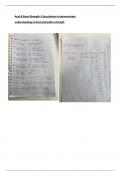
Acid & Base Strength: Calculations to demonstrate
understanding of Acid and buffer strength
,Values of Ka – practical work to determine Ka values of
carried-out titrations
This experiment aims to discover the acid dissociation constant (Ka) values of
weak acids and strong alkalis using titrations and pH analysis.
Weak acid/ Strong Alkali
,Weak acid: Ethanoic Acid
Strong Alkali: Sodium Hydroxide
First, I need to calculate the exact amount of ethanoic acid needed to neutralise
25.0 cm3 of sodium hydroxide. After that, combine half of the fresh ethanoic acid
sample with 25.0 cm3 of sodium hydroxide and test the ph. This pH reading will
allow me to compute the Ka.
Method usage:
Step 1: Set up the titration apparatus. Fill the burette with 0.1M ethanoic acid via
funnel.
2. Add 25.0 cm3 of sodium hydroxide to a beaker using a pipette.
3. Add 2-3 drops of phenolphthalein indicator to the beaker and whirl.
4. Use the burette to spin the ethanoic acid solution until it goes from pink to
colorless.
5. Titrate at least three times for consistent results and to determine the mean titre.
6. For half-neutralization, add 25.0 cm3 of sodium hydroxide to a beaker. Fill a
burette with ethanoic acid without adding the indicator.
7.Add exactly half of the average ethanoic acid concentration to the NaOH beaker.
8.Swirl to mix, then use a calibrated pH metre to test the pH of the half-neutralized
solution in the beaker. When the reading is steady, record the pH.
, Mean= 25 + 25 + 24.5 = 74.5
74.5 ÷ 3 = 24.83
V / 2= 24.83 ÷ 2 = 12.415
Determining the acid dissociation constant (Ka) for ethanoic acid
The equation that represents the acid dissociation constant for a weak acid is:
Ka = [H⁺][A⁻] / [HA]
• Hydrogen Ion Concentration at Equivalence Point: The concentration of
hydrogen ions (H⁺) at an acid-base titration's equivalence point. It is normally
calculated using the pH value recorded at the equivalency point.
• The conjugate base concentration at the titration's equivalence point is
denoted as [A⁻].
• The concentration of the weak acid that remains unreacted at the
equivalence point of the acid-base titration is denoted by the symbol [HA].
At the equivalence point in acid-base titrations, [H⁺] indicates the hydrogen ion
concentration, [A⁻] the conjugate base concentration, and [HA] the residual weak
acid concentration.
understanding of Acid and buffer strength
,Values of Ka – practical work to determine Ka values of
carried-out titrations
This experiment aims to discover the acid dissociation constant (Ka) values of
weak acids and strong alkalis using titrations and pH analysis.
Weak acid/ Strong Alkali
,Weak acid: Ethanoic Acid
Strong Alkali: Sodium Hydroxide
First, I need to calculate the exact amount of ethanoic acid needed to neutralise
25.0 cm3 of sodium hydroxide. After that, combine half of the fresh ethanoic acid
sample with 25.0 cm3 of sodium hydroxide and test the ph. This pH reading will
allow me to compute the Ka.
Method usage:
Step 1: Set up the titration apparatus. Fill the burette with 0.1M ethanoic acid via
funnel.
2. Add 25.0 cm3 of sodium hydroxide to a beaker using a pipette.
3. Add 2-3 drops of phenolphthalein indicator to the beaker and whirl.
4. Use the burette to spin the ethanoic acid solution until it goes from pink to
colorless.
5. Titrate at least three times for consistent results and to determine the mean titre.
6. For half-neutralization, add 25.0 cm3 of sodium hydroxide to a beaker. Fill a
burette with ethanoic acid without adding the indicator.
7.Add exactly half of the average ethanoic acid concentration to the NaOH beaker.
8.Swirl to mix, then use a calibrated pH metre to test the pH of the half-neutralized
solution in the beaker. When the reading is steady, record the pH.
, Mean= 25 + 25 + 24.5 = 74.5
74.5 ÷ 3 = 24.83
V / 2= 24.83 ÷ 2 = 12.415
Determining the acid dissociation constant (Ka) for ethanoic acid
The equation that represents the acid dissociation constant for a weak acid is:
Ka = [H⁺][A⁻] / [HA]
• Hydrogen Ion Concentration at Equivalence Point: The concentration of
hydrogen ions (H⁺) at an acid-base titration's equivalence point. It is normally
calculated using the pH value recorded at the equivalency point.
• The conjugate base concentration at the titration's equivalence point is
denoted as [A⁻].
• The concentration of the weak acid that remains unreacted at the
equivalence point of the acid-base titration is denoted by the symbol [HA].
At the equivalence point in acid-base titrations, [H⁺] indicates the hydrogen ion
concentration, [A⁻] the conjugate base concentration, and [HA] the residual weak
acid concentration.


