
Course: chemistry note Molecule Builder Gizmo
School: collin county community college
Student Exploration: Molecule Builder
Directions: Follow the instructions to go through the simulation. Respond to the questions and
prompts in the orange boxes.
Vocabulary: chemical bond, chemical formula, covalent bond, double covalent bond, cyclic
molecule, hydrocarbon, ionic bond, isomers, Lewis structure, molecule, organic compound
Prior Knowledge Questions (Do these BEFORE using the Gizmo.) Look at the
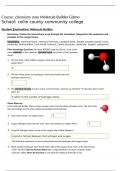
water molecule. In the molecule, chemical bonds are shown as lines between
atoms.
1. The red atom in the middle is oxygen. How many bonds does
oxygen have?
2
2. The two white atoms are hydrogens. How many bonds does one
hydrogen atom have?.
1
3. The chemical formula of water is H2O. In this formula, what do you think the "2" between the H and O
refers to?
It refers to the number of hydrogen atoms.
Gizmo Warm-up
In the Molecule Builder Gizmo, drag an oxygen atom into the white simulation area. The short blue
lines extending from the atom represent possible chemical bonds.
1. How many bonds can oxygen form? 2
2. Drag a hydrogen atom into the area. How many bonds can oxygen form? 1
3. Drag the hydrogen atom on top of the oxygen atom. What happens?
A bond is formed between the hydrogen and oxygen.
The black line represents a chemical bond between the hydrogen and oxygen atoms.
4. Bond another hydrogen atom to the other side of the oxygen atom. Now, enter the formula
"H2O" into the Type the formula below box. Congratulations! You have created a water
molecule. Select Show 3D structure to see what the molecule looks like in 3D.
, Get the Gizmo ready:
Activity A: Simple
● Check that the Free build mode is selected.
molecules ● If necessary, double-click on the trash can icon to clear the
simulation area.
Introduction: Not every group of bonded atoms is a molecule. In a molecule, the chemical bonds connecting atoms are
covalent bonds. In a covalent bond, bonded atoms share pairs of electrons. (In an ionic bond, electrons are transferred
from one atom to another.).
Question: What is the structure and chemical formula of simple molecules?
1. Explore. On your own, experiment by dragging different atoms into the simulation screen and bond them
together. When you have completed a molecule, try typing its formula into the “Type formula” box. See if you
can figure out how to write formulas for simple molecules.
When you enter the correct formula for a molecule you built, it appears in the Completed molecules area. Which
molecules have you completed so far?
H₂SO and H₄SNClC,
2. List: Drag each element into the area. How many bonds can each element form?
Carbon: 4 Nitrogen: 3 Chlorine:1 Sulfur: 2 Hydrogen: 1 Oxygen: 2
Which element forms the greatest number of bonds? Carbon
3. Create: Clear the simulation area, then drag two oxygen atoms into the area.
A. Create a bond between the two oxygen atoms. How many bonds does each atom have 1
remaining?
B. Click on the bond. What happens? It creates a double bond between the two atoms
This is a double covalent bond. In this bond, two pairs of electrons are shared.
Enter the formula O2 into the box, then view the 3D molecule. Notice the subscript “2” follows the element it
describes, in this case oxygen.
4. Create: Clear the screen, then drag out two nitrogen atoms. Bond them together to form an N2 molecule.
What type of bond do you think you formed? Triple covalent bond
Enter the formula into the area, then view the 3D nitrogen gas molecule. Nitrogen molecules contain triple bonds, so
they share three pairs of electrons.
School: collin county community college
Student Exploration: Molecule Builder
Directions: Follow the instructions to go through the simulation. Respond to the questions and
prompts in the orange boxes.
Vocabulary: chemical bond, chemical formula, covalent bond, double covalent bond, cyclic
molecule, hydrocarbon, ionic bond, isomers, Lewis structure, molecule, organic compound
Prior Knowledge Questions (Do these BEFORE using the Gizmo.) Look at the
water molecule. In the molecule, chemical bonds are shown as lines between
atoms.
1. The red atom in the middle is oxygen. How many bonds does
oxygen have?
2
2. The two white atoms are hydrogens. How many bonds does one
hydrogen atom have?.
1
3. The chemical formula of water is H2O. In this formula, what do you think the "2" between the H and O
refers to?
It refers to the number of hydrogen atoms.
Gizmo Warm-up
In the Molecule Builder Gizmo, drag an oxygen atom into the white simulation area. The short blue
lines extending from the atom represent possible chemical bonds.
1. How many bonds can oxygen form? 2
2. Drag a hydrogen atom into the area. How many bonds can oxygen form? 1
3. Drag the hydrogen atom on top of the oxygen atom. What happens?
A bond is formed between the hydrogen and oxygen.
The black line represents a chemical bond between the hydrogen and oxygen atoms.
4. Bond another hydrogen atom to the other side of the oxygen atom. Now, enter the formula
"H2O" into the Type the formula below box. Congratulations! You have created a water
molecule. Select Show 3D structure to see what the molecule looks like in 3D.
, Get the Gizmo ready:
Activity A: Simple
● Check that the Free build mode is selected.
molecules ● If necessary, double-click on the trash can icon to clear the
simulation area.
Introduction: Not every group of bonded atoms is a molecule. In a molecule, the chemical bonds connecting atoms are
covalent bonds. In a covalent bond, bonded atoms share pairs of electrons. (In an ionic bond, electrons are transferred
from one atom to another.).
Question: What is the structure and chemical formula of simple molecules?
1. Explore. On your own, experiment by dragging different atoms into the simulation screen and bond them
together. When you have completed a molecule, try typing its formula into the “Type formula” box. See if you
can figure out how to write formulas for simple molecules.
When you enter the correct formula for a molecule you built, it appears in the Completed molecules area. Which
molecules have you completed so far?
H₂SO and H₄SNClC,
2. List: Drag each element into the area. How many bonds can each element form?
Carbon: 4 Nitrogen: 3 Chlorine:1 Sulfur: 2 Hydrogen: 1 Oxygen: 2
Which element forms the greatest number of bonds? Carbon
3. Create: Clear the simulation area, then drag two oxygen atoms into the area.
A. Create a bond between the two oxygen atoms. How many bonds does each atom have 1
remaining?
B. Click on the bond. What happens? It creates a double bond between the two atoms
This is a double covalent bond. In this bond, two pairs of electrons are shared.
Enter the formula O2 into the box, then view the 3D molecule. Notice the subscript “2” follows the element it
describes, in this case oxygen.
4. Create: Clear the screen, then drag out two nitrogen atoms. Bond them together to form an N2 molecule.
What type of bond do you think you formed? Triple covalent bond
Enter the formula into the area, then view the 3D nitrogen gas molecule. Nitrogen molecules contain triple bonds, so
they share three pairs of electrons.


