

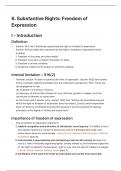
6. Substantive Rights: Freedom of
Expression
I - Introduction
Definition
• Section 16 of the Constitution guarantees the right to freedom of expression.
• Section 16(1) provides that everyone has the right to freedom of expression which
includes:
1. Freedom of the press and other media
2. Freedom to receive or impart information or ideas
3. Freedom of artistic creativity
4. Academic freedom and freedom of scientific research
Internal limitation – S16(2)
• However, section 16 does not protect all forms of expression. Section 16(2) lists several
forms of speech explicitly excluded from the protections contained in 16(1). These are:
(a) propaganda for war,
(b) incitement of imminent violence
(c) advocacy of hatred that is based on race, ethnicity, gender or religion, and that
constitutes incitement to cause harm.
• As the Court said in Islamic Unity: section 16(2) thus “defines the boundaries beyond
which the right to freedom of expression does not extend…[since] certain expression
does not deserve constitutional protection because it has the potential to impinge
adversely on the dignity of others and cause harm.’
Importance of freedom of expression
• Why is freedom of expression important?
1. Implicit recognition and protection of individuals’ moral agency. The ability to form
and express opinions is crucial for democracy and for individuals personally, even
where those views are controversial – South African National Defence Union v Minister
of Defence (para 8).
2. Instrumental in guaranteeing and maintaining a democratic society because it is
one of a ‘web of mutually supporting rights’, closely related to, and therefore supportive
of, the right to freedom of association, right to vote, and the right to freedom of religion
– South African National Defence Union (para 7).
3. Facilitation of the search for truth by individuals and society more generally
, II -UnlikeScope and ambit of the right:
United States Constitution, section 16 does not protect right to freedom of speech
•
but right to freedom of expression. The term ‘expression’ is much broader than ‘speech’
and includes symbolic acts and physical gestures.
(a) CC has held that right encompasses ideas that offend, shock or disturb – Islamic
United Convention.
(b) False speech is in principle protected, but easier to limit since easier to justify using
provisions of limitation analysis.
(c) Expression which is excluded from protection by s16(2) is not banned by the
Constitution; it is just not protected by s16(1).
Why does the Constitution not protect S16(2) items?
• Reason: Because of the harm it may pose to the constitutionally mandated objective of
building the non-racial and non-sexist society based on dignity and equality – Islamic
Unity Convention (para 31).
◦ The Constitution therefore permits the enactment of legislation that prohibits forms of
expression in 16(2). This prohibition is not a limitation on the right in section 16.
◦ It follows from this that all forms of expression outside of 16(2), if restricted by the
state, must be justified in terms of limitation clause.
◦ If restrictions on protected expression are imposed by private institutions, they will be
difficult to justify since they would not constitute a law of general application.
• Example of child pornography in De Reuck v Director of Public Prosecutions:
1. CC held that child porn was protected i.e. it fell into scope and ambit of 16(1). Not
excluded from protection by 16(2).
2. CC found, however, that the relevant section of the Film and Publications Act which
limited the right in respect of child porn was reasonable and justifiable under s36
because:
a. Nature of the right: child porn has little value, is found on the periphery of the right
in s16(1), and is not protected in other democratic societies
b. Purpose of limitation: the purpose of (section 27.1) of the Act was extremely
important. It aimed to curb child porn because it undermines the dignity of
allchildren, harms those particular children involved, and reinforces the belief that
sex with children is normal.
c. Extent of limitation: limitation did not impose a blanket ban on possession of child
porn, but only on recreational use thereof, and so did not prohibit use of such
material for academic or documentary purposes.
2
Expression
I - Introduction
Definition
• Section 16 of the Constitution guarantees the right to freedom of expression.
• Section 16(1) provides that everyone has the right to freedom of expression which
includes:
1. Freedom of the press and other media
2. Freedom to receive or impart information or ideas
3. Freedom of artistic creativity
4. Academic freedom and freedom of scientific research
Internal limitation – S16(2)
• However, section 16 does not protect all forms of expression. Section 16(2) lists several
forms of speech explicitly excluded from the protections contained in 16(1). These are:
(a) propaganda for war,
(b) incitement of imminent violence
(c) advocacy of hatred that is based on race, ethnicity, gender or religion, and that
constitutes incitement to cause harm.
• As the Court said in Islamic Unity: section 16(2) thus “defines the boundaries beyond
which the right to freedom of expression does not extend…[since] certain expression
does not deserve constitutional protection because it has the potential to impinge
adversely on the dignity of others and cause harm.’
Importance of freedom of expression
• Why is freedom of expression important?
1. Implicit recognition and protection of individuals’ moral agency. The ability to form
and express opinions is crucial for democracy and for individuals personally, even
where those views are controversial – South African National Defence Union v Minister
of Defence (para 8).
2. Instrumental in guaranteeing and maintaining a democratic society because it is
one of a ‘web of mutually supporting rights’, closely related to, and therefore supportive
of, the right to freedom of association, right to vote, and the right to freedom of religion
– South African National Defence Union (para 7).
3. Facilitation of the search for truth by individuals and society more generally
, II -UnlikeScope and ambit of the right:
United States Constitution, section 16 does not protect right to freedom of speech
•
but right to freedom of expression. The term ‘expression’ is much broader than ‘speech’
and includes symbolic acts and physical gestures.
(a) CC has held that right encompasses ideas that offend, shock or disturb – Islamic
United Convention.
(b) False speech is in principle protected, but easier to limit since easier to justify using
provisions of limitation analysis.
(c) Expression which is excluded from protection by s16(2) is not banned by the
Constitution; it is just not protected by s16(1).
Why does the Constitution not protect S16(2) items?
• Reason: Because of the harm it may pose to the constitutionally mandated objective of
building the non-racial and non-sexist society based on dignity and equality – Islamic
Unity Convention (para 31).
◦ The Constitution therefore permits the enactment of legislation that prohibits forms of
expression in 16(2). This prohibition is not a limitation on the right in section 16.
◦ It follows from this that all forms of expression outside of 16(2), if restricted by the
state, must be justified in terms of limitation clause.
◦ If restrictions on protected expression are imposed by private institutions, they will be
difficult to justify since they would not constitute a law of general application.
• Example of child pornography in De Reuck v Director of Public Prosecutions:
1. CC held that child porn was protected i.e. it fell into scope and ambit of 16(1). Not
excluded from protection by 16(2).
2. CC found, however, that the relevant section of the Film and Publications Act which
limited the right in respect of child porn was reasonable and justifiable under s36
because:
a. Nature of the right: child porn has little value, is found on the periphery of the right
in s16(1), and is not protected in other democratic societies
b. Purpose of limitation: the purpose of (section 27.1) of the Act was extremely
important. It aimed to curb child porn because it undermines the dignity of
allchildren, harms those particular children involved, and reinforces the belief that
sex with children is normal.
c. Extent of limitation: limitation did not impose a blanket ban on possession of child
porn, but only on recreational use thereof, and so did not prohibit use of such
material for academic or documentary purposes.
2


