What is business ethics? - correct answer Business ethics consists of the application of ethical values and standards to business activities.
What is a "generally accepted ethical standard"? - correct answer Ethical standards that are generally accepted by experts in business ethics, and most members of the business community. They are often at least partly codified in business law.
(This does not mean that everyone always follows them. But if someone violates one, then others in the business community will generally see it as unethical.)
Ethical Standards are not - correct answer Always followed but them if someone violates one, then others in the business community will generally see it as unethical.
Why should business professionals be concerned about ethics? - correct answer Unethical business activities harm the social and legal climate in which business operates.
Unethical business practices violate either the letter or the spirit of the law
Unethical business activities can pose unnecessary risks to the profitability of the company.
Unethical business activities compromise one's integrity because they violate the ethical values that most business people hold.
What does it mean to say that unethical business activities harm the social climate in which business operates? - correct answer Unethical business practices—especially when they are widespread and well-known—can severely tarnish the reputation of all business professionals, giving business itself a bad name.
Most of us would - correct answer Prefer to have the public regard our professions as being honorable rather than sleazy.
What does it mean to say that unethical business activities harm the legal climate in which business operates? - correct answer In the wake of major business scandals, or when there is a public perception that a business or industry is operating in a way that is unfair or detrimental to society, government often creates new laws, new regulations, new regulatory agencies, new bureaucracies, new forms to fill out, new requirements, new . . . .
Additional business regulation increases the cost and complexity of doing business.
What is the relationship between business ethics and business law? - correct answer They do not always match up perfectly
However, the law often "follows" ethics
Law is one way that society expresses strong ethical standards
The "spirit of the law" is often an ethical principle/idea
Much unethical behavior is actionable in civil court even if it is not criminal.
What are some of the main costs of unethical business practices? (Legal Cost) - correct answer Prison and fines
Judgments in Lawsuits
Attorney's fees
What are some of the main costs of unethical business practices? (Reputation Cost) - correct answer Customer/brand loyalty
Recruitment
Public goodwill (PR costs)
What are some of the main costs of unethical business practices? (Investor Confidence) - correct answer
What are some of the main costs of unethical business practices? (Employee Morale) - correct answer Turnover
Labor unrest
Productivity/ pilferage/ poor attention to quality
When you figure in all of the potential costs and benefits of unethical practices, there is reason for cautious optimism about the claim that ethics is good for the bottom line. Why? - correct answer When you figure in all the long-term and intangible costs of unethical action, this conclusion seems reasonable:
Doing the right thing is usually better from a cost-benefit perspective than it first appears.
If there ever is any overall financial advantage to an unethical course of action, it is probably smaller than it first appears
In what way might it be appropriate to see business ethics as a form of risk management? - correct answer Even if unethical practices do not always backfire, they DO carry serious risks. Protecting from such risks is worthwhile, even if it costs such protection costs more than not having it.
A policy of ethical business can be compared to an insurance policy—it protects the business from serious risks posed by unethical practices
While you MIGHT get away with unethical business practices, the insurance is still worth it (just like it's worth having car insurance even if you never need it).
In his article, "Do It Right," Jeffery Seglin argues that ethical management is better management. What reason does he give? - correct answer Because ethical management forces us to examine the effects of our decisions on key constituencies such as employees, customers, and the larger community
Seglin discusses a famous study by Kotter and Heskett, which compared the performance of US companies to their management practices over a 11-year period. What was the major finding of this study? - correct answer Among the companies studied, the more their management focused just on the "bottom line" (revenues and stock price), the less well they tended to do in terms of revenue, net income, stock price, and workforce expansion. Companies that looked "beyond the bottom line" tended to do better.
In the context of this course, what does "integrity" mean? - correct answer Integrity ("wholeness") means living in a way that is faithful to ALL of one's values—economic as well as ethical.
More to the point, integrity means living in a way that recognizes that while we value economic goods, we also have other values as well.
When you inquire about the values that people hold (either directly or through exercises like the "What do you value" exercise), what important fact emerges? - correct answer Although we may disagree about specific moral issues (like abortion), by and large, almost everyone holds the same basic set of moral values.
(The disagreements tend to involve how to apply those values, or how to balance them in situations in which they conflict with one another.)
What are some of the most widely shared ethical and personal values? - correct answer Almost everyone in our society (and most others) holds the following ethical values:
Compassion
Respect
Honesty
Fairness
Loyalty
Keeping one's word
Taking care of family and other loved ones
Most people also value such things as
Strong communities
The natural environment
A healthy society
What is the relationship between business ethics and integrity? - correct answer Both are attempts to achieve a balance among all of one's values; that is, to keep one's financial and economic values in harmony with one's moral, ethical, and personal values.
Business ethics helps us to keep our pursuit of the value material prosperity from crowding out our other important values.
If you have a strong set of ethical values, does that mean that you'll always do the right thing? - correct answer Unfortunately, no. Many very bad things have been done by—or with the cooperation of—good people with strong values.
In fact, most large-scale human-made tragedies (like the Holocaust) were caused not only by a few evil people at the top, but also with the aid or at least the complicity of many othe
Content preview
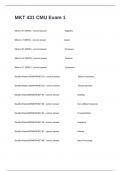
MKT 431 CMU Exam 1
What is S? (SIPOC) - correct answer Suppliers
What is I? (SIPOC) - correct answer Inputs
What is P? (SIPOC) - correct answer Processes
What is O? (SIPOC) - correct answer Outputs
What is C? (SIPOC) - correct answer Customers
Deadly Wastes (DOWNTIME)? #1 - correct answer Defect Correction
Deadly Wastes (DOWNTIME)? #2 - correct answer Overproduction
Deadly Wastes(DOWNTIME)? #3 - correct answer Waiting
Deadly Wastes(DOWNTIME)? #4 - correct answer Non-utilized resources
Deadly Wastes(DOWNTIME)? #5 - correct answer Transportation
Deadly Wastes(DOWNTIME)? #6 - correct answer Inventory
Deadly Wastes(DOWNTIME)? #7 - correct answer Motion
Deadly Wastes(DOWNTIME)? #8 - correct answer Extra Processing