

Introduction to Central Nervous
System Ischemia
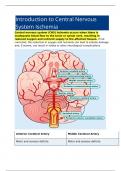
Central nervous system (CNS) ischemia occurs when there is
inadequate blood flow to the brain or spinal cord, resulting in
reduced oxygen and nutrient supply to the affected tissues. If not
corrected, the reduction in oxygen and nutrients can lead to cellular damage
and, if severe, can result in stroke or other neurological complications.
Anterior Cerebral Artery Middle Cerebral Artery
Motor and sensory deficits: Motor and sensory deficits:
, Anterior Cerebral Artery Middle Cerebral Artery
Lower extremities (leg and foot) Upper extremities and face
Slight upper extremity Decrease in conjugate gaze
involvement
Homonymous hemianopia
Contralateral (decreased vision on one half of
both sides)
Speech (motor) aphasia
The arteries that contribute to the posterior cerebral circulation include
the vertebral arteries, Posterior inferior cerebellar artery- PICA,
basilar artery, superior cerebellar artery, and posterior cerebral
artery.
The circulatory system of the brain includes the anterior circulation, supplied
by the internal carotid arteries, and the posterior cerebral circulation,
supplied by the vertebral arteries.
Formed by the posterior cerebral arteries, posterior communicating
arteries, internal carotid arteries, anterior cerebral arteries, and
anterior communicating artery, the circle of Willis forms collateral
circulation to maintain continuous arterial blood flow to most areas of the
brain.
Pathophysiology of Transient
Ischemic Attack and Ischemic
Cerebrovascular Accident
Transient ischemic attacks (TIA) involve a temporary neurological
dysfunction caused by a severe interruption in blood flow within the brain. In
a TIA, the blood flow is restored relatively quickly, usually within a few
minutes to hours, and the symptoms typically resolve completely
within 24 hours without causing permanent damage.
Causes of altered blood flow include the following:
System Ischemia
Central nervous system (CNS) ischemia occurs when there is
inadequate blood flow to the brain or spinal cord, resulting in
reduced oxygen and nutrient supply to the affected tissues. If not
corrected, the reduction in oxygen and nutrients can lead to cellular damage
and, if severe, can result in stroke or other neurological complications.
Anterior Cerebral Artery Middle Cerebral Artery
Motor and sensory deficits: Motor and sensory deficits:
, Anterior Cerebral Artery Middle Cerebral Artery
Lower extremities (leg and foot) Upper extremities and face
Slight upper extremity Decrease in conjugate gaze
involvement
Homonymous hemianopia
Contralateral (decreased vision on one half of
both sides)
Speech (motor) aphasia
The arteries that contribute to the posterior cerebral circulation include
the vertebral arteries, Posterior inferior cerebellar artery- PICA,
basilar artery, superior cerebellar artery, and posterior cerebral
artery.
The circulatory system of the brain includes the anterior circulation, supplied
by the internal carotid arteries, and the posterior cerebral circulation,
supplied by the vertebral arteries.
Formed by the posterior cerebral arteries, posterior communicating
arteries, internal carotid arteries, anterior cerebral arteries, and
anterior communicating artery, the circle of Willis forms collateral
circulation to maintain continuous arterial blood flow to most areas of the
brain.
Pathophysiology of Transient
Ischemic Attack and Ischemic
Cerebrovascular Accident
Transient ischemic attacks (TIA) involve a temporary neurological
dysfunction caused by a severe interruption in blood flow within the brain. In
a TIA, the blood flow is restored relatively quickly, usually within a few
minutes to hours, and the symptoms typically resolve completely
within 24 hours without causing permanent damage.
Causes of altered blood flow include the following:


