
Biochem module 1 exam
Study online at https://quizlet.com/_ekrr5x
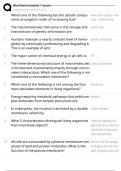
1. Which one of the following has the cellular compo- Amino acid < protein < ribo-
nents arranged in order of increasing size? some < mitochondrion
2. The macromolecules that serve in the storage and nucleic acids
transmission of genetic information are:
3. Humans maintain a nearly constant level of hemo- dynamic steady state.
globin by continually synthesizing and degrading it.
This is an example of a(n):
4. The major carrier of chemical energy in all cells is: ATP
5. The three-dimensional structure of macromolecules carbon-carbonbonds
is formed and maintained primarily through nonco-
valent interactions. Which one of the following is not
considered a noncovalent interaction?
6. Which one of the following is not among the four phosphorus
most abundant elements in living organisms?
7. Energy requiring metabolic pathways that yield com- Anabolic
plex molecules from simpler precursors are:
8. In eukaryotes, the nucleus is enclosed by a double nuclear envelope
membrane called the:
9. What 5 characteristics distinguish living organisms Chemical complexity, bio-
from inanimate objects? logical structures, extract en-
vironmental energy, living
state, self replication
10. All cells are surrounded by a plasma membrane com- barrier to the free passage
posed of lipid and protein molecules. What is the of inorganic ions and most
function of the plasma membrane? other charged or polar com-
, Biochem module 1 exam
Study online at https://quizlet.com/_ekrr5x
pounds into or out of the
cell, transportation, or com-
munication
11. E. coli is known as a gram-negative bacterial species. Gram neg: Low affinity for
(a) How is this determined? (b) How do gram-neg- dye; single layer of peptido-
ative bacteria differ structurally from gram-positive glycan + outer layer
bacteria?
12. a) List the types of noncovalent interactions that are a) H-bonds, ionic interac-
important in providing stability to the three-dimen- tions, van der waals, and hy-
sional structures of macromolecules. drophobic
b)Why is it important that these interactions be non- b) easy to form and break
covalent, rather than covalent, using less energy. Help with
flexibility
13. Describe the relationship between a living organism Living organisms: Open sys-
and its surroundings in terms of both matter and tems (exchange matter and
energy. energy with surroundings;
no equilibrium with sur-
roundings)
14. What is meant by feedback inhibition and why is it biochem pathway regulation
important in a living organism? reaction product inhibits an
earlier step in the pathway;
ensures energy is not wast-
ed by an organism produc-
ing molecules it does not
need
15. Dynamic steady state consistent build and degra-
dation
, Biochem module 1 exam
Study online at https://quizlet.com/_ekrr5x
16. What are the consequences of the fact that "living need to use stored energy
organisms" are not in equilibrium with their sur- for basic-functions
roundings
17. Catabolism vs Anabolism C: Nutrients to simple prod-
ucts; waste products CO2
and H2O; produces energy
A: Biosynthesis; requires en-
ergy
18. Feedback pathways Neg: decreases product
production by inhibiting en-
zyme activity
Pos: Increases product pro-
duction by stimulating en-
zymes
19. Prokaryotic vs eukaryotic cells nucleus/membrane bound
organelles
20. Major difference between a plant and animal cell cell wall, chloroplast; lyso-
somes, centrosome
21. Cell fractionation methods Differential: Pellets form
based on density
Density-gradient: Separated
by density with no pellet
22. A true statement about hydrohobic interactions is are the driving force in the
that they formation of micelles of am-
phipathic compounds in wa-
ter
Study online at https://quizlet.com/_ekrr5x
1. Which one of the following has the cellular compo- Amino acid < protein < ribo-
nents arranged in order of increasing size? some < mitochondrion
2. The macromolecules that serve in the storage and nucleic acids
transmission of genetic information are:
3. Humans maintain a nearly constant level of hemo- dynamic steady state.
globin by continually synthesizing and degrading it.
This is an example of a(n):
4. The major carrier of chemical energy in all cells is: ATP
5. The three-dimensional structure of macromolecules carbon-carbonbonds
is formed and maintained primarily through nonco-
valent interactions. Which one of the following is not
considered a noncovalent interaction?
6. Which one of the following is not among the four phosphorus
most abundant elements in living organisms?
7. Energy requiring metabolic pathways that yield com- Anabolic
plex molecules from simpler precursors are:
8. In eukaryotes, the nucleus is enclosed by a double nuclear envelope
membrane called the:
9. What 5 characteristics distinguish living organisms Chemical complexity, bio-
from inanimate objects? logical structures, extract en-
vironmental energy, living
state, self replication
10. All cells are surrounded by a plasma membrane com- barrier to the free passage
posed of lipid and protein molecules. What is the of inorganic ions and most
function of the plasma membrane? other charged or polar com-
, Biochem module 1 exam
Study online at https://quizlet.com/_ekrr5x
pounds into or out of the
cell, transportation, or com-
munication
11. E. coli is known as a gram-negative bacterial species. Gram neg: Low affinity for
(a) How is this determined? (b) How do gram-neg- dye; single layer of peptido-
ative bacteria differ structurally from gram-positive glycan + outer layer
bacteria?
12. a) List the types of noncovalent interactions that are a) H-bonds, ionic interac-
important in providing stability to the three-dimen- tions, van der waals, and hy-
sional structures of macromolecules. drophobic
b)Why is it important that these interactions be non- b) easy to form and break
covalent, rather than covalent, using less energy. Help with
flexibility
13. Describe the relationship between a living organism Living organisms: Open sys-
and its surroundings in terms of both matter and tems (exchange matter and
energy. energy with surroundings;
no equilibrium with sur-
roundings)
14. What is meant by feedback inhibition and why is it biochem pathway regulation
important in a living organism? reaction product inhibits an
earlier step in the pathway;
ensures energy is not wast-
ed by an organism produc-
ing molecules it does not
need
15. Dynamic steady state consistent build and degra-
dation
, Biochem module 1 exam
Study online at https://quizlet.com/_ekrr5x
16. What are the consequences of the fact that "living need to use stored energy
organisms" are not in equilibrium with their sur- for basic-functions
roundings
17. Catabolism vs Anabolism C: Nutrients to simple prod-
ucts; waste products CO2
and H2O; produces energy
A: Biosynthesis; requires en-
ergy
18. Feedback pathways Neg: decreases product
production by inhibiting en-
zyme activity
Pos: Increases product pro-
duction by stimulating en-
zymes
19. Prokaryotic vs eukaryotic cells nucleus/membrane bound
organelles
20. Major difference between a plant and animal cell cell wall, chloroplast; lyso-
somes, centrosome
21. Cell fractionation methods Differential: Pellets form
based on density
Density-gradient: Separated
by density with no pellet
22. A true statement about hydrohobic interactions is are the driving force in the
that they formation of micelles of am-
phipathic compounds in wa-
ter


